The Hierophant and Three of Swords Tarot as Feelings
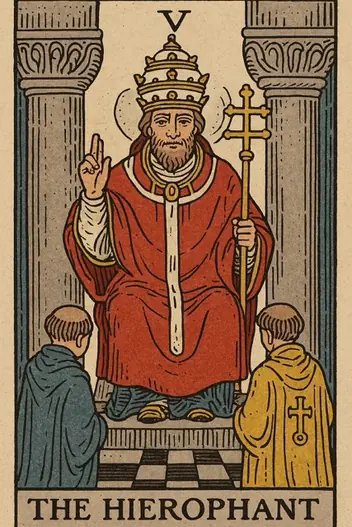
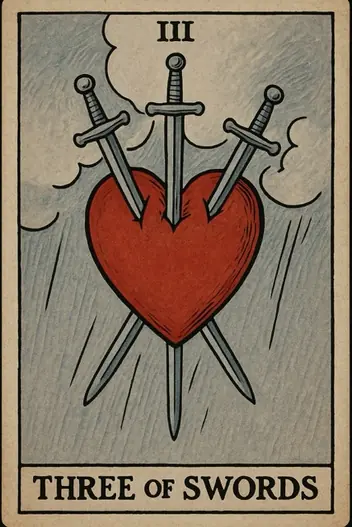
- Arcana
- The Hierophant — Major Arcana; Three of Swords — Minor Arcana, Swords
- Elements
- The Hierophant — Earth; Three of Swords — Air
- Elemental interaction
- Opposing elements — energies create tension
- Numerology
- 5 + 3 = 8
When The Hierophant, the card of established systems, moral codes, and institutional wisdom, collides with The Three of Swords, the archetype of heartbreak, cognitive dissonance, and painful truth, we witness a psychological crisis of faith. This combination reveals a scenario where the structures you once trusted—a relationship, a career path, a belief system—are now the source of your deepest pain. The core conflict here is not external chaos, but an internal war between loyalty to a system and the undeniable evidence of its failure.
This pairing forces a pragmatic choice: do you repair the broken structure, or do you leave it behind? The Hierophant represents the desire for order, tradition, and external validation. The Three of Swords represents the price of ignoring reality. Together, they demand a ruthless audit of what you are sacrificing for the sake of stability. The key insight is that pain is a signal, not a punishment. Your task is to separate the valuable core of a tradition from its toxic, outdated rules.
Core Dynamics & Interpretation
The psychological state created by The Hierophant and Three of Swords is one of cognitive dissonance—the mental stress experienced when holding two conflicting beliefs. You may believe a relationship "should" work because it follows a traditional script (marriage, commitment), yet you are experiencing acute emotional pain. Or, you may feel trapped in a career path that offers security but demands you suppress your authentic self. The Jungian shadow here is the "false self"—the persona you maintain to fit into a system, even as it wounds you.
The real-world implication is a test of integrity. Are you willing to endure short-term pain for long-term alignment? The Hierophant’s energy can be used constructively: you can seek counsel from a trusted mentor, therapist, or established framework to process the trauma of the Three of Swords. However, the danger is using tradition as a shield against change. Beware the trap of "sunk cost fallacy" —staying in a painful situation simply because you have already invested time, energy, or identity into it. The most pragmatic move is to extract the lesson from the pain (Three of Swords) and reform your commitments (The Hierophant) with greater wisdom.
Your pair is already on the table. Ask your question and draw the clarifying card
or simply focus on it
Career Meaning of The Hierophant and Three of Swords
Strategic Opportunities:
Leverage established mentors or industry standards to help you navigate a painful professional setback (layoff, failed project, toxic boss). Use the system to protect yourself.
Strategic Opportunities:
Reform a broken process. This is an ideal time to audit a failing business model or team dynamic and propose a pragmatic, evidence-based restructuring that honors the best of the old while cutting out the dysfunction.
Calculated Risks:
Avoid signing long-term contracts or making permanent financial commitments while you are processing this emotional wound. The desire for security (Hierophant) can lead you to lock into a bad deal to escape the pain (Three of Swords).
In your professional life, this pairing signals a conflict between institutional loyalty and personal wellbeing. You may feel betrayed by a company, a boss, or a professional code you once believed in. The strategic approach is to treat this as a data point, not a catastrophe. Analyze the specific source of the pain: Is it a broken agreement? A misalignment of values? A lack of recognition? Bold important financial warning: Do not make a "loyalty-based" financial decision. Do not take a pay cut to stay with a toxic employer out of a sense of duty. The Three of Swords demands you cut the emotional cord from the institution and make decisions based on objective market value and personal capacity. If you must leave, do so with a severance plan and a new framework for your next venture.
What Do The Hierophant and Three of Swords Say About Love?
If you are single:
This combination warns against idealizing a potential partner based on societal expectations. A person may "look good on paper" but your emotional response is the real data. If you feel a sharp pang of unease, trust it over the narrative of "this is what I should want."
If you are in a relationship:
You are likely facing a painful truth about a core incompatibility. This is not about surface-level arguments; it is about a fundamental breach of trust or values. The relationship’s existing structure may be the source of the wound.
The relationship dynamic here is a crisis of loyalty versus authenticity. One partner may be clinging to the "institution" of the relationship (marriage, family expectations) while the other is experiencing emotional isolation or betrayal. The most important action is to stop rationalizing the pain. Do not use spiritual or traditional justifications ("we must stay together for the kids," "this is my karma") to avoid addressing the specific, concrete hurt. Bold key relationship advice: Schedule a structured, honest conversation using "I" statements to name the pain without blame. Then, decide if the existing container can be repaired, or if it must be dismantled for both parties to heal. This is not about who is right; it is about whether the relationship’s structure serves your mutual growth.
Your unique Tarot reading
See how these cards interact with your destiny. Start a free personal reading now.
What If The Hierophant or Three of Swords Appears Reversed?
Reversed Hierophant (Upright Three of Swords). Here, you suffer not from the tyranny of the system, but from its absence. You feel pain due to chaos and a lack of clear rules. This could be being laid off from a company without a clear structure or a breakup with a partner who didn't provide you with a sense of stability. Advice: seek new, healthy structures, rather than trying to revive old ones. You need clarity, not freedom.
Reversed Three of Swords (Upright Hierophant). The pain is denied or suppressed. You continue to blindly follow the rules, ignoring the traumatic experience. This is a classic case of the "overachiever syndrome," working yourself to the bone without noticing the burnout. Warning: your body or psyche will soon break down. It is necessary to acknowledge the fact of suffering to avoid more serious consequences.
Both cards reversed. Complete imbalance. You simultaneously rebel against all authorities (Reversed Hierophant), yet you cannot process and let go of old grievances (Reversed Three of Swords). This is a state of chronic neurosis. Advice: immediately stop looking for someone to blame. Focus on one concrete action: write a plan to exit your current situation, without looking back at the past or fearing future rules.
The Hierophant and Three of Swords: Warning Signs
The shadow manifestation of this combination is masochistic martyrdom. You may unconsciously believe that suffering is noble, that staying in a painful situation is a sign of spiritual strength or loyalty. This is a cognitive bias known as "effort justification" —you value something more simply because you have suffered for it. The Three of Swords’ pain becomes a perverse badge of honor, and The Hierophant’s tradition becomes the altar on which you sacrifice your happiness. Another pitfall is projecting the wound onto the institution itself, blaming "the system" or "society" for your pain, when in fact, you need to take personal responsibility for your choice to remain. The shadow also manifests as rigid cynicism: after one betrayal, you reject all structures (relationships, careers, faith) and become isolated, trading pain for loneliness. The danger is confusing the map with the territory—the tradition is not the truth; it is a tool. When it breaks, you must find a new tool.
What Is the Overall Message of The Hierophant and Three of Swords?
How can the energy of the Hierophant be used constructively to balance the Three of Swords? The key lies in the transition from external authority to internal authority. The Hierophant in its highest manifestation is not a dictator, but a Guardian of Knowledge. Your task is not to discard all structures, but to find the one that serves your growth, rather than suppressing you.
In this synthesis, the Three of Swords becomes not a curse, but an instrument of clarity. It severs illusions that someone else can solve your problems. This pain is the price of freedom. Accept it as the cost of becoming an authority for yourself. The strategic algorithm of action is as follows: 1) Acknowledge that you are experiencing pain, without trying to rationalize it. 2) Identify which specific "system" (relationship, job, belief) is causing this pain. 3) Make a decision: either you change the system from within (become a reformer), or you leave it (separation).
Deep strategic advice:
Do not try to "fix" the source of pain. Do not write long explanatory letters, do not try to prove you are right. In this combination, energy is wasted on fighting windmills. Instead, invest all your energy into creating your own system of values and rules. Become the Hierophant for yourself. Define what is sacred to you and what is not. Once you do this, the Three of Swords will cease to be a blow from the outside and will transform into an internal discipline that cuts away everything superfluous on the path to your goal.
Applying This to Your Situation
The core message of The Hierophant and Three of Swords is that pain is a powerful teacher, but only if you are willing to question the system that caused it. You are being asked to separate the wisdom of the past from its wounded patterns. This is a time for radical honesty, not blind faith. The structure you need may not be the one you inherited; it may be one you must consciously design based on the lessons of your heartbreak.
Ready to apply this insight to your specific situation? While this analysis provides the archetypal dynamics, the true power of Tarot lies in its personal application. The Fortune Cards app allows you to input your exact question—about a specific person, a career choice, or a personal dilemma—and receive a deep, personalized interpretation of The Hierophant and Three of Swords tailored to your unique context. Use it on the web or download it now to transform this general wisdom into a strategic roadmap for your next move.
Interpretation by the Fortune Cards editorial team, based on the Rider–Waite tradition and Jungian archetypes. About our methodology · Updated: 2026-08-26
Other Combinations with The Hierophant
Other Combinations with Three of Swords
Explore Individual Card Meanings
Table of Contents
- Core Dynamics & Interpretation
- Career Meaning of The Hierophant and Three of Swords
- What Do The Hierophant and Three of Swords Say About Love?
- What If The Hierophant or Three of Swords Appears Reversed?
- The Hierophant and Three of Swords: Warning Signs
- What Is the Overall Message of The Hierophant and Three of Swords?
- Applying This to Your Situation
Ready to find answers to your questions?
Start your first reading now and look at your situation with fresh clarity. The cards are ready to reveal deeper meaning.