Three of Cups and Three of Swords Tarot as Feelings
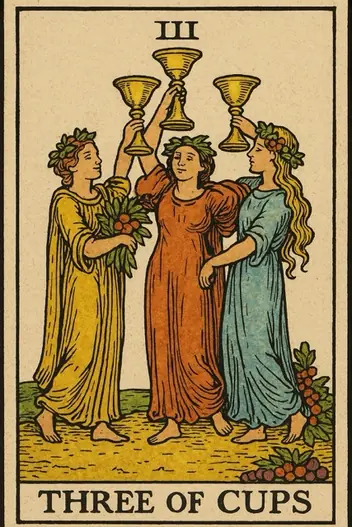

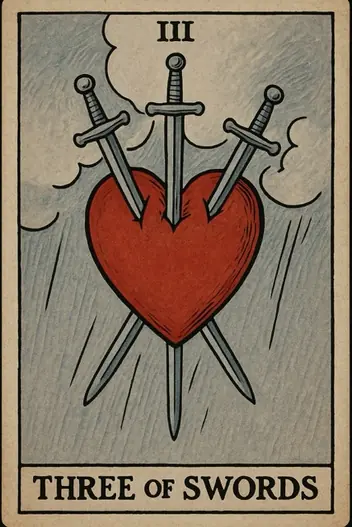
- Arcana
- Three of Cups — Minor Arcana, Cups; Three of Swords — Minor Arcana, Swords
- Elements
- Three of Cups — Water; Three of Swords — Air
- Elemental interaction
- Neutral elements — energies coexist without conflict
- Numerology
- 3 + 3 = 6
This pairing creates a powerful psychological tension: the collective celebration of the Three of Cups collides with the individualized pain of the Three of Swords. In real life, this often manifests as a social gathering where someone is secretly heartbroken, a friend group that hides envy behind laughter, or a celebration that feels hollow because a core relationship is damaged. The core conflict here is between external harmony and internal truth. You are likely smiling on the outside while processing a painful realization on the inside—or you are witnessing this dynamic in others. The strategic question becomes: How do I honor my social bonds without betraying my emotional reality?
What Do Three of Cups and Three of Swords Mean Together?
When the Three of Cups (representing friendship, community, and shared joy) meets the Three of Swords (representing heartbreak, betrayal, and painful truth), the psychological state is one of cognitive dissonance. You are simultaneously experiencing the warmth of connection and the cold sting of disappointment. This is not a simple conflict; it is a developmental challenge that forces you to integrate two opposing truths: you can love your community while feeling deeply hurt by one member, or you can enjoy a celebration while grieving a loss no one else sees.
From a Jungian perspective, this combination activates the Shadow of the Social Persona. The Three of Cups represents the Persona—the mask we wear to fit in, to be liked, to belong. The Three of Swords represents the Shadow—the unacknowledged pain, the truth we suppress to maintain peace. When these cards appear together, the psyche is demanding that you stop compartmentalizing your emotions. The real-world implication is clear: repressing pain to maintain social harmony is not sustainable. The longer you pretend everything is fine, the more likely the Three of Swords will erupt in a destructive way—through passive-aggression, sudden withdrawal, or a public outburst. Strategic action requires you to find a safe, private space to process the truth before returning to the collective.
Career Meaning of Three of Cups and Three of Swords
Strategic Opportunities:
Leverage your social network for emotional support during a professional transition. The Three of Cups indicates that your colleagues or peers are genuinely willing to help—if you let them see your vulnerability. Share your challenges selectively with trusted allies to gain advice and referrals.
Strategic Opportunities:
Use a team celebration to reset dynamics after a conflict. If your work group has experienced a betrayal or a failed project, this combination suggests that a planned social event (like a team lunch or offsite) can be a low-risk space to rebuild trust—provided you address the issue privately first.
Calculated Risks:
Avoid making financial commitments based on social pressure. The Three of Swords warns that a friend or partner may pressure you into an investment (e.g., a joint business or loan) that feels emotionally coercive. Objectively evaluate the numbers without guilt. If your gut says "this hurts," walk away.
From a professional standpoint, this combination often appears when your career identity is tied to a group (a startup, a creative collective, a tight-knit team). The Three of Swords signals that one member of this group is causing you pain—perhaps through gossip, credit-stealing, or a broken promise. Your strategic move is to document the issue professionally before addressing it. Do not let the social bond of the Three of Cups prevent you from setting boundaries. Financially, this is a time for cautious optimism. You can celebrate wins, but do not increase your spending to match the group’s energy. A key financial warning: avoid "keeping up with the Joneses" —especially if you are using credit or savings to fund a social lifestyle that feels hollow.
Your pair is already on the table. Ask your question and draw the clarifying card
or simply focus on it
Love and Relationships
If you are single:
This combination warns against romanticizing a new connection based solely on social chemistry or group approval. You may feel a strong sense of belonging with someone new, but the Three of Swords suggests a hidden incompatibility or a past wound that hasn’t healed. Prioritize private, one-on-one conversations over group dates to assess the real emotional fit.
If you are in a relationship:
This is a red flag for unresolved conflict hiding behind a happy facade. You and your partner may be attending social events together while avoiding a painful conversation about infidelity, unmet needs, or a breach of trust. The relationship cannot heal until the sword is removed—meaning the painful truth must be spoken aloud.
In existing relationships, this pairing demands emotional courage over social convenience. The Three of Cups often signals a couple that is well-liked by friends, the "fun pair" everyone admires. But the Three of Swords reveals that this external image is costing your internal peace. The key relationship advice here is to prioritize authenticity over approval. Ask yourself: Are we staying together because we genuinely love each other, or because we love the social identity we have built together? The most strategic move is to schedule a private, honest conversation without distractions. Use "I" statements to express your hurt without blaming your partner for the social dynamic. Remember: a relationship that survives a painful truth is stronger than one that crumbles under a comfortable lie.
Shadow Side & Pitfalls
The shadow manifestation of this pairing is emotional martyrdom disguised as loyalty. You may convince yourself that you are "protecting the group" by hiding your pain, when in reality you are avoiding the discomfort of confrontation. This leads to a cognitive bias known as the "false consensus effect" —you assume everyone else is happy, so you must be the problem. In truth, the Three of Swords often reveals that others in the group feel similarly hurt but are also silent. Another pitfall is toxic positivity: forcing yourself to "just be grateful" for your friends while ignoring a real betrayal. This suppresses the Shadow, which will eventually erupt as cynicism, bitterness, or a sudden, dramatic exit from the group. Self-sabotage occurs when you prioritize the group’s image over your own psychological health. If you find yourself drinking more than usual at social events to numb the pain, or avoiding certain friends without explanation, you are in the shadow zone. The rational action is to seek a therapist or a trusted confidant outside the group to process the truth without fear of social repercussions.
Ask your specific question
Don't rely on generic meanings. Get a customized reading tailored specifically to your energies.
Reversed Positions: What Changes?
When cards appear in reversed positions, the conflict dynamic shifts from the external to the internal plane, but becomes no less dangerous.
If the Three of Cups is reversed:
This indicates sabotage of joy from within. You yourself refuse celebration, isolate yourself from friends, and reject help. The potential for social support exists, but you block it due to guilt or mistrust. Advice: consciously accept an invitation to meet, even if you don't feel like it. This will break the vicious cycle of self-isolation.
If the Three of Swords is reversed:
This is a sign of suppressed aggression and unspoken resentment. The truth does not break through to the surface but gets stuck inside, poisoning the psyche. Instead of acute but short-lived pain, you get chronic tension and psychosomatic issues. Warning: do not accumulate grievances. Find a safe way to release them—through sports, writing practices, or talking to a therapist.
If BOTH are reversed:
A complete imbalance of dynamics. You are in a state of emotional masochism: refusing support while simultaneously avoiding conflict. This is a dead end that leads to depression and apathy. The logical way to correct this: break the pattern. Take an unexpected action—call an old friend (reversed Three of Cups) or write a letter to the person who wronged you (but don't send it) (reversed Three of Swords). You need to exit the cycle of passive suffering.
Synthesis: Strategic Conclusion
How to constructively use the energy of this pair? The key lies in a conscious shift from reactivity to proactivity. The Three of Swords points to pain but doesn't say what to do with it. The Three of Cups offers comfort but can be deceptive. Your strategic task is to use pain as a signal for action, not as a reason for suffering. Do not let emotions control you; use them as data for analysis.
The synthesis of these archetypes provides a powerful tool for personal growth: the ability to maintain connection with others without losing connection with yourself. You can remain in a group while still having your own opinion and the willingness to defend it. This requires a high degree of emotional separation — the ability not to merge with the mood of the crowd. A practical algorithm: 1) Identify the fact that hurts you (Three of Swords). 2) Assess whether there are people in your circle with whom you can discuss this without fear of judgment (Three of Cups). 3) Make a decision: either change the situation through conflict, or accept it and stop suffering.
A deep strategic piece of advice: do not look for who is to blame; look for the lesson. This combination is not a sentence to loneliness, but an invitation to reconsider your social criteria. Which relationships are valuable enough to you to endure pain for their sake? And which are merely decorations that it's time to dismantle? By answering these questions, you will transform the destructive energy of the Three of Swords into building material for a more mature and honest social life.
Where to Go From Here
The core message of Three of Cups and Three of Swords is that true belonging requires honesty. You cannot have sustainable joy if it is built on suppressed pain. The path forward is not to abandon your community, but to integrate your truth into it—gently, privately, and with courage. This combination is a call to mature your relationships from surface-level fun to a deeper, more resilient bond.
While this analysis provides the general archetype, the real power of Tarot lies in its application to your unique situation. Your specific question, your personal history, and the other cards in your spread all matter. That is why you need a tool that can synthesize these variables instantly. Use the Fortune Cards app to get a deep, personalized interpretation of this exact combination for your question right now. Whether on the web or downloaded, the app analyzes your context—love, career, or shadow work—and delivers actionable, psychologically-grounded advice. Stop guessing. Get clarity. Download Fortune Cards now.
Interpretation by the Fortune Cards editorial team, based on the Rider–Waite tradition and Jungian archetypes. About our methodology · Updated: 2026-08-26
Other Combinations with Three of Cups
Other Combinations with Three of Swords
Explore Individual Card Meanings
Ready to find answers to your questions?
Start your first reading now and look at your situation with fresh clarity. The cards are ready to reveal deeper meaning.