Love Tarot: Three of Swords and Four of Pentacles

- Arcana
- Three of Swords — Minor Arcana, Swords; Four of Pentacles — Minor Arcana, Pentacles
- Elements
- Three of Swords — Air; Four of Pentacles — Earth
- Elemental interaction
- Opposing elements — energies create tension
- Numerology
- 3 + 4 = 7
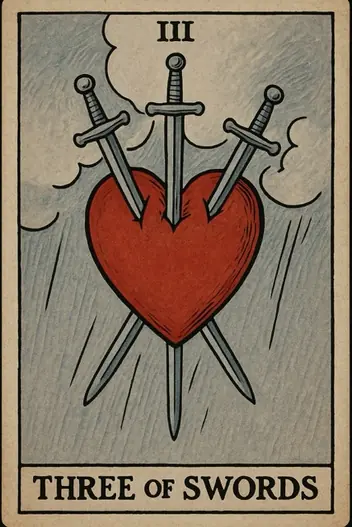
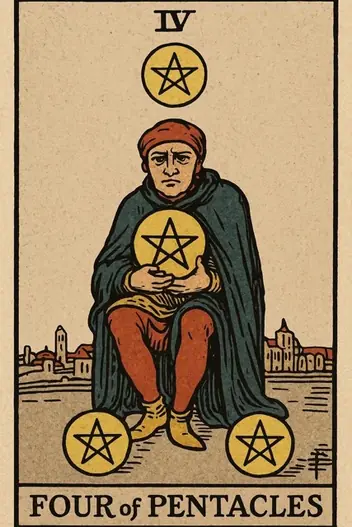
When the Three of Swords—the card of heartbreak, cognitive dissonance, and painful truth—collides with the Four of Pentacles—the archetype of rigid control, hoarding, and fear of loss—you get a psychological state defined by defensive contraction. This is not a pairing of passive suffering; it is an active, often unconscious, strategy to prevent further pain by clamping down on resources, emotions, and trust.
The core conflict here is between the need to process grief and the compulsion to control outcomes. The mind (Swords) is still bleeding, but the ego (Pentacles) is building a fortress. This combination often appears when a person has been hurt and is now over-functioning in the material world to avoid confronting their emotional wounds. The result is a brittle, anxious stability—one that feels safe but is inherently unsustainable.
What Do Three of Swords and Four of Pentacles Mean Together?
The psychological dynamic of the Three of Swords and Four of Pentacles is a defense mechanism against vulnerability. The Three of Swords represents the painful incision of reality—a betrayal, a harsh truth, or a necessary ending. The Four of Pentacles represents the immediate, rigid response: clinging to what remains. This could manifest as hoarding money, refusing to compromise in a partnership, or isolating oneself to avoid future rejection.
The key insight is that the pain is not being processed; it is being buried under control. The seeker may appear stoic, financially secure, or emotionally detached, but this is a brittle facade. Inside, the Three of Swords’ grief is festering, creating a cognitive dissonance between their outward stability and inner turmoil. This pairing warns against the trap of using material security or rigid boundaries as a substitute for genuine emotional healing. The real work is not to hold tighter, but to learn how to hold pain without being destroyed by it.
What Do Three of Swords and Four of Pentacles Say About Love?
If you are single:
This combination suggests you are guarding your heart so heavily that you are likely rejecting potential partners before they can get close. Your fear of another "stab" is causing you to misinterpret neutral behavior as threatening.
If you are in a relationship:
You are likely in a dynamic of emotional withdrawal and financial or emotional control. One partner is nursing a wound (Three of Swords) while the other is met with stonewalling or possessiveness (Four of Pentacles).
In a relationship context, this pairing points to a profound breakdown in emotional reciprocity. The wounded partner (Three of Swords) may use the Four of Pentacles’ tactics—withholding affection, money, or time—as a form of self-protection or passive punishment. The other partner may feel they are walking on eggshells, unable to address the underlying hurt. The core advice is to stop using material or emotional resources as a shield. True intimacy requires the courage to show the wound, not to armor it. If you are the one holding the Four of Pentacles, ask yourself: "Am I protecting my heart, or am I starving the relationship by holding back?" If you are the one with the Three of Swords, recognize that silence is not safety.
Your pair is already on the table. Ask your question and draw the clarifying card
or simply focus on it
What Do Three of Swords and Four of Pentacles Indicate for Your Career?
Strategic Opportunities:
Audit your emotional investments. Are you staying in a job or business deal out of fear of loss (Four of Pentacles) rather than genuine opportunity? Cutting a dead-end project can be the "heartbreak" that frees up capital.
Strategic Opportunities:
Re-negotiate from a position of strength, not fear. If you are holding onto a contract or salary out of scarcity, you are blocking growth. Use the Three of Swords’ clarity to see the true value of your work.
Calculated Risks:
Do not make major financial decisions while emotionally raw. The combination of grief (Three of Swords) and control (Four of Pentacles) can lead to miserly, short-sighted choices like hoarding cash at the expense of investment, or making a vengeful business move that damages your reputation.
In the professional realm, this pairing signals a tension between emotional burnout and financial rigidity. You may be working excessively to distract from personal pain, or you may be clinging to a role or client that no longer serves you because you fear the "loss" of starting over. The strategic warning is to separate your self-worth from your net worth. The Three of Swords demands you cut what is toxic; the Four of Pentacles demands you hold tight. The correct action is to identify what is truly worth protecting—your skills, your reputation, your core values—and release the rest. A financial review is recommended, but only after an emotional one.
Ask your specific question
Don't rely on generic meanings. Get a customized reading tailored specifically to your energies.
Three of Swords and Four of Pentacles: Warning Signs
The shadow side of this combination is emotional miserliness and self-sabotage through control. The seeker may develop a "scarcity mindset" regarding love, money, and even time. They believe that if they give anything away—a kind word, a financial risk, an emotional opening—they will have less for themselves. This is a cognitive bias known as loss aversion, magnified by the Three of Swords’ pain.
Common pitfalls include hoarding grievances as a way to justify withholding affection, or micromanaging a partner or employee to the point of suffocation. There is also a risk of performative stability—projecting an image of being "fine" and "in control" while internally crumbling. This can lead to sudden, explosive releases of pent-up pain, or a slow descent into depression masked as discipline. The most dangerous shadow manifestation is using financial control as a tool for emotional revenge. If you see this pattern, the shadow demands you stop managing the external and start healing the internal.
What If Three of Swords or Four of Pentacles Appears Reversed?
If the Three of Swords is reversed:
The sharp pain is either being denied or has already been experienced. Warning: the person may fall into recklessness, thinking that "all the bad is behind them," and begin impulsively spending resources (the Four of Pentacles in an upright position). This risks ruining oneself in attempts to "buy happiness."
If the Four of Pentacles is reversed:
The defensive wall is crumbling. Inner resistance weakens, and the person becomes extremely vulnerable to new pain. With the Three of Swords upright, this means you are voluntarily heading toward a repeated trauma, lacking the resources for protection. Advice: urgently seek external support—a mentor, a psychologist, friends.
If BOTH are reversed:
Complete imbalance. The pain is suppressed, and control is lost. This is a state of emotional and financial chaos. The person may engage in irrational spending to numb an inner void, or break off relationships without explanation. A logical way to correct this: artificially introduce structure. Start keeping a strict budget and an emotions journal—this will restore a minimal framework of safety.
Synthesis: Strategic Conclusion
To constructively use this energy, it is necessary to recognize that the Four of Pentacles is not a solution, but a temporary bandage. Your task is not to cling to the bandage forever, but to use the period of stability for the genuine healing of the wound inflicted by the Three of Swords. The strategic advice: conduct an audit of your "vaults." What are you guarding so fiercely? Money, status, habits? Most likely, unprocessed pain is hidden behind them.
Use the pragmatism of the Four of Pentacles to create an action plan for emerging from the crisis. Break the large trauma down into small steps: acknowledge the loss, mourn it, extract the lesson, create a new budget or schedule. In this context, the Three of Swords is not a sentence, but a tool for amputating toxic connections or projects. It provides clarity: exactly what needs to be cut away in order to be saved.
Key synthesis: pain is the price you pay for growth, and control is a tool that should not become a goal. Your true wealth lies not in what you hold onto, but in the ability to let go of what is outdated and move forward, even if it hurts. Only by passing through the Three of Swords with open eyes can you build a Four of Pentacles that is not a prison, but a fortress for your future.
Applying This to Your Situation
The Three of Swords and Four of Pentacles together deliver a stark message: you cannot hold onto the past and the future at the same time. The pain you are guarding against is the very thing you need to process to move forward. Your fortress is not a home; it is a prison. The practical path forward involves a controlled release—letting go of one small thing (a grudge, a savings account, a rigid schedule) to test if the world ends. It won’t.
Want to know exactly what this combination means for your specific situation? The Fortune Cards app uses your unique question to provide a deep, personalized interpretation of this exact card pairing. Whether you are asking about a specific relationship or a career decision, the app applies these archetypes to your real-world context. Use the app on the web or download it now to transform this general insight into a precise, actionable roadmap for your next step.
Interpretation by the Fortune Cards editorial team, based on the Rider–Waite tradition and Jungian archetypes. About our methodology · Updated: 2026-08-26
Other Combinations with Three of Swords
Other Combinations with Four of Pentacles
Explore Individual Card Meanings
Table of Contents
- What Do Three of Swords and Four of Pentacles Mean Together?
- What Do Three of Swords and Four of Pentacles Say About Love?
- What Do Three of Swords and Four of Pentacles Indicate for Your Career?
- Three of Swords and Four of Pentacles: Warning Signs
- What If Three of Swords or Four of Pentacles Appears Reversed?
- Synthesis: Strategic Conclusion
- Applying This to Your Situation
Ready to find answers to your questions?
Start your first reading now and look at your situation with fresh clarity. The cards are ready to reveal deeper meaning.