Love Tarot: The Tower and Eight of Swords
- Arcana
- The Tower — Major Arcana; Eight of Swords — Minor Arcana, Swords
- Elements
- The Tower — Fire; Eight of Swords — Air
- Elemental interaction
- Friendly elements — energies support each other
- Numerology
- 16 + 8 = 24 → 6
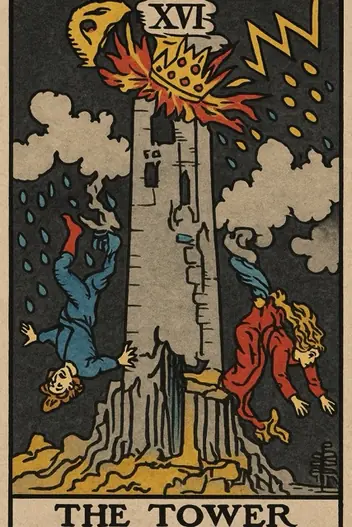
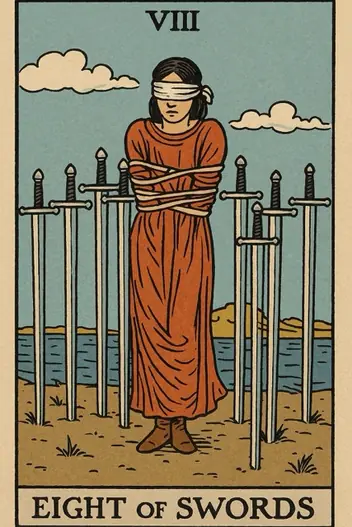
The intersection of The Tower and the Eight of Swords represents a profound psychological crisis—a moment when a sudden, disruptive event shatters the mental prison you’ve been living in. The Tower is the lightning strike of external reality: a job loss, a betrayal, a health scare, or a revelation that dismantles your safe assumptions. The Eight of Swords is the internal counterpart: the self-imposed limitations, the blindfold of denial, and the belief that you are trapped without escape.
When these two cards collide, the message is clear: the structure you relied on was already fragile, and your own thinking kept you bound within it. The Tower doesn’t create the trap; it exposes it. This combination forces you to confront the difference between a real threat and a perceived one. The swords that surround the figure in the Eight are not walls—they are beliefs. The Tower knocks them down, leaving you disoriented but, for the first time, able to see the exit. The key insight here is that the crisis is not your enemy; your resistance to change is. Psychologically, this is a classic ego-dissolution moment—the part of you that clung to control must die so a more adaptive, resilient self can emerge.
The Tower and Eight of Swords Combination Meaning
The core dynamic of The Tower and Eight of Swords is a forced cognitive restructuring. The Tower represents an external event that is sudden, uncontrollable, and often destructive. The Eight of Swords represents the internal narrative that interprets this event as a dead end. Together, they create a feedback loop: the crisis triggers panic, which activates the victim mentality, which reinforces the belief that you cannot act. However, this cycle is an illusion. The swords in the Eight are not locked; the blindfold is not tied. The Tower’s chaos is the catalyst that finally motivates you to remove the blindfold and walk through the perceived barriers.
In practical terms, this combination signals a period of high volatility but high potential for liberation. You may feel paralyzed by shock or shame, but this is precisely the moment to examine your assumptions. Ask yourself: What belief about myself or my situation is keeping me stuck? The answer is often a false sense of powerlessness. The Tower’s destruction is not random; it is surgical. It removes what is no longer serving your growth—a job that was draining you, a relationship built on lies, a identity based on external validation. The Eight of Swords warns that if you cling to the ruins, you will simply rebuild your prison. The strategic move is to let the old structure burn, and use the clarity of the aftermath to map a new path.
Your pair is already on the table. Ask your question and draw the clarifying card
or simply focus on it
Love and Relationships
If you are single:
This pairing suggests a sudden realization about a past or potential partner—perhaps a betrayal, a hidden flaw, or a mismatch in values that you were ignoring. It is not a sign to rush into a new connection, but to conduct a ruthless audit of your own relationship patterns. The crisis is an opportunity to break free from a cycle of attracting unavailable or toxic people.
If you are in a relationship:
Expect a disruptive event—a confession, an argument, or an external pressure—that forces you to confront the power imbalance or lack of authenticity in your partnership. The blindfold is off; you can no longer pretend everything is fine.
In a relationship context, The Tower and Eight of Swords reveal a dynamic where one or both partners feel trapped by unspoken rules, fear of conflict, or past trauma. A sudden revelation—infidelity, a financial crisis, a family intervention—breaks the silence. The danger is that the betrayed or shocked partner will retreat into victimhood (“I can’t leave,” “I have no choice”). The healthy response is to use the collapse as a reset button. This is not about blaming the Tower event, but about recognizing that the relationship structure was already unsustainable. Bold action is required: seek couples therapy, set clear boundaries, or accept that separation is the only path to freedom. The Eight of Swords reminds you that the prison is in your mind—real options exist, even if they are uncomfortable.
Uncover hidden insights
Let our advanced Tarot system interpret these archetypes specifically for your personal path.
Career and Finances
Strategic Opportunities:
The Tower event (e.g., a layoff, a project failure, a market crash) frees you from a role or industry that was draining your energy. Use this disruption to pivot to a career aligned with your authentic skills, not your old identity.
Strategic Opportunities:
The crisis exposes hidden inefficiencies or toxic dynamics in your current workplace. This is the moment to advocate for change, or to start a side project that addresses a gap you now see clearly.
Calculated Risks:
Avoid rash decisions driven by panic. Do not quit without a plan, accept the first offer out of fear, or make large financial commitments to “fix” the situation. The Eight of Swords warns that impulsive reactions will recreate the trap.
For your professional life, this combination is a wake-up call about risk management and self-sabotage. You may have been over-reliant on a single source of income, a specific boss, or a comfortable routine. The Tower reveals the fragility of that structure. Financially, this is a time to strip away non-essential expenses and build a buffer. The Eight of Swords suggests that your fear of scarcity is the real obstacle—not the actual numbers. Strategically, focus on what you can control: update your resume, network authentically, and learn a new skill that makes you more adaptable. The key is to reframe the crisis as a forced upgrade. If you were stuck in a dead-end job, the layoff is a gift. If a business deal collapses, it frees capital for a better opportunity. Do not mistake the pain for a permanent loss.
What Are the Risks of The Tower and Eight of Swords?
The shadow manifestation of The Tower and Eight of Swords is catastrophizing and learned helplessness. The seeker may become so overwhelmed by the sudden change that they retreat into a narrative of total victimhood. Cognitive biases like disaster magnification (seeing the event as the end of everything) and confirmation bias (only noticing evidence that supports their powerlessness) take hold. This leads to paralysis by analysis—endlessly replaying the event, blaming others, or waiting for a savior. The shadow also includes self-sabotage through rebellion: acting out against the chaos by making reckless decisions (e.g., blowing savings, starting a fight) to regain a false sense of control. The greatest pitfall is mistaking the collapse of a flawed structure for the collapse of your entire self. The Eight of Swords warns that the real prison is the belief that you cannot rebuild.
Reversed The Tower and Eight of Swords Explained
Reversed cards shift the dynamic from an "acute crisis" to a "protracted conflict."
If The Tower is reversed:
Destruction does not occur, but tension escalates. This is a situation of "premonition of catastrophe." You are desperately trying to hold onto what is destined to collapse (a job, a relationship). Advice: do not waste resources on preserving ruins. Acknowledge the inevitability of change and begin preparing an "evacuation plan" in advance.
If the Eight of Swords is reversed:
This is internal resistance to liberation. You already see the way out and understand that your fears are irrational, yet you refuse to act out of laziness or pride. Warning: this is passive aggression directed at yourself. Self-sabotage is most dangerous here — you know the truth, but you prefer to suffer.
If BOTH are reversed:
Complete imbalance: exhaustion without catharsis. You have experienced many minor crises but have failed to draw any conclusions. This is a state of "chronic fatigue" and apathy. Method for correction: you do not need another attempt, but a complete change of your coordinate system. It is recommended to take an extended break (at least 2 weeks) to fully disconnect from triggers.
Synthesis: Strategic Conclusion
How to constructively utilize the energy of this pair? Perceive the Tower not as a punishment, but as a surgical instrument that amputated a cancerous tumor. Your task is not to mourn the loss, but to use the shock to reprogram neural pathways. The Eight of Swords tells you: "You are trapped." The Tower replies: "The prison is destroyed, just open your eyes."
The action strategy is built on three steps. First: acknowledge your helplessness before the past. You cannot bring back what has collapsed. Second: identify exactly one irrational belief that is blocking you (for example, "I will never find such a job again"). Third: take one micro-action that proves this belief false (send a resume to a different field). Deep strategic advice: do not try to "restore" the old life. Build a new one, using the rubble of the old as a foundation. Only in this way will you turn destruction into transformation.
Applying This to Your Situation
The Tower and Eight of Swords combination is a powerful signal that a crisis is also a liberation. The external event is not your destiny; your response to it is. The core message is: your perceived limitations are the only real cage. The lightning has struck—now you must decide whether to rebuild the same old prison or walk out into the open. The clarity is painful, but it is also a gift.
This article provides the general archetype, but the true power of Tarot lies in applying it to your specific situation. The meaning of The Tower and Eight of Swords changes based on your question, your history, and the surrounding cards. To get a deep, personalized interpretation of this exact combination for your question right now, use the Fortune Cards app. Available on the web or as a download, it delivers a tailored analysis that accounts for your unique context, helping you turn this crisis into a strategic breakthrough.
Interpretation by the Fortune Cards editorial team, based on the Rider–Waite tradition and Jungian archetypes. About our methodology · Updated: 2026-08-26
Other Combinations with The Tower
Other Combinations with Eight of Swords
Explore Individual Card Meanings
Ready to find answers to your questions?
Start your first reading now and look at your situation with fresh clarity. The cards are ready to reveal deeper meaning.