Ace of Swords and Ten of Swords Meaning in Tarot
- Arcana
- Ace of Swords — Minor Arcana, Swords; Ten of Swords — Minor Arcana, Swords
- Elements
- Ace of Swords — Air; Ten of Swords — Air
- Elemental interaction
- Same element — energies intensify each other
- Numerology
- 1 + 10 = 11 → 2
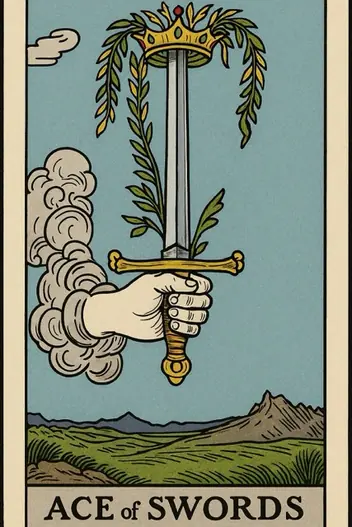
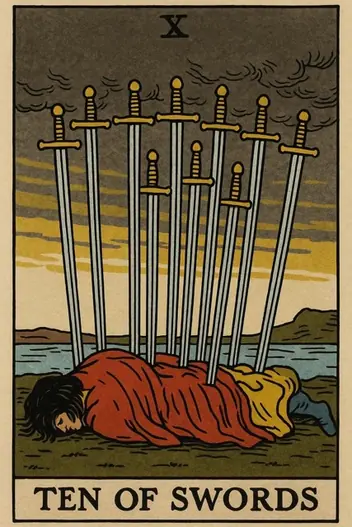
The Ace of Swords represents a sudden, piercing clarity—a new idea, a decisive truth, or a mental breakthrough that cuts through confusion. In stark contrast, the Ten of Swords depicts a painful conclusion, a moment of defeat, or the final blow of a long struggle. When these two cards appear together in a reading, they create a powerful psychological paradox: the moment of greatest clarity arrives at the moment of greatest defeat. This is not a gentle transition but a surgical severance, where the mind's sharpest insight is forged in the crucible of loss.
In real life, this combination signals a critical juncture where you are forced to accept a harsh reality. The pain of the Ten of Swords is not random; it is the necessary catalyst for the Ace of Swords' revelation. The key psychological task here is to distinguish between the ego's narrative of victimhood and the objective truth that the situation is finally, irrevocably over. This pairing demands a pragmatic, almost clinical, assessment of what must be ended to allow a new mental framework to emerge.
Ace of Swords and Ten of Swords Card Meaning Explained
The core dynamic of the Ace of Swords and Ten of Swords is a cognitive restructuring born from crisis. The Ten of Swords represents the culmination of a negative pattern—a betrayal, a failure, or a collapse that leaves you feeling pinned down. The Ace of Swords then enters not as a rescuer, but as a surgeon. It provides the mental tools to dissect the situation with brutal honesty. The psychological state is one of post-traumatic insight: you are not processing grief but analyzing the anatomy of the disaster.
This pairing forces a shift from emotional overwhelm to strategic clarity. The pain is real, but the Ace of Swords demands you stop feeling and start thinking. It asks: "What truth have you been avoiding that led to this ending?" The answer is often a single, uncomfortable fact that, once accepted, liberates you from the cycle of suffering. The most important insight is that this is a mental victory, not a physical one. You may have lost the battle, but you have gained the intelligence to never repeat the same mistake. The real-world implication is a call for radical acceptance—acknowledging the end without resistance, so the new mental framework can be built on solid, honest ground.
Ace of Swords and Ten of Swords Love Outcome
If you are single:
This combination warns against pursuing a new relationship with someone who embodies unresolved conflict or a "savior complex." The clarity you need is about recognizing toxic patterns from past relationships before they repeat.
If you are in a relationship:
A painful truth must be spoken or accepted. This card pair often signals the end of a relationship that has been dying for some time, where the final argument provides the clarity to walk away.
In relationships, the Ace of Swords and Ten of Swords together signal a communication crisis that leads to a decisive break. The Ten of Swords represents the culmination of accumulated grievances—a final betrayal, a cruel word, or a complete breakdown of trust. The Ace of Swords then provides the clarity to see the relationship's fundamental flaw. The key relationship advice here is to avoid the trap of "winning the argument." The goal is not to prove your point but to see the truth of the dynamic. If you are in a partnership, this combination demands a brutally honest conversation about whether the relationship can be salvaged, or if it is time to end it with dignity. Bold action is required: speak your truth, but be prepared for the relationship to end. Emotional intelligence here means recognizing that the sharpest truth is often the kindest in the long run, as it prevents years of drawn-out suffering. The boundary you need to set is against self-deception.
Your pair is already on the table. Ask your question and draw the clarifying card
or simply focus on it
Ace of Swords and Ten of Swords for Career and Money
Strategic Opportunities:
A necessary restructuring of a failing project or department. Use the Ace of Swords' clarity to cut costs or eliminate a non-performing asset.
Strategic Opportunities:
A legal or contractual breakthrough. A final ruling, a lawsuit settlement, or a termination that provides a clean slate.
Calculated Risks:
Do not retaliate or engage in a public dispute. The Ten of Swords warns that further conflict will only deepen the wounds. Accept the loss and move on.
In your professional life, this combination signals a definitive ending that requires a strategic pivot. The Ten of Swords may represent a layoff, a project failure, a partnership dissolution, or a public setback. The Ace of Swords provides the intellectual discipline to analyze what went wrong without self-blame. The practical advice is to document every lesson learned and use that knowledge to negotiate a severance, a new role, or a fresh start. A critical financial warning: avoid any temptation to sue, argue, or seek revenge. The energy of the Ten of Swords is about finality, not escalation. Instead, use the Ace of Swords to draft a new business plan, a new career strategy, or a clear exit from a toxic professional environment. The strategic tip is to treat this as a "reset button" for your career logic.
Uncover hidden insights
Let our advanced Tarot system interpret these archetypes specifically for your personal path.
Ace of Swords and Ten of Swords Reversed Meaning
Reversed cards introduce an element of delay, self-sabotage, or unconscious resistance into this scenario. The dynamic becomes less outwardly dramatic, but more toxic internally.
If the Ace of Swords is Reversed:
Insight is blocked or distorted. The person cannot see the obvious, denies reality, or makes irrational decisions. Instead of clarity, there is confusion and self-deception. Warning: you risk prolonging the agony by clinging to false hopes. The advice is to seek an external expert or consultant who can provide an objective assessment.
If the Ten of Swords is Reversed:
Resistance to the inevitable end. The person tries to "resurrect the dead"—to restore a relationship, project, or business that is doomed. This is a state of deep weakness and an inability to let go. Psychological advice: your persistence now is not strength, but fear of the void. Acknowledge that the end has already come, even if you don't see the blood.
If BOTH are Reversed:
Complete imbalance and psychological paralysis. The person is in a state of "suspension": they cannot see the truth and cannot complete the cycle. This can manifest as chronic depression, apathy, and avoidance of decisions. Method of correction: a forced stop is necessary. Temporary isolation, a change of scenery, or therapy. An artificial "crisis" needs to be created to break out of the stupor.
The Shadow Side of Ace of Swords and Ten of Swords
The shadow side of this combination emerges when the seeker misuses the Ace of Swords' clarity as a weapon. Instead of accepting the ending, they may use the truth to prosecute others—blaming, shaming, or engaging in a ruthless verbal assault. This is the cognitive bias of "hindsight bias" where you believe you saw the ending coming all along, leading to arrogance rather than wisdom. Another pitfall is paralysis by analysis: the seeker becomes so fixated on dissecting the failure that they remain stuck in the past, unable to move forward. The Ten of Swords already signifies a low point; adding obsessive rumination only prolongs the suffering. Self-sabotage manifests as a refusal to let go of the narrative of victimhood, using the pain as an identity rather than a lesson. The irrational action here is to seek revenge or to make a dramatic, public statement of your "truth" without considering the consequences.
Overall Meaning of Ace of Swords and Ten of Swords
How can the energy of the Ace of Swords be used constructively to balance the destructive force of the Ten of Swords? The answer is paradoxical: Do not try to balance it. Use the destruction as fuel for new clarity.
Your task is not to "save" the situation, but to perform an autopsy. Imagine you are a surgeon who sees gangrene. The Ace of Swords is the scalpel. The Ten of Swords is the amputation. Your goal is not to avoid the operation, but to perform it as cleanly and quickly as possible. Strategic advice: accept the loss as a fait accompli and focus on extracting the lessons. Ask yourself: "What lie in my life led to this collapse? What price am I paying for not seeing the obvious?"
The energy of the Ace of Swords, applied to the past, yields wisdom. Applied to the future, it yields strategy. You cannot change the fact of the fall, but you can change your reaction to it. Instead of lying there and suffering (passive Ten), use mental clarity (active Ace) to analyze the trajectory of the fall and understand how not to fall into the same pit again. This shifts you from the position of a victim to that of an investigator. Your main asset after this crisis is not money or connections, but the sharpness of mind, tempered by the pain of experience.
Applying This to Your Situation
The Ace of Swords and Ten of Swords together deliver a powerful message: the end is a beginning, but only if you accept the truth of the ending. This is a time for surgical honesty, not emotional indulgence. Your next step is to identify one harsh truth you have been avoiding and write it down. Then, use that truth to make a single, decisive decision about what you will no longer tolerate.
While this article provides the general archetype, the true magic happens when Tarot is applied to your unique situation. The Fortune Cards app can give you a deep, personalized interpretation of this exact combination for your specific question right now. Use it on the web or download it to gain the precise clarity you need to turn this ending into your most strategic new beginning.
Interpretation by the Fortune Cards editorial team, based on the Rider–Waite tradition and Jungian archetypes. About our methodology · Updated: 2026-08-26
Other Combinations with Ace of Swords
Other Combinations with Ten of Swords
Explore Individual Card Meanings
Table of Contents
- Ace of Swords and Ten of Swords Card Meaning Explained
- Ace of Swords and Ten of Swords Love Outcome
- Ace of Swords and Ten of Swords for Career and Money
- Ace of Swords and Ten of Swords Reversed Meaning
- The Shadow Side of Ace of Swords and Ten of Swords
- Overall Meaning of Ace of Swords and Ten of Swords
- Applying This to Your Situation
Ready to find answers to your questions?
Start your first reading now and look at your situation with fresh clarity. The cards are ready to reveal deeper meaning.