The Devil and Eight of Swords Meaning in Tarot
- Arcana
- The Devil — Major Arcana; Eight of Swords — Minor Arcana, Swords
- Elements
- The Devil — Earth; Eight of Swords — Air
- Elemental interaction
- Opposing elements — energies create tension
- Numerology
- 15 + 8 = 23 → 5
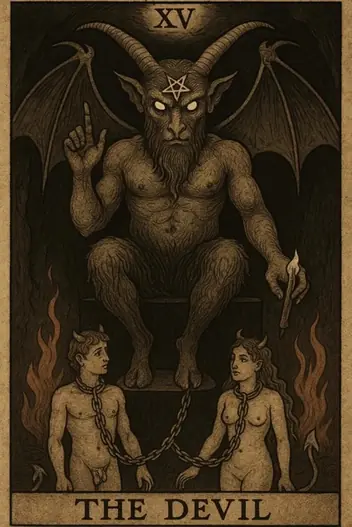
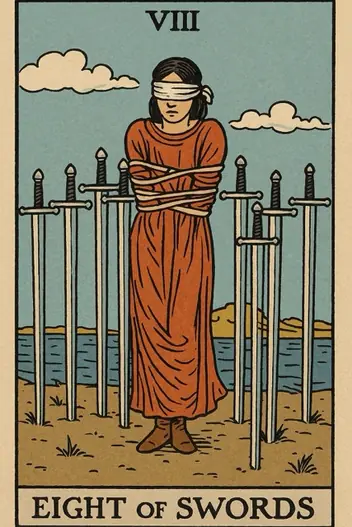
When the Devil’s chains of attachment meet the Eight of Swords’ blindfold of perceived helplessness, you are looking at a potent psychological cocktail: compulsive self-sabotage disguised as external oppression. The Devil represents the raw, binding energy of addiction, materialism, or toxic attachment. The Eight of Swords reveals the cognitive distortion that keeps you from seeing the exit. Together, they map a state where you feel trapped by circumstances, yet the primary jailer is your own unconscious belief system. This is not a random misfortune; it is a pattern of thinking that reinforces a cycle of dependency and fear. The core question becomes: Are you truly bound, or have you simply stopped looking for the key?
The Devil and Eight of Swords: How These Energies Interact
The fusion of these two cards creates a feedback loop of learned helplessness. The Devil provides the motive—a craving for control, security, or pleasure that has become compulsive. The Eight of Swords provides the justification—a narrative of victimhood that says, "I cannot change because I am surrounded by obstacles." In reality, the obstacles are often mental constructs: a fear of failure, a rigid belief about what you "deserve," or an unwillingness to confront the discomfort of freedom. The psychological state here is one of paralyzed awareness. You know something is wrong, but you have convinced yourself that any action will make it worse.
This combination demands a pragmatic, deconstructive approach. The first step is to separate objective facts from subjective fears. The Devil’s chains are real—perhaps a debt, a contract, or a relationship pattern—but the Eight of Swords’ blindfold is self-imposed. You must audit your own thinking. Ask: "What specific piece of information am I refusing to see? What would I do if I were not afraid of the consequences?" The energy of this pair is not about instant liberation; it is about identifying the first link in the chain and choosing to break it, one small, rational decision at a time.
The Devil and Eight of Swords for Career and Money
Strategic Opportunities:
Identify the one constraint you can actually control. Often, the "trap" is an inefficient process, a toxic coworker, or a client you should fire. Focus on that single variable.
Strategic Opportunities:
Leverage your dissatisfaction as data. The discomfort you feel is a reliable indicator that your current strategy is not working. Use it to refine your approach, not to justify inaction.
Calculated Risks:
Avoid any high-stakes gamble to "escape" the situation. Do not quit without a plan. Do not confront your boss without documented evidence. The Devil warns against impulsive moves driven by desperation.
In your professional life, this combination often signals a golden handcuffs scenario—a job that pays well but drains your spirit, or a business partnership that is profitable but unethical. The Eight of Swords highlights the mental narrative that keeps you there: "I can't leave because of the mortgage," or "No one else will hire me." Bold important financial warnings or strategic tips: Run a cold, hard calculation. Write down the actual financial cost of staying versus leaving. Include the cost of your mental health, lost time, and missed opportunities. The Devil’s trap is that it makes you overvalue short-term security and undervalue long-term autonomy. The strategic move is to build a bridge, not burn it. Start networking, update your resume, or save a "freedom fund." The act of planning, even without immediate action, will begin to dissolve the blindfold.
Your pair is already on the table. Ask your question and draw the clarifying card
or simply focus on it
The Devil and Eight of Swords as Feelings
If you are single:
This pairing warns against idealizing a partner who is unavailable, manipulative, or emotionally draining. You may be mistaking intensity for intimacy. Evaluate whether your attraction is based on genuine compatibility or a compulsive need to "fix" or "save" someone.
If you are in a relationship:
A clear sign of a power imbalance or codependent dynamic. One or both partners feel silenced, controlled, or unable to leave despite clear unhappiness. The "chains" are often unspoken agreements or shared fears (e.g., fear of loneliness, financial dependence).
In a relationship context, The Devil and Eight of Swords often points to a toxic stalemate. You may feel trapped by a partner’s behavior—their addiction, their criticism, or their emotional withdrawal. However, the Eight of Swords insists you examine your own role in maintaining the cage. Bold key relationship advice: Stop focusing on "fixing" your partner and start asking what you are afraid to lose. Are you staying because of genuine love, or because of a fear of being alone, a fear of financial instability, or a fear of admitting you made a mistake? The path forward requires radical honesty about your own boundaries. If you feel unable to speak, the Eight of Swords suggests you have the words—you just haven't trusted yourself to use them yet. A professional counselor or mediator may be necessary to break the silence.
Your unique Tarot reading
See how these cards interact with your destiny. Start a free personal reading now.
The Devil and Eight of Swords Reversed: How to Read It
Reversed cards complicate the situation, but do not simplify it.
If The Devil is reversed:
This indicates a blocked potential for liberation. The person is already on the verge of breaking free from an addiction, but the Eight of Swords (in its upright position) holds them back with fear. They are literally standing on the threshold of freedom but cannot take the step. Advice: seek an external mentor or coach who will "push" you, as your internal resources for the final push are currently insufficient.
If the Eight of Swords is reversed:
This speaks to an internal resistance to clarity. The person is removing the blindfold, sees the way out, but The Devil (in its upright position) beckons them back into the comfort zone. They understand what needs to be done but find a thousand reasons not to do it. Warning: you risk remaining in the trap because it has become comfortable.
If BOTH are reversed:
Complete imbalance. The addiction is denied ("I can quit anytime"), and the limitations are perceived as external ("the world is unfair"). This is the position of a victim who takes no responsibility. Remedy: an honest inventory of your life. Make a list of 10 things you are responsible for and 10 things you complain about. There is a high probability the lists will match.
Negative Meaning of The Devil and Eight of Swords
The shadow of this combination is paralysis by analysis—a state where you intellectualize your suffering to avoid changing it. You may become obsessed with "understanding" why you are stuck, endlessly reading articles (like this one) or consulting multiple advisors, but never taking a single concrete step. This is a form of spiritual bypassing where insight becomes a substitute for action. Another pitfall is projection: blaming a partner, a boss, or "the system" for your chains, while ignoring your own choices that led you there. The most dangerous cognitive bias here is the sunk cost fallacy—the irrational belief that because you have invested so much time, money, or emotion, you must continue. This is the Devil’s core deception. The truth is that the only wasted investment is the one that keeps you from a better future.
The Devil and Eight of Swords: The Combined Message
How to constructively use the energy of this pair? The key lies in dividing responsibility. The Devil governs attachment and gain, while the Eight of Swords governs perception and fear. Your task is to attack the Eight of Swords in order to weaken the Devil's grip.
Strategic advice: stop searching for the "right" solution and start taking small, "wrong" steps. If you are afraid to leave a relationship — do not leave. But do what was previously forbidden: sign up for a course, meet a friend without your partner's permission, set aside money in a separate account. Break the dictatorship of "all or nothing." Every micro-act of disobedience to the system returns your agency to you.
The Devil gives you passion and will to live, but channeled into a destructive direction. The Eight of Swords gives you sensitivity and awareness, but paralyzed by fear. Your synthesis is conscious passion. Direct the same energy you spend on anxiety and addictions toward creating something new. Want to control? Control your budget. Want dependency? Become dependent on your own growth. The only way to defeat this combination is to stop being a victim and become the author of your own trap, and then — the author of your own liberation.
Where to Go From Here
The Devil and Eight of Swords is a powerful signal that your feeling of entrapment is both real and exaggerated. The chains are tangible, but the blindfold is optional. Your next step is not to find a magical escape route, but to name the specific fear that is keeping you still. Is it fear of failure? Fear of conflict? Fear of the unknown? Once named, you can treat it as a problem to be solved, not a fate to be endured. The path out is through small, deliberate acts of agency—saying no, setting a boundary, or making a plan.
While this article provides a deep archetypal map, the true value of Tarot lies in its application to your unique life. Your specific question—your relationship, your career, your internal struggle—deserves a personalized reading. Do not rely on generalities when your freedom is at stake. Use the Fortune Cards app to get a deep, personalized interpretation of this exact combination for your specific situation. Available on the web or as a download, the app applies these psychological principles directly to your question, helping you see the exact blind spot and the precise chain you need to break. Stop reading about the cage. Start finding your own key.
Interpretation by the Fortune Cards editorial team, based on the Rider–Waite tradition and Jungian archetypes. About our methodology · Updated: 2026-08-26
Other Combinations with The Devil
Other Combinations with Eight of Swords
Explore Individual Card Meanings
Table of Contents
- The Devil and Eight of Swords: How These Energies Interact
- The Devil and Eight of Swords for Career and Money
- The Devil and Eight of Swords as Feelings
- The Devil and Eight of Swords Reversed: How to Read It
- Negative Meaning of The Devil and Eight of Swords
- The Devil and Eight of Swords: The Combined Message
- Where to Go From Here
Ready to find answers to your questions?
Start your first reading now and look at your situation with fresh clarity. The cards are ready to reveal deeper meaning.