Five of Cups and Nine of Swords Tarot as Feelings

- Arcana
- Five of Cups — Minor Arcana, Cups; Nine of Swords — Minor Arcana, Swords
- Elements
- Five of Cups — Water; Nine of Swords — Air
- Elemental interaction
- Neutral elements — energies coexist without conflict
- Numerology
- 5 + 9 = 14 → 5
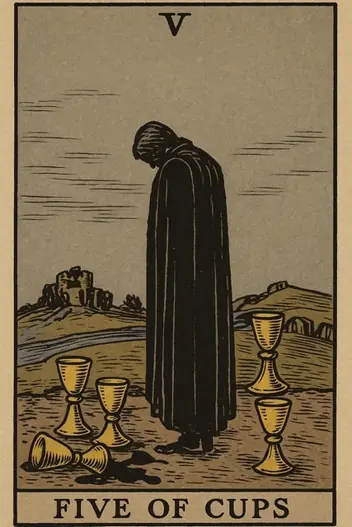
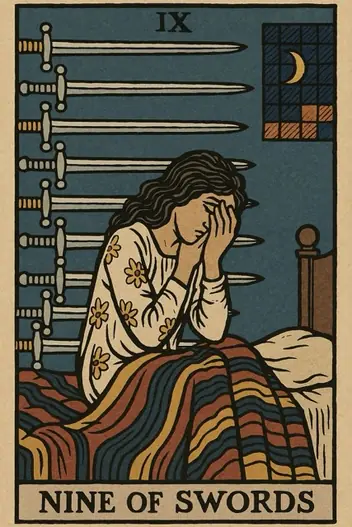
When the Five of Cups—the card of grief and perceived loss—collides with the Nine of Swords—the card of anxiety and sleepless nights—you are not dealing with mere sadness. You are witnessing a psychological feedback loop where a specific disappointment (Five of Cups) triggers a spiral of catastrophic thinking (Nine of Swords). This combination reveals a mind trapped in the past, replaying a single failure while ignoring the resources still available. From a Jungian perspective, the seeker is caught in a shadow identification with the wounded ego, unable to see the two remaining cups that symbolize untapped potential.
Pragmatically, this pairing is a red flag for decision paralysis. The emotional weight of the Five of Cups fuels the Nine of Swords’ tendency to exaggerate threats, leading to a state where objective risk assessment becomes impossible. This is not a time for major life changes; it is a time for cognitive restructuring and grounding techniques. The core dynamic here is a war between the heart’s grief and the mind’s fear, and neither side is telling the truth about the present moment.
What Do Five of Cups and Nine of Swords Mean Together?
The Five of Cups represents a selective focus on loss. The figure in the card stares at three spilled cups, ignoring the two standing behind them. When combined with the Nine of Swords, this selective attention becomes a cognitive distortion: the seeker fixates on what went wrong and then projects that failure into a terrifying future. The Nine of Swords amplifies the Five of Cups’ grief into a full-blown anxiety disorder—the fear that the loss is permanent, that it defines the self, and that worse is coming.
Psychologically, this is a classic case of rumination—the repetitive, passive focus on negative emotions and their causes. The mind loops through the same painful memory (Five of Cups) while the Nine of Swords adds layers of “what if” scenarios. The result is emotional exhaustion without resolution. The key insight here is that both cards are illusions: the Five of Cups lies about the total loss, and the Nine of Swords lies about the future. The seeker is not seeing reality; they are seeing a projection of their own unprocessed pain.
From a strategic standpoint, this combination demands a break in the thought pattern. The first step is not to solve the problem but to interrupt the loop. This can be done through physical grounding (cold water, deep breathing) or external perspective (a trusted friend or therapist). The cards are not predicting doom; they are describing a psychological trap that the seeker must consciously escape.
Your pair is already on the table. Ask your question and draw the clarifying card
or simply focus on it
What Do Five of Cups and Nine of Swords Say About Love?
If you are single:
This combination suggests you are projecting past heartbreak onto new potential partners. You are not seeing them clearly; you are seeing a ghost of a past disappointment. Take a break from dating to distinguish between a genuine red flag and a triggered memory.
If you are in a relationship:
You or your partner are dwelling on a specific conflict or betrayal, turning it into a narrative that the relationship is doomed. This is catastrophizing, not clear communication. Set a time limit for discussing the issue to prevent endless rumination.
In a relationship context, the Five of Cups and Nine of Swords signal a crisis of trust that has become self-fulfilling. One partner (or both) is holding onto a past mistake—perhaps an infidelity, a harsh word, or a broken promise—and using it as evidence that the relationship is fundamentally broken. The Nine of Swords then adds anxiety about the future: “If they did this once, they will do it again.” This is a classic cognitive distortion known as overgeneralization.
The pragmatic advice here is to differentiate between a pattern and an incident. The Five of Cups represents a single event; the Nine of Swords represents the fear of a pattern. Healthy relationships require closure on past events—not forgiveness, but a clear decision to move forward or separate. If the couple cannot stop re-litigating the past, they need structured communication (e.g., “We will talk about this for 20 minutes, then pivot to solutions”). Bold: The greatest risk here is that the anxiety becomes a self-fulfilling prophecy—your fear of the relationship failing may cause you to sabotage it.
Deepen your understanding
Find out exactly what this reading means for your current life situation with our oracle.
Career Meaning of Five of Cups and Nine of Swords
Strategic Opportunities:
Audit your assumptions. The loss you are grieving (a missed promotion, a failed project) may have hidden benefits—a lesson learned, a new direction, or a resource you overlooked.
Strategic Opportunities:
Use the anxiety as a signal. The Nine of Swords indicates you are overestimating risks. Ask: “What is the worst that can realistically happen?” Then plan for it. This turns fear into contingency planning.
Calculated Risks:
Do not make major financial moves while in this state. The combination of grief and anxiety leads to impulsive decisions—either reckless spending to feel better or paralyzing inaction that misses real opportunities.
In a professional context, this card pair often appears when a setback has triggered a crisis of confidence. Perhaps you lost a client, received negative feedback, or were passed over for a role. The Five of Cups makes you focus on that single failure, while the Nine of Swords makes you believe it defines your entire career. This is irrational, but it feels real. The key strategic move is to separate the event from your identity.
Financially, this is a dangerous combination because it can lead to two opposite errors: flight (selling assets, quitting a job out of fear) or freeze (ignoring real financial problems because the anxiety is overwhelming). The pragmatic approach is to make a list of objective facts: What exactly was lost? What resources remain? What is the actual probability of the feared outcome? Bold: The Nine of Swords’ anxiety is almost always disproportionate to the real risk. Use data, not feelings, to make career decisions.
What If Five of Cups or Nine of Swords Appears Reversed?
Five of Cups Reversed:
This indicates a blocked potential for healing. The person may be denying their pain or, conversely, trying too quickly to "forgive and forget" without having processed the grief. Warning: this can lead to repeating the same mistake, as the lesson has not been learned. The advice is not to force positivity, but to deliberately take time for reflection.
Nine of Swords Reversed:
Here we see an internal resistance to acknowledging the problem. The fear is so strong that it is repressed into the subconscious, manifesting as psychosomatic symptoms (headaches, insomnia) or passive aggression. Advice: pay attention to the body — if you don't feel the anxiety, but it is present in the form of physical symptoms, this is a signal of the need for professional support.
BOTH Reversed:
This is a complete imbalance, where denial and repression reach their peak. The person may appear outwardly calm but is in a state of deep internal crisis. A logical way to correct this is to create a safe space for the "legalization" of emotions. Start keeping a journal where you write down exactly three things: what you are feeling, what you are afraid of, and what you regret. This will restore contact with reality.
Five of Cups and Nine of Swords: Warning Signs
The shadow side of this combination is learned helplessness—the belief that because something bad happened, you are powerless to prevent future bad outcomes. The Five of Cups feeds the shadow by romanticizing the loss, making it seem larger and more defining than it is. The Nine of Swords feeds the shadow by convincing you that your fear is a form of foresight—that worrying means you are prepared. This is a cognitive bias known as the illusion of control through worry.
Another major pitfall is moralizing the loss. The seeker may subconsciously believe they deserve the pain (Five of Cups) and the anxiety (Nine of Swords) as a form of punishment. This is a shadow manifestation of the inner critic, which uses these cards to keep the seeker small and safe. The result is chronic self-sabotage: avoiding new opportunities because “I’ll only fail again,” or staying in a bad situation because “I deserve this.”
From a Jungian perspective, this is the Wounded Healer archetype gone wrong. The seeker is so identified with their pain that they cannot see the healing potential in the two remaining cups. The shadow asks: What would you do if you believed the loss was not the end? If the answer is “I don’t know,” that is the work that needs to be done.
Synthesis: Strategic Conclusion
Constructive use of this pair requires rigorous rationalization. The Five of Cups must be transformed from a source of pain into a tool for learning. Instead of "I lost a wonderful opportunity," ask: "What three specific lessons did I learn from this loss?" This shifts the emotion into the cognitive realm. The Nine of Swords, in turn, must be stripped of its power through decatastrophizing. Write your worst fear down on paper and ask: "What is the probability of this event on a scale of 1 to 10?" and "What will I do if it happens?" Often, the answer to the second question reveals that you are capable of handling even the worst-case scenario.
A deep strategic advice — use the "Paradoxical Intention" technique. If you are tormented by the fear of failure, deliberately plan a "failure" on a controlled scale. For example, if you are afraid of failing a presentation, give it to one friend who will provide harsh feedback. By experiencing this "mini-failure," you will see that the catastrophe did not occur, and your anxiety (Nine of Swords) will lose its power. Regret over the past (Five of Cups) transforms into experience, and fear of the future into a challenge.
This synthesis provides clarity for decision-making: you cannot change the past, but you can change its interpretation. You cannot control the future, but you can manage your attitude toward risk. The energy of these cards is fuel for personal growth, if you decide to stop being a passenger of your grief and become its pilot.
Applying This to Your Situation
The Five of Cups and Nine of Swords are not a prophecy of doom. They are a psychological snapshot of a mind caught in a loop of grief and fear. The core message is that you are misreading the evidence: the loss is not total, and the future is not as dangerous as it feels. The path forward requires interrupting the rumination, fact-checking your fears, and acknowledging the resources you still have. This is a call to step out of the past and into the present.
But this general analysis is just the starting point. The true power of Tarot lies in applying these archetypes to your specific situation. What exactly are you grieving? What specific fear is keeping you awake? The Fortune Cards app allows you to input your exact question and receive a deep, personalized interpretation of this combination tailored to your life right now. Whether you are navigating a breakup, a career crisis, or a financial decision, the app turns these abstract symbols into actionable psychological insight. Use it on the web or download it today—your unique context matters, and the cards are waiting to speak directly to you.
Interpretation by the Fortune Cards editorial team, based on the Rider–Waite tradition and Jungian archetypes. About our methodology · Updated: 2026-08-26
Other Combinations with Five of Cups
Other Combinations with Nine of Swords
Explore Individual Card Meanings
Table of Contents
- What Do Five of Cups and Nine of Swords Mean Together?
- What Do Five of Cups and Nine of Swords Say About Love?
- Career Meaning of Five of Cups and Nine of Swords
- What If Five of Cups or Nine of Swords Appears Reversed?
- Five of Cups and Nine of Swords: Warning Signs
- Synthesis: Strategic Conclusion
- Applying This to Your Situation
Ready to find answers to your questions?
Start your first reading now and look at your situation with fresh clarity. The cards are ready to reveal deeper meaning.