Love Tarot: Five of Swords and Seven of Swords

- Arcana
- Five of Swords — Minor Arcana, Swords; Seven of Swords — Minor Arcana, Swords
- Elements
- Five of Swords — Air; Seven of Swords — Air
- Elemental interaction
- Same element — energies intensify each other
- Numerology
- 5 + 7 = 12 → 3
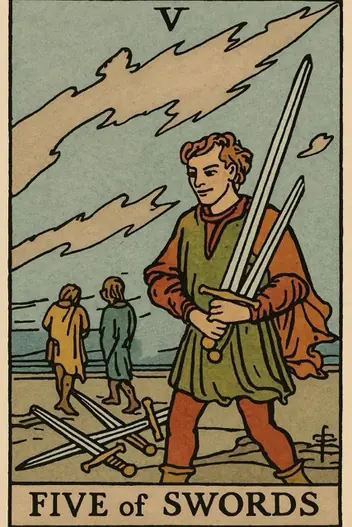
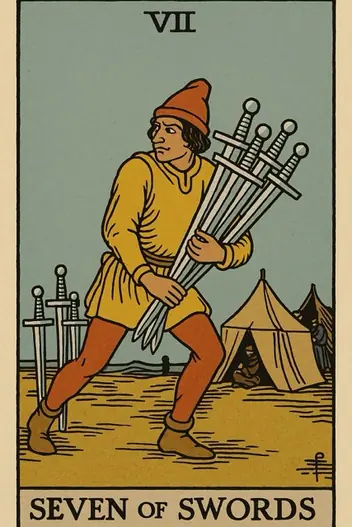
When the Five of Swords—a card of conflict, defeat, and hollow triumph—meets the Seven of Swords—a card of deception, cunning, and strategic withdrawal—you are looking at a psychological landscape defined by winning at any cost. This combination often signals a situation where someone is willing to bend rules, withhold truth, or manipulate others to secure a short-term advantage. The core tension here is between aggressive confrontation (Five) and covert retreat (Seven). The result is a mindset that prioritizes tactical victory over relational integrity, often leaving the "winner" isolated and the "loser" resentful.
In practical terms, this pairing warns of a power struggle where the rules are unclear. You may be tempted to fight openly for what you want, then secretly change your approach when the battle turns against you. Alternatively, you might be dealing with someone who appears to concede but is actually plotting their next move. The psychological archetype at play is the Trickster combined with the Warrior—a dangerous fusion that can achieve results but at the cost of trust and long-term stability.
What Do Five of Swords and Seven of Swords Mean Together?
The Five of Swords archetype represents the ego's need to win. It is the part of you that believes victory is zero-sum—your gain is someone else's loss. When combined with the Seven of Swords, the strategy shifts from open combat to guerrilla warfare. You are no longer just fighting; you are outsmarting, dodging, and using deception to secure the upper hand. This creates a hyper-vigilant mental state where every interaction is viewed as a potential trap or opportunity for exploitation.
Psychologically, this combination activates the Shadow archetype of the Machiavellian strategist. You may rationalize your actions as "necessary" or "just business," but the underlying drive is often fear of loss or unresolved shame about past defeats. The Seven of Swords encourages you to "take what you can get," while the Five of Swords insists you must "prove you are stronger." The result is a cognitive distortion where you believe that winning at all costs is the only path to safety.
The real-world implication is a high-risk, low-trust environment. If you are in this energy, you may achieve your immediate goal, but you will likely damage your reputation, burn bridges, or create enemies who will remember your tactics. The key insight here is that this combination rarely leads to sustainable success. The victory feels hollow because it was achieved through manipulation or aggression, not genuine competence or collaboration.
Career Meaning of Five of Swords and Seven of Swords
Strategic Opportunities:
Use your analytical skills to identify weaknesses in a competitor's strategy. This is a good time for competitive intelligence—but keep it legal and ethical.
Strategic Opportunities:
Negotiate from a position of information advantage. Gather data before making a move. The Seven of Swords energy can be used for discreet research or behind-the-scenes planning.
Calculated Risks:
Avoid blatant deception or sabotage of colleagues. The risk of being caught is high, and the long-term damage to your reputation outweighs any short-term gain. Do not sign contracts without legal review.
In a career context, this combination often appears when you are facing office politics or a hostile takeover scenario. You may feel forced to choose between being "nice" and being "effective." The Five of Swords energy says "fight for your position," while the Seven of Swords says "work around the system." The pragmatic approach is to combine strategic patience with ethical boundaries. Use the Seven of Swords energy to observe and plan, not to deceive.
Financial warning:
Be cautious of get-rich-quick schemes or investments that require secrecy. This combination can indicate hidden fees, fine-print traps, or partnerships where one party is not transparent. Bold the key advice: Do not make major financial decisions based on incomplete information. If something feels too good to be true, it likely is.
Your pair is already on the table. Ask your question and draw the clarifying card
or simply focus on it
Five of Swords and Seven of Swords in Love Tarot
If you are single:
This pairing suggests you may be attracted to someone who is emotionally unavailable or manipulative. Alternatively, you might be using charm and half-truths to win someone over, which will backfire once the facade cracks. Focus on transparency, not tactics.
If you are in a relationship:
You are likely in a power struggle where one partner is "winning" arguments through manipulation or withdrawal. The relationship may feel like a chess match rather than a partnership. Honest communication is the only antidote.
In relationships, this combination often indicates betrayal of trust—either you suspect your partner is hiding something, or you are the one withholding information to avoid conflict. The Five of Swords energy creates defensive arguments where you try to "prove you're right," while the Seven of Swords energy encourages secretive behavior like hiding finances, emotional affairs, or passive-aggressive silence. The psychological cost is emotional exhaustion. Both partners feel unseen and unsafe.
Key relationship advice:
Stop keeping score. This combination thrives on tit-for-tat dynamics where each party tries to outmaneuver the other. Instead, ask yourself: "Am I trying to win this argument, or am I trying to understand my partner?" If the answer is the former, you are stuck in the Five of Swords mindset. The only real win here is mutual respect, not unilateral victory.
Reversed Positions: What Changes?
When cards appear in a reversed position, their dynamic transforms from an external conflict into an internal one.
If the Five of Swords is reversed:
This indicates blocked potential for aggression or recklessness. You may feel like a victim, lacking the strength to fight back, or conversely, your aggression is directed inward (self-flagellation). Advice: stop blaming yourself for past failures. The energy of this card demands not a struggle against an external enemy, but a reconciliation with your own powerlessness.
If the Seven of Swords is reversed:
This is a classic syndrome of self-sabotage and internal resistance. You are not deceiving others; you are deceiving yourself by refusing to see obvious facts. Warning: do not ignore the "red flags" in projects or relationships. Your indecisiveness and fear of the truth lead to greater losses than any open confrontation.
If BOTH are reversed:
Complete imbalance. This is a state of paralysis of the will and a total loss of control. You can neither attack (the upright Five) nor defend (the upright Seven). The logical way to correct this: temporarily withdraw from all active actions. You need not to plan moves, but to restore a basic sense of security. Focus on routine and physical health to regain your footing.
Get a personalized interpretation
Unlock the combined meaning of your cards in the context of your unique question — for free.
Shadow Side & Pitfalls
The shadow of this combination is paranoia and self-sabotage. You may become so focused on "winning" or "not being played" that you alienate allies and miss genuine opportunities for collaboration. The psychological trap is projection: You assume everyone else is as cunning as you are, leading you to act defensively even when no threat exists. This can create a self-fulfilling prophecy where your distrust provokes the very betrayal you fear.
Another pitfall is moral disengagement. You may justify unethical behavior by telling yourself "everyone does it" or "it's just business." This erodes your sense of integrity and, over time, your capacity for authentic connection. The cost of this mindset is loneliness. People may respect your strategic mind, but they will not trust you with their vulnerability.
Cognitive biases to watch for:
Confirmation bias (seeing only evidence that supports your suspicion), the fundamental attribution error (assuming others' actions are malicious while your own are justified), and illusory superiority (believing you are smarter than everyone else in the room). These biases make the Five of Swords and Seven of Swords combination particularly dangerous for decision-making.
What Is the Overall Message of Five of Swords and Seven of Swords?
How can the energy of the Five of Swords be used constructively to balance the Seven of Swords? The answer lies in the realm of ethics and long-term planning. The Five of Swords provides you with willpower and the ability to assert your boundaries. The Seven of Swords represents intellect and the capacity to see non-obvious paths. Your task is to channel these qualities toward creation, not destruction.
Imagine you are a commander who must take a fortress. The Five of Swords is a direct assault that would lead to heavy losses. The Seven of Swords is a diversion behind enemy lines. Instead of waging war against competitors or partners, apply these energies to protecting your resources and creating a "Plan B." Use the Seven's perceptiveness to calculate risks in advance, and the Five's drive to decisively implement protective mechanisms (e.g., insurance, legal safeguards, a reserve fund).
A deep strategic counsel: abandon the concept of "victory" in favor of the concept of "resilience." If you feel yourself being drawn into a conflict, ask yourself: "What will I gain if I win? And what will I lose if I lose?" If the answers are unclear, the best move is not to play that game. Your strength now lies not in striking first or outsmarting everyone, but in maintaining clarity of mind and not succumbing to provocations. Only in this way can this destructive combination be transformed into a tool for strengthening your position.
Your Next Step: Personal Context Matters
The Five of Swords and Seven of Swords combination is a call to examine your relationship with power and truth. Are you using your intelligence to build or to destroy? Are you fighting for what matters, or just for the sake of winning? The core message is that strategic thinking is valuable, but only when aligned with integrity. The hollow victory of these cards is a warning: you can win the battle and lose the war for your own soul.
To understand how this archetype applies to your unique situation, a personalized Tarot reading is essential. The general interpretation is a map, but your specific question—about a relationship, career move, or personal conflict—requires a tailored analysis. Use the Fortune Cards app to get a deep, personalized interpretation of this exact combination for your specific question right now. Whether you access it on the web or download the app, you will receive a reading that considers your context, your energy, and your next best step. Don't navigate this complex energy alone—let the cards speak directly to your situation.
Interpretation by the Fortune Cards editorial team, based on the Rider–Waite tradition and Jungian archetypes. About our methodology · Updated: 2026-08-26
Other Combinations with Five of Swords
Other Combinations with Seven of Swords
Explore Individual Card Meanings
Table of Contents
- What Do Five of Swords and Seven of Swords Mean Together?
- Career Meaning of Five of Swords and Seven of Swords
- Five of Swords and Seven of Swords in Love Tarot
- Reversed Positions: What Changes?
- Shadow Side & Pitfalls
- What Is the Overall Message of Five of Swords and Seven of Swords?
- Your Next Step: Personal Context Matters
Ready to find answers to your questions?
Start your first reading now and look at your situation with fresh clarity. The cards are ready to reveal deeper meaning.