Five of Wands and Seven of Swords Meaning in Tarot

- Arcana
- Five of Wands — Minor Arcana, Wands; Seven of Swords — Minor Arcana, Swords
- Elements
- Five of Wands — Fire; Seven of Swords — Air
- Elemental interaction
- Friendly elements — energies support each other
- Numerology
- 5 + 7 = 12 → 3
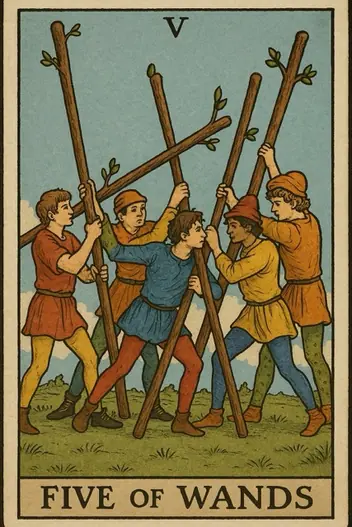
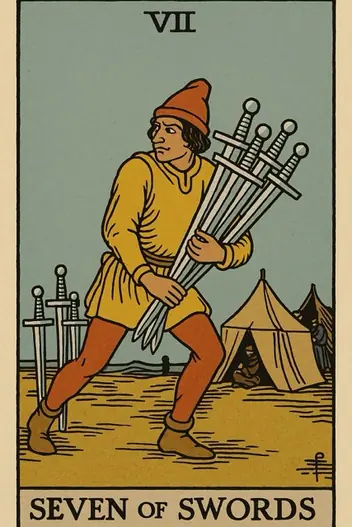
When the Five of Wands—a card of open rivalry, competition, and scattered energy—collides with the Seven of Swords—a card of stealth, strategy, and calculated withdrawal—you get a powerful psychological cocktail. This pairing is less about a simple fight and more about a strategic power struggle where direct confrontation gives way to subtle maneuvering.
At its core, this combination reveals a situation where your initial impulse to compete or clash (Five of Wands) must be tempered by a more pragmatic, even covert, approach (Seven of Swords). You are not just fighting; you are out-thinking. The key insight here is that winning isn't about brute force, but about knowing when to engage, when to deceive, and when to slip away unnoticed.
Five of Wands and Seven of Swords Together: Meaning
The psychological state created by the Five of Wands and Seven of Swords is one of heightened vigilance and tactical anxiety. You feel the pressure of competition (Five of Wands) but realize that a direct, head-on attack is either impossible or unwise. This forces your mind into a problem-solving, almost paranoid, mode. You are scanning for weaknesses, assessing risks, and planning your next move with precision. The ego is engaged, but it's not about dominance; it's about survival and advantage.
This combination often appears when you are navigating a "game" environment—office politics, a competitive market, or a complex social dynamic. The energy demands that you separate your emotions from your strategy. The Five of Wands wants to fight; the Seven of Swords wants to win. The most effective path is to channel the competitive fire into calculated, discreet actions. It’s about knowing who your real opponents are and avoiding unnecessary skirmishes.
The real-world implication is a call for mental agility over brute force. You are not being asked to be dishonest, but to be highly selective about what you reveal and to whom. The core dynamic is a tension between transparent conflict and opaque strategy. Your greatest asset right now is your ability to think several moves ahead, keeping your ultimate objective clear while your immediate actions remain ambiguous to others.
Your pair is already on the table. Ask your question and draw the clarifying card
or simply focus on it
Five of Wands and Seven of Swords in Love and Relationships
If you are single:
This pair suggests you might be entering a dating scene where competition is high and not everyone is playing fair. Be wary of partners who seem charming but evasive; verify actions over words.
If you are in a relationship:
You or your partner may be withholding information or engaging in subtle power plays to avoid a direct argument. The issue is not the conflict itself, but the lack of transparency.
In relationships, this combination points to a dynamic where communication is strategic rather than genuine. One partner may feel the need to "win" an argument by using emotional manipulation or withholding the full truth. The Five of Wands brings the friction of clashing wills, while the Seven of Swords adds a layer of defensiveness and secrecy. This is a red flag for passive-aggressive behavior. The key relationship advice here is to call for a truce on the "game-playing." If you sense someone is being less than direct, the healthiest move is to state your observations calmly and ask for complete honesty, even if it leads to a difficult conversation. Avoid the trap of trying to outsmart your partner; it erodes trust faster than any open fight.
Five of Wands and Seven of Swords for Career and Money
Strategic Opportunities:
Use this energy to outmaneuver a competitor by identifying their blind spots and positioning yourself where they aren't looking.
Strategic Opportunities:
This is an excellent time for stealth research—gathering competitive intelligence or data on a potential business move without revealing your hand.
Calculated Risks:
Be extremely careful with intellectual property and contracts. The Seven of Swords warns of potential theft, deception, or hidden clauses. Do not sign anything without a thorough legal review.
From a career perspective, this combination is a powerful indicator of a tactical opportunity—but only if you are disciplined. The Five of Wands represents the competitive landscape, the "noise" of the marketplace. The Seven of Swords tells you to work quietly and efficiently behind the scenes. If you are in a negotiation, reveal your bottom line last. If you are leading a project, be mindful of team members who may be withholding information or working on their own agenda. Financially, this is a time for conservative moves—protect your assets and avoid flashy investments. The greatest risk is overconfidence in your own cleverness; a single miscalculation can lead to significant loss.
Uncover hidden insights
Let our advanced Tarot system interpret these archetypes specifically for your personal path.
When Five of Wands and Seven of Swords Signal Trouble
The shadow side of this pairing is a descent into paranoia and Machiavellianism. The cognitive bias here is a "zero-sum" mindset—the belief that for you to win, someone else must lose. This can lead to self-sabotage through overcomplication. Instead of taking a simple, direct action, you may find yourself constructing elaborate schemes that are unnecessary and exhausting. The biggest pitfall is confusing strategy with dishonesty. If you consistently choose the covert route when a transparent one would work, you risk damaging your reputation and your relationships. Poor judgment manifests as blaming others for the conflict (Five of Wands shadow) while secretly manipulating outcomes (Seven of Wands shadow). The trap is believing you are the only smart person in the room.
Five of Wands and Seven of Swords Reversed Meaning
When cards appear in a reversed position, the dynamic becomes distorted, but does not disappear. If the Five of Wands is reversed, it indicates blocked potential or recklessness. The conflict is either suppressed (you are enduring an injustice) or has devolved into a chaotic stage with no rules. Paired with an upright Seven of Swords, this creates a "stab in the back" scenario: you are being provoked, but you do not fight back, allowing the manipulator to get their way. Advice: stop avoiding conflict if it is inevitable. Your silence is consent to someone else's rules of the game.
If the Seven of Swords is reversed, it signals internal resistance and weakness. You know what needs to be done (to be cunning, to maneuver), but you cannot bring yourself to act. This may be linked to feelings of guilt or fear of exposure. Paired with an upright Five of Wands, this leads to self-sabotage: you start a fight but abandon it halfway, leaving yourself vulnerable. Your main enemy is not your opponent, but your indecisiveness.
If BOTH cards are reversed, a complete imbalance of dynamics arises. This is a state of total disorientation, where there is neither a clear conflict nor a defined strategy. You act chaotically, sometimes attacking, sometimes hiding, which drains your resources. The logical way to correct this: return to basics. Before making plans, determine who your allies are and who your adversaries are. Stop playing "cat and mouse" with yourself. Start small—establish one clear boundary or goal, and stick to it.
Five of Wands and Seven of Swords: The Combined Message
Constructive use of this combination requires a high level of reflection and emotional maturity from you. The energy of the Five of Wands is your drive, your desire to be first, and your need to defend your boundaries. The energy of the Seven of Swords is your intellect, your ability to see hidden connections, and to plan several steps ahead. Your task is not to suppress one energy in favor of the other, but to teach them to work in tandem.
Strategic advice: imagine you are playing poker. The Five of Wands is your bluff and your bets, while the Seven of Swords is your ability to read your opponent and conceal your emotions. You are not obliged to show all your cards, but you are obliged to follow the rules of the game. Use cunning not to deceive, but to protect your interests. For example, in negotiations, do not immediately state your ultimate goal, but do not lie about your intentions either. Ask questions to identify your opponent's weaknesses, and propose mutually beneficial compromises.
Key takeaway: this combination is a tool for navigating complex, competitive environments. It does not say the world is hostile, but rather that it has rules you need to know. Your strength lies in conscious choice: knowing when to be direct and assertive, and when to be flexible and discreet. Accept conflict as a given, but do not let it control you. Turn it into fuel for growth, not a source of stress. Only then can you emerge from this "game" a winner, while maintaining respect for yourself and others.
Applying This to Your Situation
The core message of the Five of Wands and Seven of Swords is this: Competition is a mental game, not a physical brawl. Your next step is to assess whether you are fighting the right battle and with the right tools. Are you being strategically clever, or just clever for clever's sake? The answer lies in your specific situation.
While this analysis provides the general archetype, the true power of Tarot lies in its application to your unique life. To get a deep, personalized interpretation of exactly how this combination applies to your specific question—whether about a relationship conflict, a career move, or a personal dilemma—use the Fortune Cards app. You can access it on the web or download it now to receive a reading tailored to your exact circumstances, guiding you toward the most effective and authentic path forward.
Interpretation by the Fortune Cards editorial team, based on the Rider–Waite tradition and Jungian archetypes. About our methodology · Updated: 2026-09-17
Other Combinations with Five of Wands
Other Combinations with Seven of Swords
Explore Individual Card Meanings
Table of Contents
- Five of Wands and Seven of Swords Together: Meaning
- Five of Wands and Seven of Swords in Love and Relationships
- Five of Wands and Seven of Swords for Career and Money
- When Five of Wands and Seven of Swords Signal Trouble
- Five of Wands and Seven of Swords Reversed Meaning
- Five of Wands and Seven of Swords: The Combined Message
- Applying This to Your Situation
Ready to find answers to your questions?
Start your first reading now and look at your situation with fresh clarity. The cards are ready to reveal deeper meaning.