The Hermit and Six of Swords Reversed in Tarot
- Arcana
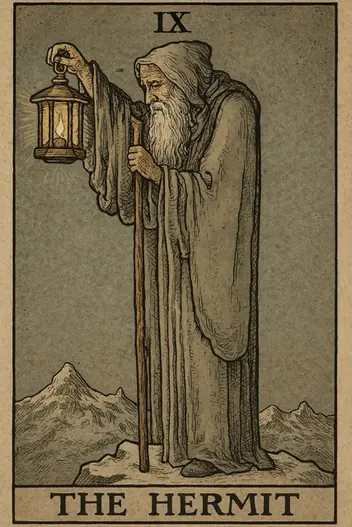
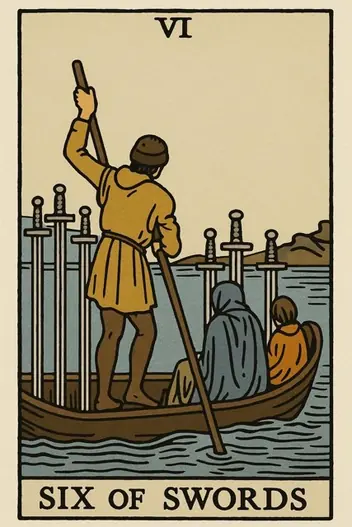
- The Hermit — Major Arcana; Six of Swords — Minor Arcana, Swords
- Elements
- The Hermit — Earth; Six of Swords — Air
- Elemental interaction
- Opposing elements — energies create tension
- Numerology
- 9 + 6 = 15 → 6
When The Hermit—the archetype of solitary introspection and inner guidance—meets The Six of Swords—the card of deliberate transition and emotional passage—the result is a unique psychological state. This is not passive waiting or aimless drifting. It is a strategic retreat designed to navigate a necessary change with clarity and minimal emotional turbulence. The seeker is called to leave behind a familiar shore (a belief, a relationship, a career path) and travel into the unknown, but only after consulting their own inner compass. The core dynamic is moving forward by first looking inward, recognizing that the most effective transitions are those guided by hard-won self-knowledge rather than external validation.
The Hermit and Six of Swords Card Meaning Explained
The fusion of The Hermit and Six of Swords creates a mindset of calculated detachment. You are not running from your problems; you are repositioning yourself to see them more clearly. The Hermit’s lamp illuminates the emotional baggage and outdated patterns that the Six of Swords is ferrying away. This is a time to conduct a rigorous audit of your attachments—what beliefs, relationships, or fears are you carrying that no longer serve your growth? The psychological payoff is a reduction in cognitive dissonance: you stop pretending a situation is working when it is not.
Practically, this combination signals a period where solitude is a strategic asset, not a punishment. The Six of Swords often involves a literal or metaphorical journey—moving cities, changing jobs, ending a relationship—but The Hermit insists you go alone, or at least with a quiet inner focus. The real work is not the destination but the internal navigation system you build along the way. Bold text highlights the key insight: The most successful transitions are not about escaping the past, but about integrating its lessons into a lighter, more focused vessel.
The Hermit and Six of Swords: Career and Money
Strategic Opportunities:
Use this time to conduct a deep skills audit and identify which competencies are portable to a new industry or role. The Hermit’s focus on expertise aligns with specialized training, certification, or research.
Strategic Opportunities:
The Six of Swords encourages a lateral move—a shift in geography, department, or client focus—that leverages your existing knowledge while shedding toxic work environments or outdated projects.
Calculated Risks:
Avoid making major financial commitments or career announcements during this introspective phase. The risk is analysis paralysis disguised as prudence, or impulsive quitting without a safety net.
For career and finances, this is a phase of strategic repositioning, not aggressive action. The Hermit advises you to become an expert in your domain rather than seeking broad visibility. The Six of Swords warns against clinging to a sinking ship out of loyalty or fear. The bold financial warning is this: Do not invest money or energy into rescuing a failing venture or relationship at work. Instead, save cash, update your resume, and network quietly with people who represent your next logical step. This combination favors consulting roles, research positions, or solo projects that allow for deep focus. Financially, it is a time to pay down debt and simplify your budget to create the flexibility needed for a transition. The most profitable move is often the one that reduces your emotional overhead—even if it means a temporary pay cut.
Your pair is already on the table. Ask your question and draw the clarifying card
or simply focus on it
The Hermit and Six of Swords Love Outcome
If you are single:
This combination suggests you are not ready to date for connection, but rather to date for self-discovery. Evaluate potential partners through the lens of what they reveal about your own unmet needs or avoidant patterns. Prioritize emotional clarity over romantic chemistry.
If you are in a relationship:
The relationship is likely in a phase of quiet reassessment. One or both partners may be emotionally withdrawing to think. This is not a crisis if handled with conscious communication about the need for space. The risk is silent drifting; the opportunity is a mutually agreed-upon reset.
In relationships, The Hermit and Six of Swords point to a powerful but delicate dynamic of emotional intelligence. The person embodying The Hermit must avoid making unilateral decisions in their solitude. The partner must resist the urge to chase or force connection. The key relationship advice is to establish clear, non-accusatory boundaries: “I need time to think about us, not time away from you.” This combination favors therapeutic conversations, journaling together, or a short, intentional break to recalibrate. The goal is not to end the relationship, but to ferry it from a place of reactivity to a place of conscious choice. If one partner has already emotionally checked out, this card pair warns of a silent, unacknowledged ending rather than a clean break.
The Hermit and Six of Swords Reversed: How to Read It
Reversed cards indicate a distortion of the archetypal dynamic.
If The Hermit is Reversed:
You risk turning withdrawal into isolation, and reflection into rumination. Instead of seeking truth, you seek confirmation of your fears. Advice: set a strict timer for reflection (e.g., 30 minutes a day) and force yourself to make contact with the world, even through short walks.
If the Six of Swords is Reversed:
You are sabotaging your own movement. You understand that you need to leave, but you cling to the past out of fear of the unknown. This leads to stagnation. Warning: this state can develop into depression. You need to literally force yourself to take the first step, even if it feels wrong.
If BOTH are Reversed:
Complete imbalance of the dynamic. You are simultaneously afraid of being alone (The Hermit) and afraid of moving forward (Six of Swords). This creates a paralysis of the will. The logical way to correct this: seek out a mentor or psychologist. You need an external "compass" that you cannot find within yourself.
Uncover hidden insights
Let our advanced Tarot system interpret these archetypes specifically for your personal path.
When The Hermit and Six of Swords Signal Trouble
The shadow of The Hermit and Six of Swords manifests as emotional avoidance disguised as wisdom. The seeker may use “I need time to think” as a justification for ghosting, procrastination, or refusing to make a decision. This is a cognitive bias called the “ostrich effect”—burying your head in the sand while claiming to seek clarity. Another pitfall is intellectualizing feelings to the point of paralysis: analyzing a relationship or career move to death without ever taking the ferry across the water. Self-sabotage here can look like isolating yourself when you actually need a guide, or carrying resentment silently while pretending to be “above the drama.” The most dangerous shadow is a false sense of moral superiority—believing your solitary path is inherently more enlightened than others’ messy, engaged lives. This combination demands honest self-confrontation, not self-congratulation.
The Hermit and Six of Swords: The Combined Message
Constructive use of this pair's energy requires the discipline of the Hermit and the resolve of the Traveler. Your task is to create a "mobile laboratory": take with you only what has passed the test of endurance. This is a time for creating a mental map of your future. You are not simply drifting with the current—you are purposefully charting a course, using the Hermit's lantern to read the maps.
A deep strategic counsel: divide the process into two phases. The first phase (1-2 weeks) is a complete disconnection from external noise. You only observe, record, and analyze. The second phase is the beginning of movement. You choose one direction and take one, but confident, step. The key metric of success here is not speed, but vector. If you feel you are moving in a direction that resonates with your deepest values, you are on the right path.
Remember: The Hermit and the Six of Swords are not cards of defeat, but cards of transformation through strategic retreat. You are not fleeing the world; you are regrouping to return to it with new understanding and strength. Use this time wisely, and it will become the foundation for your next great leap forward.
Your Next Step: Personal Context Matters
The Hermit and Six of Swords is a powerful call to move forward with intention, not inertia. Your core message is this: the transition you face is less about where you are going and more about who you are becoming along the way. The lamp and the ferry are tools, not solutions. The real work is in your hands.
But Tarot is not a generic guide. The true power of this combination reveals itself only when applied to your specific question. Are you leaving a relationship or a job? Do you need a week of silence or a year of solitude? Is this a temporary pause or a permanent shift? Get a deep, personalized interpretation of The Hermit and Six of Swords for your exact situation. Download the Fortune Cards app now—or use it on the web—to ask your question and receive a reading that accounts for your unique context, timing, and emotional landscape. Don’t navigate this transition alone. Let the cards speak directly to you.
Interpretation by the Fortune Cards editorial team, based on the Rider–Waite tradition and Jungian archetypes. About our methodology · Updated: 2026-09-17
Other Combinations with The Hermit
Other Combinations with Six of Swords
Explore Individual Card Meanings
Table of Contents
- The Hermit and Six of Swords Card Meaning Explained
- The Hermit and Six of Swords: Career and Money
- The Hermit and Six of Swords Love Outcome
- The Hermit and Six of Swords Reversed: How to Read It
- When The Hermit and Six of Swords Signal Trouble
- The Hermit and Six of Swords: The Combined Message
- Your Next Step: Personal Context Matters
Ready to find answers to your questions?
Start your first reading now and look at your situation with fresh clarity. The cards are ready to reveal deeper meaning.