Love Tarot: Seven of Wands and Five of Cups

- Arcana
- Seven of Wands — Minor Arcana, Wands; Five of Cups — Minor Arcana, Cups
- Elements
- Seven of Wands — Fire; Five of Cups — Water
- Elemental interaction
- Opposing elements — energies create tension
- Numerology
- 7 + 5 = 12 → 3
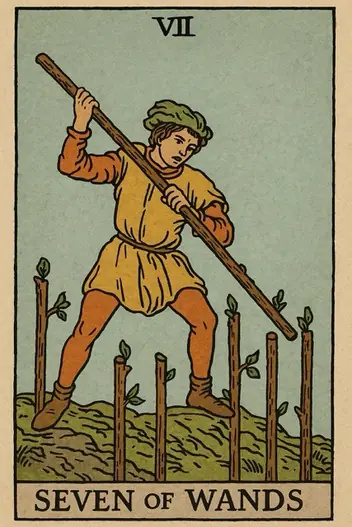
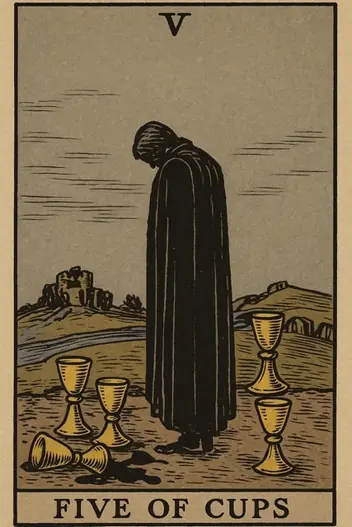
This combination presents a powerful psychological tension: the Seven of Wands represents active defense, resilience, and holding your ground against external challenges, while the Five of Cups embodies grief, disappointment, and a fixation on what has been lost. When these two archetypes collide, you are likely in a state of defensive mourning—struggling to protect your position while simultaneously grieving a previous failure or missed opportunity.
The core conflict here is between action and emotion. You may be fighting hard to maintain control in one area of life, yet your energy is being drained by unresolved sadness from another. This is not a time for passive acceptance; rather, it demands that you strategically choose which battles to fight and which losses to release.
What Do Seven of Wands and Five of Cups Mean Together?
The psychological state created by the Seven of Wands and Five of Cups is one of defensive grief. You are standing on a hilltop, defending your territory, but your gaze keeps drifting backward to the spilled cups at your feet. This creates a dangerous loop: the Five of Cups pulls your attention to past disappointments, while the Seven of Wands demands immediate, present-moment resistance. The result is a fragmented mindset where you are neither fully present in your defense nor fully processing your grief.
This combination often signals that you are fighting harder than necessary because you are trying to compensate for a previous loss. For example, you might overwork to prove your worth after a professional setback, or cling to a relationship dynamic that no longer serves you because you fear another failure. The real-world implication is clear: your defensive posture is being fueled by emotional debt, not by strategic necessity.
The key psychological insight here is that you must separate the grief from the fight. The Five of Cups asks you to acknowledge what is truly lost and to stop pouring energy into mourning. The Seven of Wands then demands that you conserve that energy for only the most critical defenses. Misidentifying an emotional wound as an external threat is the primary cognitive bias at play. You are not under attack from the world; you are under attack from your own unresolved feelings.
Your pair is already on the table. Ask your question and draw the clarifying card
or simply focus on it
Career Meaning of Seven of Wands and Five of Cups
Strategic Opportunities:
Use this energy to protect your core responsibilities while letting go of peripheral projects that are draining your resources.
Strategic Opportunities:
Channel your defensive energy into auditing your workflow—identify which tasks are truly under threat and which are just emotional baggage from past failures.
Calculated Risks:
Avoid making financial decisions based on a recent loss. Do not "revenge spend" or over-invest to make up for a previous mistake.
In a professional context, the Seven of Wands and Five of Cups demands strategic triage. You are likely facing external pressure—a difficult client, a competitive colleague, or a looming deadline—while simultaneously nursing a recent professional wound, such as a missed promotion or a failed project. The danger is that your grief will cause you to over-defend, wasting energy on battles that don't matter.
The pragmatic financial warning is clear: do not confuse resilience with stubbornness. The Seven of Wands can be a powerful asset for protecting your position, but only if you are defending the right hill. Ask yourself: is this fight worth the emotional cost? If the answer is no, the Five of Cups advises you to accept the loss and redirect your resources. Bold strategic advice: Let the small defeats go. Conserve your energy for the one or two critical defenses that will define your next career move.
Deepen your understanding
Find out exactly what this reading means for your current life situation with our oracle.
What Do Seven of Wands and Five of Cups Say About Love?
If you are single:
This combination warns against defending a fantasy. You may be holding out for a past connection or comparing new prospects to an idealized memory. Your defensiveness is blocking genuine new connections.
If you are in a relationship:
You and your partner may be locked in a cycle of grievance and resistance. One person is focused on a past hurt (Five of Cups), while the other is on the defensive (Seven of Wands), creating a stalemate.
In relationships, this pair often indicates a power struggle rooted in past disappointment. One partner feels wounded and withdrawn (Five of Cups), while the other feels attacked and becomes combative (Seven of Wands). The core dynamic is a misaligned emotional timeline: you are fighting about the present, but the real issue is unresolved pain from the past.
The most critical relationship advice is to pause the defense and address the grief first. Before you can stand your ground, you must validate the loss. This does not mean surrendering your boundaries; it means acknowledging the emotional cost of the conflict. Bold action without emotional processing will only deepen the rift. If you are single, stop defending your past choices. The Seven of Wands energy is better used to protect your future, not your history.
What If Seven of Wands or Five of Cups Appears Reversed?
When cards appear reversed, the dynamic becomes distorted but does not disappear—it shifts into a passive phase.
Seven of Wands reversed:
The archetype of the defender becomes a paranoid or a deserter. You either see a threat where none exists, wasting energy fighting windmills, or conversely, you surrender positions without a fight when you should have held the line. Advice: Check the reality of your fears. Your "fortress" may be empty, and the enemy—a figment of your imagination. Stop defending against your own fantasies.
Five of Cups reversed:
This is denial of grief or being stuck in the shock stage. You refuse to acknowledge a loss, pretending nothing happened. This leads to internal tension and psychosomatic issues. Warning: Unshed tears block your ability to see new opportunities. Allow yourself to grieve, but set a timer—you have exactly one week for this stage.
BOTH reversed:
Complete imbalance—chaotic defense and suppressed pain. You don't know what to defend against and don't understand what you've lost. This is a state of internal chaos, where external aggression mixes with apathy. Logical way to correct it: Stop completely. Take a 48-hour pause from any decisions and actions. Your task is not to fight or grieve, but simply to observe your reactions, as if watching the weather. Only after this pause should you begin to restore your hierarchy of values.
Seven of Wands and Five of Cups: Warning Signs
The shadow manifestation of this combination is defensive despair. You become a martyr, fighting against the world while secretly wallowing in your own sadness. The cognitive bias here is confirmation bias: you interpret every small challenge as proof that you are a victim, reinforcing your grief. This leads to self-sabotage—you push away help, reject reasonable compromises, and escalate conflicts because you are more invested in being right about your pain than in finding a solution.
Another pitfall is emotional bankruptcy. You are so focused on defending your position that you have no emotional reserves left for healing. This can manifest as burnout, cynicism, or passive-aggressive behavior. You may say you are "standing your ground," but in reality, you are just too exhausted to move forward. The shadow warns that holding onto grief as a justification for aggression will isolate you from support and prolong your suffering.
What Is the Overall Message of Seven of Wands and Five of Cups?
To use this energy constructively, you need to perform an act of intellectual courage: acknowledge that your defense and your grief are two sides of the same coin called "fear of change." The Seven of Wands fears losing control; the Five of Cups fears the future will be worse than the past. Strategic advice: use the energy of the Seven (drive, resilience) not to defend the past, but to build the future. Channel your fighting spirit into seeking new opportunities (the two remaining cups), rather than clinging to the broken ones.
Your task is to shift energy from reactive (defense/grief) to proactive (creation/integration). Stop asking "Why did this happen to me?" (Five of Cups) and "How do I fight this off?" (Seven of Wands). Start asking: "What of what I have left can I strengthen and develop?" This shift in focus is the only way to break the vicious cycle. Accept the loss as a fact, stop defending the ruins, and you will see that the battlefield where you stood your ground is, in reality, fertile soil for a new beginning.
Your Next Step: Personal Context Matters
The core message of the Seven of Wands and Five of Cups is this: you cannot defend your future while holding onto your past. You must choose which battle to fight—the one against external challenges, or the one against your own disappointment. The cards advise you to process the grief first, then strategically defend what truly matters. This is not a time for half-measures; it requires a clear-eyed assessment of what is worth protecting and what must be released.
Your unique situation demands more than general archetypes. While this article provides the psychological framework, the true insight comes from applying these energies to your specific question. The Fortune Cards app offers a deep, personalized interpretation of this exact combination for your unique context. You can use it on the web or download it now to get an immediate, tailored reading that tells you exactly which battle to fight and which loss to release. Stop guessing. Get your answer.
Interpretation by the Fortune Cards editorial team, based on the Rider–Waite tradition and Jungian archetypes. About our methodology · Updated: 2026-08-26
Other Combinations with Seven of Wands
Other Combinations with Five of Cups
Explore Individual Card Meanings
Table of Contents
- What Do Seven of Wands and Five of Cups Mean Together?
- Career Meaning of Seven of Wands and Five of Cups
- What Do Seven of Wands and Five of Cups Say About Love?
- What If Seven of Wands or Five of Cups Appears Reversed?
- Seven of Wands and Five of Cups: Warning Signs
- What Is the Overall Message of Seven of Wands and Five of Cups?
- Your Next Step: Personal Context Matters
Ready to find answers to your questions?
Start your first reading now and look at your situation with fresh clarity. The cards are ready to reveal deeper meaning.