Six of Cups and Ace of Swords Meaning in Tarot
- Arcana
- Six of Cups — Minor Arcana, Cups; Ace of Swords — Minor Arcana, Swords
- Elements
- Six of Cups — Water; Ace of Swords — Air
- Elemental interaction
- Neutral elements — energies coexist without conflict
- Numerology
- 6 + 1 = 7
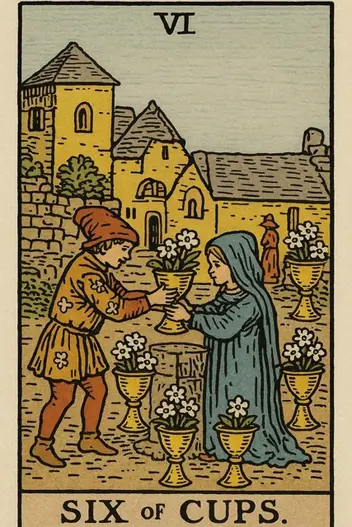
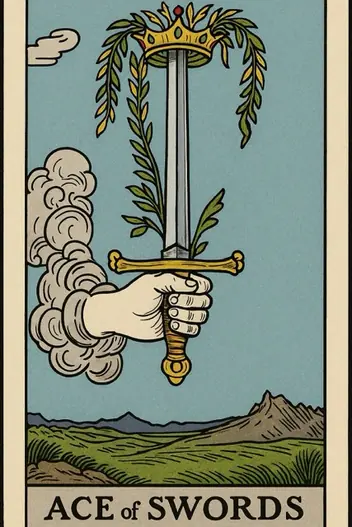
The intersection of the Six of Cups and the Ace of Swords represents a powerful psychological tension: the pull of familiar emotional comfort colliding with the demand for intellectual honesty and decisive action. The Six of Cups evokes the archetype of the Inner Child—a state of sweet, often idealized, memory and a desire for simplicity. The Ace of Swords, in contrast, embodies the Rational Mind—a sharp, penetrating force that strips away illusion to reveal the unvarnished truth. When these two energies combine, the seeker faces a critical moment: can you honor your emotional history without being ruled by it? The card pair suggests a need to bring clarity to a situation rooted in the past, using logical discernment to cut through nostalgia and make a decision that serves your future self.
Six of Cups and Ace of Swords Together: Meaning
This combination creates a psychological state of cognitive dissonance between sentiment and reason. You may find yourself revisiting a person, place, or project from your past—perhaps a childhood dream, an old friendship, or a former career path. The Ace of Swords demands you evaluate this return with cold pragmatism: Is this a genuine opportunity for growth, or are you romanticizing a memory? The core dynamic is the integration of heart and head—not by dismissing the emotion, but by using the Sword to dissect why it holds power over you. The key insight here is that emotional attachment must be tested by logic.
In practical terms, this pair often appears when you are about to make a decision that feels "meant to be" due to its familiarity. However, the Ace of Swords warns against blind faith. You must ask hard questions: Does this situation actually align with your current values and goals, or are you clinging to a version of yourself that no longer exists? The path forward requires objective analysis of subjective feelings. The most productive mindset is one of compassionate detachment—acknowledging the sweetness of the memory while accepting that the present requires a different, more mature choice. This is not about killing the past, but about learning from it without repeating its mistakes.
Your pair is already on the table. Ask your question and draw the clarifying card
or simply focus on it
Six of Cups and Ace of Swords Love Outcome
If you are single:
This combination suggests you are likely to encounter someone who feels familiar, perhaps reminding you of a past love or a childhood crush. Use the Ace of Swords to investigate whether this is genuine chemistry or just comfortable nostalgia. List the objective qualities you seek now, and compare them to what this person offers.
If you are in a relationship:
You and your partner may be revisiting an old issue, or trying to recapture the "honeymoon phase." The Ace of Swords here is a call for radical honesty about what has changed. Avoid idealizing the past; instead, use clear communication to define what you both need in the present.
The relationship dynamics here are about maturity and boundary-setting. The Six of Cups can manifest as a desire to return to a simpler, less conflicted time, but the Ace of Swords insists that you cannot go back—only forward with new understanding. If you are feeling suffocated by a partner's clinging to the "good old days," this card pair advises you to state your truth clearly and without apology. For couples, this is a potent time to heal old wounds by putting them into words rather than ignoring them. The most powerful relationship advice is this: Love that cannot withstand the truth is not love worth preserving. Use the Sword to cut away the stories you tell yourselves, and rebuild on a foundation of authentic, present-moment connection.
Six of Cups and Ace of Swords in Career Readings
Strategic Opportunities:
Leverage your past experience (Six of Cups) as a competitive advantage (Ace of Swords). Apply lessons learned from a previous failure or success to a new project.
Strategic Opportunities:
Reconnect with an old mentor or client—but approach the meeting with a clear, data-driven proposal. This is not a social call; it is a strategic re-engagement.
Calculated Risks:
Beware of "golden handcuffs" —a return to a former job or industry that offers emotional comfort but stifles your growth. Objectively assess whether the financial stability is worth the intellectual stagnation.
In your career, this combination signals a critical decision point where past and future collide. You may be offered a chance to return to a former role, or to use an old skill in a new context. The Ace of Swords demands you cut through the emotional noise. Ask yourself: Is this opportunity a genuine stepping stone or a sentimental trap? Financially, this pair warns against investing based on nostalgia—don't buy a stock just because it reminds you of your grandfather, or take a job because it feels like "home." The strategic move is to use your memory as a source of data, not a guide for action. List the pros and cons objectively, and if the past holds a valuable lesson, extract that lesson and leave the rest behind. This is a time for sharp, precise planning, not emotional decision-making.
Get a personalized interpretation
Unlock the combined meaning of your cards in the context of your unique question — for free.
Six of Cups and Ace of Swords Reversed: How to Read It
If the Six of Cups is reversed:
This indicates blocked emotional potential. You cannot let go of the past, but you also do not want to analyze it. You are stuck in resentment or guilt. Advice: Instead of waiting for nostalgia to "wash over you," consciously perform a ritual of farewell to the past experience. Write down what you gained, and release it.
If the Ace of Swords is reversed:
This is internal resistance to the truth. You know the truth but are afraid to voice or accept it. The mind is clouded by fear or self-deception. Warning: Ignoring the obvious will cause the situation to resolve itself, but painfully — through crisis or scandal. Act proactively.
If BOTH are reversed:
Complete imbalance. The past weighs heavily, and clarity is absent. The person is in a state of chaotic regression. They are trying to bring back "the good old days," but do not know how. Method for correction: Pause. Do not make decisions. First, bring order to your mind (meditation, therapy, journaling), and then to your affairs. Slow down the pace and return to basic facts.
The Shadow Side of Six of Cups and Ace of Swords
The shadow of this combination is cognitive bias, specifically the rosy retrospection bias—the tendency to remember the past as better than it actually was. When this energy is blocked, you may idealize a former lover, job, or lifestyle while ignoring the reasons it ended. This can lead to repeating cycles of disappointment because you refuse to see the flaws. Alternatively, the Ace of Swords can become cold and ruthless if the seeker over-corrects, dismissing all emotional value as weakness. The pitfall is a false dichotomy: that you must either be sentimental (Six of Cups) or brutally logical (Ace of Swords). Self-sabotage occurs when you use "clarity" as an excuse to avoid vulnerability. Watch for signs of intellectual arrogance—believing you have already figured out the past, when in fact you are still emotionally entangled. The true shadow is denial of the heart's wisdom in favor of the head's dogma.
Six of Cups and Ace of Swords: The Combined Message
How can the energy of the Six of Cups be used constructively to balance the Ace of Swords? The answer lies in deliberate reflection. Do not allow memories to be merely a backdrop. Make them a tool. Take a specific pleasant memory (e.g., a successful project from the past) and perform an "autopsy" on it with the Ace of Swords. Ask questions: "What specific actions led to success?", "What mistakes did I make then that I have since forgotten?", "Are those lessons applicable now?". This transforms passive nostalgia into an active strategy.
The Ace of Swords, in turn, needs to be "softened" by the Six of Cups. Truth without empathy is cruelty. Before cutting through things bluntly, remember that behind every decision stand people with their own stories. This does not mean softening the truth. It means dosing it, taking context and relationships into account. The energy of this pair is directed at "cutting away" not people from the past, but outdated behavioral scripts. Your goal is to preserve the essence (the value of experience, the warmth of connection) while changing the form (strategy, boundaries, communication).
A deep strategic piece of advice: Use this combination as a "Clean Slate" moment. The Six of Cups gives you a draft—what was written before. The Ace of Swords gives you scissors and glue. Your task is not to throw away the entire text, but to cut out the key ideas and rewrite the ending. This is a moment when you accept your past but refuse to be its hostage. You become the author, not the reader, of your life.
Where to Go From Here
The core message of the Six of Cups and Ace of Swords is this: Honor your past, but do not let it dictate your future. Use the clarity of the Sword to examine your emotional attachments with honest, unflinching eyes. The key is to integrate—not choose one energy over the other. Every decision you make must be informed by both your heart's history and your mind's present analysis. This is a powerful combination for breaking free from old patterns and making a conscious choice that aligns with your authentic self.
While this article provides the general archetype, the true magic happens when Tarot is applied to your unique situation. Your specific question, your personal history, and the surrounding cards in your spread will shift the interpretation dramatically. Don't settle for generic advice. Use the Fortune Cards app to get a deep, personalized interpretation of this exact combination for your specific question right now. Available on the web or as a download, it will help you see exactly how these archetypes are playing out in your life—so you can act with confidence and clarity.
Interpretation by the Fortune Cards editorial team, based on the Rider–Waite tradition and Jungian archetypes. About our methodology · Updated: 2026-08-26
Other Combinations with Six of Cups
Other Combinations with Ace of Swords
Explore Individual Card Meanings
Table of Contents
- Six of Cups and Ace of Swords Together: Meaning
- Six of Cups and Ace of Swords Love Outcome
- Six of Cups and Ace of Swords in Career Readings
- Six of Cups and Ace of Swords Reversed: How to Read It
- The Shadow Side of Six of Cups and Ace of Swords
- Six of Cups and Ace of Swords: The Combined Message
- Where to Go From Here
Ready to find answers to your questions?
Start your first reading now and look at your situation with fresh clarity. The cards are ready to reveal deeper meaning.