Love Tarot: Six of Cups and Four of Swords
- Arcana
- Six of Cups — Minor Arcana, Cups; Four of Swords — Minor Arcana, Swords
- Elements
- Six of Cups — Water; Four of Swords — Air
- Elemental interaction
- Neutral elements — energies coexist without conflict
- Numerology
- 6 + 4 = 10 → 1
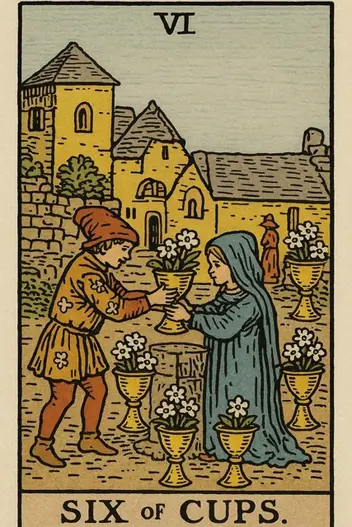
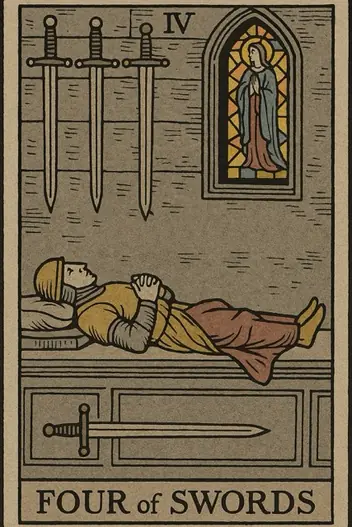
When the Six of Cups, the card of innocent memory and emotional generosity, meets the Four of Swords, the card of deliberate rest and mental retreat, a powerful psychological paradox emerges. This combination suggests a period where the seeker is not just remembering the past, but actively retreating into it as a form of self-preservation. The core dynamic here is the tension between emotional security found in familiar memories and the cognitive need for isolation to heal from mental fatigue.
In practical terms, this pairing often appears when a person is processing a recent loss, a major life transition, or a deep disappointment. Instead of moving forward aggressively, the psyche demands a strategic pause—a chance to revisit old joys, safe relationships, or simpler times. This is not escapism for its own sake; it is a Jungian form of incubation, where the unconscious mind uses positive memories as a scaffold to rebuild resilience. The key question is: Are you resting to recover, or resting to avoid the present?
Core Dynamics & Interpretation
The intersection of the Six of Cups and Four of Swords creates a psychological state of restorative nostalgia. This is not the melancholic longing for a lost past, but rather an active, conscious choice to engage with positive memories as a therapeutic tool. The mind, overwhelmed by current stressors, seeks a temporary shelter in what is known and safe. This can manifest as reconnecting with an old friend, revisiting a childhood hobby, or simply allowing yourself to daydream about a time when life felt simpler.
From a Jungian perspective, this combination represents the integration of the "Inner Child" archetype with the need for cognitive rest. The Four of Swords provides the mental space for the Six of Cups to operate without judgment. The seeker is effectively giving themselves permission to be vulnerable and gentle. However, the pragmatic warning is clear: this retreat must have a time limit. Without a conscious boundary, this healing pause can turn into a regressive pattern where the seeker refuses to engage with adult responsibilities. The real-world implication is that you are currently in a low-energy phase where the most productive action is to conserve energy, not spend it.
Love and Relationships
If you are single:
This combination suggests you may be idealizing a past relationship or a childhood crush. Before pursuing a new connection, complete the emotional closure on old stories. Your next partner will feel like a safe, familiar friend, not a dramatic stranger.
If you are in a relationship:
The couple may be in a protective bubble, withdrawing from social pressures to focus on each other. This can be healing, but watch for emotional stagnation where both partners avoid difficult conversations by retreating into shared nostalgia.
In a relationship reading, the Six of Cups and Four of Swords point to a period of quiet intimacy and emotional recharging. This is a powerful time for couples to revisit the foundation of their bond—look at old photos, talk about how you met, or recreate a favorite memory from your early days. The psychological benefit is a reinforcement of attachment security. However, the shadow risk is that one or both partners use this nostalgia to avoid addressing current conflicts. Bold advice: Use this energy to build a "relationship retreat" where you actively choose to rest together, but schedule a follow-up conversation to address any unspoken issues. For singles, this card pair strongly warns against projecting past relationship dynamics onto a new person. Your task is to differentiate between a healthy, safe connection and a comfortable but limiting pattern.
Your pair is already on the table. Ask your question and draw the clarifying card
or simply focus on it
What Do Six of Cups and Four of Swords Indicate for Your Career?
Strategic Opportunities:
Leverage your professional network. Reconnect with former mentors, colleagues, or clients who know your capabilities. This is a low-risk way to generate new opportunities.
Strategic Opportunities:
Audit your "emotional assets." Identify past projects or skills you enjoyed but abandoned. This is an ideal time to retrain or refresh a forgotten talent without pressure.
Calculated Risks:
Avoid making major financial decisions from a place of nostalgia. Do not invest in a business or property simply because it "feels like home" or reminds you of a successful past.
In the professional realm, this combination signals a strategic withdrawal to consolidate your resources and reputation. The most pragmatic action is to slow down your output and focus on quality over quantity. If you are in negotiations, the Four of Swords advises you to take a break before signing anything. The Six of Cups suggests that your strongest leverage may come from past goodwill—a favor you can call in, or a trusted relationship you can reactivate. Bold financial warning: Be wary of "get-rich-quick" schemes that promise a return to a previous golden era. The past is a reference point, not a business plan. Financially, this is a time for conservation, not expansion. Build a cash reserve and pay down debt. The only "investment" that makes sense here is in your own mental health and skill development.
Shadow Side & Pitfalls
The shadow manifestation of this pairing is pathological nostalgia—a cognitive bias where the seeker filters out all negative memories to create a fantasy past. This leads to decision paralysis and a refusal to accept the present reality. The Four of Swords shadow emerges as emotional hibernation, where the seeker uses rest as a permanent excuse to avoid growth. The Six of Cups shadow is codependency, where the seeker clings to people or situations that are no longer healthy simply because they feel familiar. Watch for self-sabotage through rumination: replaying past hurts or successes instead of taking a single, small step forward. The key bias to avoid is the "golden age fallacy"—believing that the best days are behind you, which justifies inaction.
Get a personalized interpretation
Unlock the combined meaning of your cards in the context of your unique question — for free.
Reversed Six of Cups and Four of Swords Explained
Reversed cards shatter fragile equilibrium and expose the problem.
If the Six of Cups is reversed:
The blocked potential of the past turns into a toxic attachment or an unfinished gestalt. You are not just nostalgic; you are stuck in a trauma. Instead of comfort, memories evoke pain and anger. Advice: Active processing with a psychologist or the technique of "writing a letter to your past self" is required to complete the cycle.
If the Four of Swords is reversed:
This is a state of forced activity against a backdrop of exhaustion. You cannot allow yourself rest; you are being "pulled" out of seclusion. This leads to mistakes due to fatigue. Warning: Risk of a nervous breakdown. Sleep and isolation are vitally necessary for you, even if it seems there is no time.
If BOTH are reversed:
Complete imbalance. The past actively attacks (Six of Cups reversed), and there is no opportunity for recovery (Four of Swords reversed). This is a crisis where the psyche is overloaded and cannot cope with the flow of negative memories. Corrective measure: Emergency reset – a complete change of scenery, disconnection from social networks and contacts that remind you of the past, and a strict daily routine prioritizing sleep.
What Is the Overall Message of Six of Cups and Four of Swords?
How can the energy of the Six of Cups be used constructively to balance the Four of Swords? The answer lies in actively using nostalgia as fuel for the future. Do not allow the past to be a passive refuge. Make it an active tool. For example, if you recall a successful project from 5 years ago, do not simply feel wistful about it. Instead, write down 3 specific skills or strategies you used then, and consider how to apply them in your current context.
In this pairing, the Four of Swords should become not a bed for eternal sleep, but a laboratory for synthesizing a new "Self" from old ingredients. Your task is to transform passive waiting into active planning. Lie in silence, but with a notebook. Remember, but with the question: "What did this teach me, and how can I use it tomorrow?"
Strategic advice: introduce a practice of "Archiving the Past." Once a week, set aside 30 minutes to consciously immerse yourself in a memory, record its value, and then CLOSE it. This allows you to obtain a resource without the risk of getting stuck in it. Then, the energy of the Six of Cups will become the foundation, and the Four of Swords, the architect of your new plan.
Where to Go From Here
The core message of the Six of Cups and Four of Swords is clear: rest is not retreat; it is preparation. You are being asked to honor your need for emotional safety and mental stillness, but only as a strategic pause, not a permanent destination. Use this time to heal, not hide. The memories you revisit are tools for building resilience, not cages for your future.
This analysis provides the general archetype, but the true power of Tarot lies in its application to your unique situation. Your specific question, your exact relationship dynamic, or your precise career crossroads changes everything. To get a deep, personalized interpretation of this exact combination for your specific question right now, use the Fortune Cards app. Available on the web and for download, it applies Jungian psychology and practical strategy to your life, not just a textbook meaning. Get your answer now.
Interpretation by the Fortune Cards editorial team, based on the Rider–Waite tradition and Jungian archetypes. About our methodology · Updated: 2026-09-24
Other Combinations with Six of Cups
Other Combinations with Four of Swords
Explore Individual Card Meanings
Table of Contents
Ready to find answers to your questions?
Start your first reading now and look at your situation with fresh clarity. The cards are ready to reveal deeper meaning.