Six of Swords and Ten of Swords Tarot as Feelings
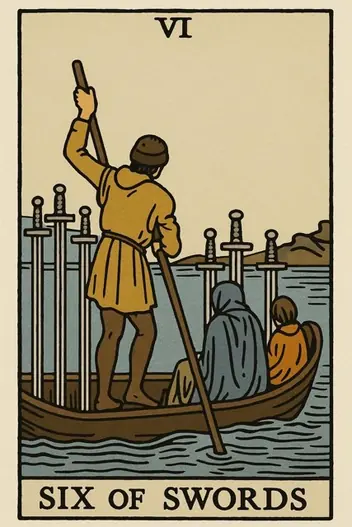

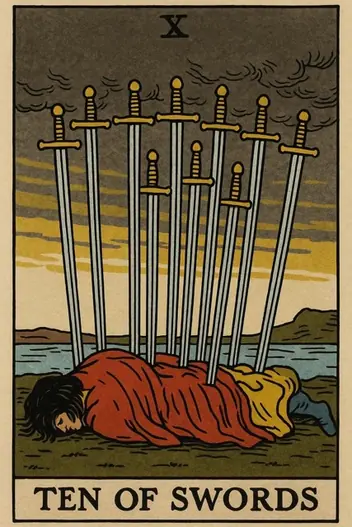
- Arcana
- Six of Swords — Minor Arcana, Swords; Ten of Swords — Minor Arcana, Swords
- Elements
- Six of Swords — Air; Ten of Swords — Air
- Elemental interaction
- Same element — energies intensify each other
- Numerology
- 6 + 10 = 16 → 7
These two cards—the Ten of Swords, representing a painful finality or a "rock bottom" moment, and the Six of Swords, signifying a necessary, though emotionally charged, transition—create a powerful narrative of crisis and controlled escape. The core question here is not if you will leave a difficult situation, but how you will manage the aftermath and chart your course forward.
Psychologically, this pairing describes a mind that has been overwhelmed by negative thoughts (Ten of Swords) and is now desperately seeking a rational, albeit emotionally detached, solution (Six of Swords). The collision of these energies suggests a pragmatic choice to abandon a sinking ship, not out of cowardice, but out of a clear-eyed assessment that further struggle is futile.
Core Dynamics & Interpretation
The combined energy of the Six and Ten of Swords indicates a transition born from a definitive ending. The Ten of Swords signifies the culmination of a painful mental or emotional pattern—a betrayal, a failure, or a deep-seated belief system that has finally collapsed. The Six of Swords is the strategic retreat that follows. This is not a happy reunion or a triumphant victory; it is a sober, necessary relocation of your mental and emotional resources.
From a Jungian perspective, this is the Shadow integration of defeat. You are being forced to accept that a part of your ego-identity (the one that believed it could win this fight, fix this relationship, or succeed in this venture) has been "killed." The Six of Swords represents the conscious decision to carry the lessons learned into a new, more protected psychological territory. The key insight is resilience through acceptance: you stop fighting the past and start navigating the future.
In practical terms, this combination demands a strict separation between emotion and action. You may feel devastated, betrayed, or exhausted (Ten of Swords), but the Six of Swords requires you to act with cold logic and purposeful detachment. The real-world implication is a phased withdrawal from a toxic environment, a failed project, or a harmful relationship. The most important strategic action is to stop trying to heal the wound and instead focus on relocating to safer ground.
Career Meaning of Six of Swords and Ten of Swords
Strategic Opportunities:
The end of a failed project, job, or business venture (Ten of Swords) creates a clean slate. The Six of Swords points to an opportunity to pivot to a completely different industry, role, or location where your past reputation doesn't follow you.
Strategic Opportunities:
This is a powerful time for restructuring your finances. Use the "rock bottom" moment to negotiate a severance, write off bad debts, or sell underperforming assets to fund your transition.
Calculated Risks:
Avoid any offer that looks like a "quick fix" to your career problems. The Six of Swords is a slow, deliberate journey, not a magic solution. The risk is jumping into another high-pressure role without healing from the burnout of the last one.
Practical Analysis:
In a career reading, this combination is a blunt warning against stubbornness. If you have been trying to salvage a failing business, a toxic work environment, or a dying industry, the Ten of Swords says the situation is terminal. The Six of Swords advises a systematic exit strategy. The most important financial warning is to avoid pouring more money or time into a "sunk cost." Accept the loss, liquidate what you can, and use the capital to fund your journey to a more stable professional environment. This is a time for conservative financial planning; think of yourself as a refugee moving to a new country—you need to conserve resources for the transition, not for a lavish lifestyle.
Your pair is already on the table. Ask your question and draw the clarifying card
or simply focus on it
Love and Relationships
If you are single:
This pairing suggests you are carrying the painful baggage of a past relationship (Ten of Swords) into your search for a new partner. Your next step is not to find love, but to complete a psychological journey away from that trauma. Do not begin a new relationship until you have physically and mentally distanced yourself from the old one.
If you are in a relationship:
The relationship itself may be at a terminal point (Ten of Swords), or one partner has been deeply wounded by the other. The Six of Swords indicates that a separation—physical, emotional, or both—is the only logical next step. Trying to "fix" things now will only prolong the agony.
Detailed Interpretation:
In a relationship context, this combination signals a critical point of no return. The Ten of Swords often represents a brutal truth or a betrayal that shatters the foundation of trust. The Six of Swords is the emotional evacuation that follows. The key relationship advice is to prioritize your own psychological safety over the desire to reconcile. The healthiest dynamic here is a structured, respectful separation where both parties acknowledge the end. If you stay, you risk perpetuating a cycle of resentment and victimhood. Emotional intelligence here means recognizing that the "relationship" as you knew it is dead, and your only responsibility is to carry yourself—and any children or shared responsibilities—to a new, stable shore.
What Are the Risks of Six of Swords and Ten of Swords?
The shadow manifestation of this pairing is chronic victimhood and avoidance. The seeker may become stuck in the "Ten of Swords" narrative, endlessly replaying the betrayal or failure, using it as an excuse to not take the difficult journey of the Six of Swords. This is a cognitive bias known as catastrophizing, where one believes the pain is so unique and total that no forward movement is possible. Another pitfall is escapism without resolution—using the Six of Swords to physically leave a situation (e.g., quitting a job, moving cities) without doing the psychological work of understanding why the situation collapsed. This leads to repeating the same patterns in a new location. The poor judgment here is mistaking a tactical retreat for a strategic victory. You haven't won; you've survived. Acting irrationally means refusing to learn the lesson the Ten of Swords is trying to teach you.
Deepen your understanding
Find out exactly what this reading means for your current life situation with our oracle.
Reversed Six of Swords and Ten of Swords Explained
Reversed cards in this pair signal a disruption of the natural "crisis-evacuation" cycle. The situation loses its fatal clarity and transforms into a protracted neurosis.
If the Six of Swords is reversed:
You are stuck in the denial phase. The Ten of Swords has already occurred, but you refuse to leave the crash site. This is blocked potential — you know you need to leave, but the fear of the unknown paralyzes your will. Advice: Acknowledge that your "stuckness" is a conscious choice, not an objective necessity. Take the first micro-step: open a job listings website for another city or schedule an appointment with a therapist.
If the Ten of Swords is reversed:
This is internal resistance to completion. You refuse to admit that the game is lost. The crisis drags on because you cling to the illusion of control. Warning: This position is dangerous because you are wasting energy trying to resuscitate a corpse. The reversed Ten of Swords is not a "reprieve" but an accumulation of toxic stress.
If BOTH are reversed:
Complete imbalance. The situation resembles running in place: you are aware of the collapse (reversed Ten) but cannot move from the spot (reversed Six). This is a state of paralysis of the will. The logical way to correct it: artificially create an external deadline. Set a timer for 72 hours, during which you must make a decision and take at least some action (quit your job, break a contract, move). External compulsion will replace the absent internal will.
Six of Swords and Ten of Swords Combined Message
Constructive use of this combination requires mental flexibility and a readiness for amputation. Your task is to accept the Ten of Swords as a diagnosis and the Six of Swords as a prescription. Do not attempt to rewrite history or change the past. Focus on what you can control: the direction of your movement.
The strategic algorithm of action consists of three steps. Step one is total inventory. Make a list of what has been irrevocably lost (money, relationships, reputation) and what remains (skills, health, connections, free time). The Ten of Swords destroys only what is meant to die. Step two is choosing a "new shore." The Six of Swords does not specify exactly where to sail. You need to determine not an ideal place, but a safe harbor — a temporary refuge where you can recover your strength. This could be a part-time job, moving in with relatives, or transitioning to freelance work. Step three is separation from the past. Physically and mentally sever ties with the place of collapse. Delete contacts, remove items that remind you of the past. A farewell ritual (a letter you burn, or the symbolic sale of an old car) is not mysticism, but a psychotechnique that helps your brain switch gears.
The main strategic advice: do not seek meaning in this crisis. Seek tactical advantage. The Ten of Swords does not make you wiser — it makes you freer from ballast. The Six of Swords does not promise happiness — it promises safety. Your goal is not to become happy tomorrow, but to become invulnerable to repeating this mistake. Use the energy of the Six of Swords to create an "early warning system": now you know the signs of an approaching Ten of Swords and will be able to leave the sinking ship before it goes under.
Applying This to Your Situation
The Six and Ten of Swords together deliver a clear, sobering message: an ending is here, and a difficult, necessary journey is about to begin. Your strength lies not in fighting the ending, but in managing the transition with dignity and strategic foresight. The core message is one of psychological survival—you must leave behind what is dead to carry what is living forward.
While this article provides the general archetype, the true power of Tarot lies in applying it to your unique situation. The Fortune Cards app allows you to input your specific question—about a relationship, a career choice, or a personal dilemma—and receive a deep, personalized interpretation of the Six of Swords and Ten of Swords combination for your life. Don't settle for generic advice. Use the app on the web or download it now to get the clarity you need to make your next move with confidence.
Interpretation by the Fortune Cards editorial team, based on the Rider–Waite tradition and Jungian archetypes. About our methodology · Updated: 2026-09-24
Other Combinations with Six of Swords
Other Combinations with Ten of Swords
Explore Individual Card Meanings
Table of Contents
Ready to find answers to your questions?
Start your first reading now and look at your situation with fresh clarity. The cards are ready to reveal deeper meaning.