The Star and Ten of Swords Meaning in Tarot
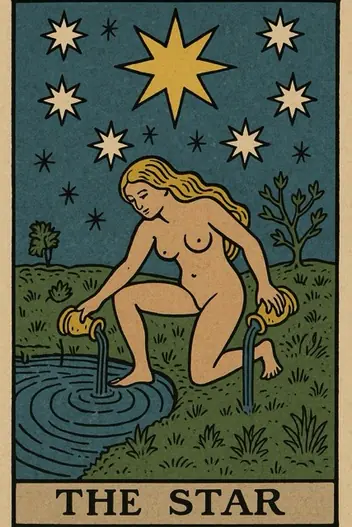
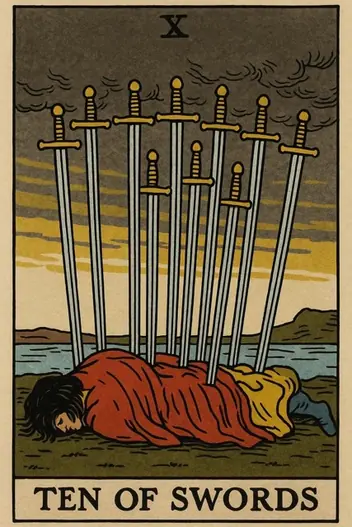
- Arcana
- The Star — Major Arcana; Ten of Swords — Minor Arcana, Swords
- Elements
- The Star — Air; Ten of Swords — Air
- Elemental interaction
- Same element — energies intensify each other
- Numerology
- 17 + 10 = 27 → 9
When The Star and Ten of Swords appear together in a reading, we witness a psychological paradox: the moment of greatest defeat coinciding with the seed of profound renewal. The Ten of Swords represents a final, often brutal ending—a mental or emotional breakdown where the seeker feels completely overwhelmed, betrayed, or pinned down by circumstances. The Star, by contrast, embodies hope, healing, and a quiet, enduring faith in the future.
Strategically, this combination signals that the worst is already over, even if the seeker is still lying on the battlefield. The emotional or professional crisis has reached its natural conclusion. The Star’s energy is not about denial of the pain but about applying a calm, analytical perspective to rebuild from the rubble. This is a time for pragmatic self-care, not impulsive action. The key insight is that true recovery begins only when you stop trying to salvage what is already dead.
The Star and Ten of Swords Together: Meaning
The psychological state created by The Star and Ten of Swords is one of post-traumatic clarity. The seeker has endured a mental or emotional “death” — perhaps a betrayal, a public failure, or the shattering of a core belief. The Ten of Swords brings the raw, unfiltered experience of hitting rock bottom. However, The Star introduces a crucial pivot: the ability to step back and observe the wreckage without being consumed by it.
This combination demands that you distinguish between pain that signals a necessary end and pain that is merely part of growth. The Star’s archetype is the wounded healer—someone who has been through the fire and now possesses a calm, almost detached wisdom. The practical implication is clear: stop re-litigating the past. The Ten of Swords shows a fixed, completed event. The Star shows a new horizon. Your task is not to understand why the defeat happened, but to use its lessons as a foundation for a more resilient strategy moving forward.
In real-world terms, this pairing often appears when a person is stuck in a loop of rumination, replaying the final blow. The Star offers a psychological escape hatch: accept the loss as a necessary sacrifice for a cleaner, more authentic path forward. The mindset required is that of a strategist who has lost a battle but knows the war is not over. Bold self-compassion is the bridge between the despair of the Ten and the hope of the Star.
Your pair is already on the table. Ask your question and draw the clarifying card
or simply focus on it
The Star and Ten of Swords in Career Readings
Strategic Opportunities:
Complete a clean exit from a toxic job, failing project, or partnership. The Ten of Swords shows that staying will only prolong the damage. Use this as a chance to reset your professional identity.
Strategic Opportunities:
Leverage your “rock bottom” experience as a credential. The Star suggests that your most valuable asset now is the calm wisdom gained from failure. Pitch yourself as someone who has learned hard lessons and is now resilient.
Calculated Risks:
Avoid any new venture that promises a quick fix or requires you to ignore recent red flags. The Star’s hope is long-term, not instant gratification. Do not invest in anything that feels like a desperate attempt to recoup losses.
Professionally, this combination is a strategic retreat, not a surrender. The Ten of Swords indicates a situation that is beyond salvage—perhaps a layoff, a business failure, or a public mistake. The Star advises you to focus on your core skills and long-term vision rather than trying to prove your worth in the same arena. This is a time for skill-building, networking with integrity, and creating a quiet, sustainable plan.
Important financial warning:
Do not take on debt to “fix” the situation. The Ten of Swords shows that the current structure is broken. Pouring money into it is like pouring water into a cracked vessel. Instead, cut losses ruthlessly. The Star’s energy is about conservation and renewal, not expansion. The most strategic move is to downsize, simplify, and rebuild from a position of strength. Financially, this means building an emergency fund and avoiding speculative gambles for at least three months.
Uncover hidden insights
Let our advanced Tarot system interpret these archetypes specifically for your personal path.
The Star and Ten of Swords Love Outcome
If you are single:
This combination suggests you are emerging from a painful breakup or disillusionment. Do not rush into a new connection to soothe the wound. Instead, use this period to evaluate what core values you need in a partner, as the Star represents authentic alignment, not rebound comfort.
If you are in a relationship:
A major betrayal, argument, or fundamental incompatibility has likely come to a head. This is not a time for patching things up. The Ten of Swords indicates a final, decisive break in the current dynamic. The Star offers the possibility of a new relationship—but only if both parties are willing to start from scratch, not repair the old.
The relationship dynamics here are stark. The Ten of Swords often represents a psychological "death" of the relationship as you knew it. This could be an affair revealed, a trust shattered, or a realization that you have fundamentally different life goals. The Star does not promise reconciliation; it promises healing through acceptance. The most emotionally intelligent move is to acknowledge the ending without blame. The Star’s energy is cool and clear—it sees the relationship’s limitations without bitterness.
Key relationship advice in bold:
Do not attempt to resurrect a dead dynamic. The Star’s hope is for a future self, not a return to the past. If you are single, focus on rebuilding your own sense of worth before offering it to someone new. If you are partnered, a clean break with mutual respect is far healthier than a drawn-out, painful negotiation. The Ten of Swords shows a completed cycle; the Star shows the beginning of a new one. Your next relationship will be based on truth, not fantasy.
The Shadow Side of The Star and Ten of Swords
The shadow manifestation of this combination is toxic optimism—using the Star’s hope to deny the reality of the Ten of Swords. The seeker may convince themselves that “everything happens for a reason” while failing to set necessary boundaries or take concrete action. This is a cognitive bias known as the Pollyanna principle, where the individual ignores critical data about the severity of the situation.
Another pitfall is premature trust. The Star’s openness can be weaponized by the seeker to rush into a new relationship, job, or project without due diligence. The Ten of Swords warns that the previous collapse was real and painful. Blindly trusting again without learning from the past is self-sabotage. The shadow side also includes self-pity or victimhood—using the Ten of Swords’ dramatic imagery to justify passivity or to manipulate others for sympathy. The Star’s healing cannot occur if the seeker refuses to put down the sword that stabbed them.
Finally, there is a risk of spiritual bypassing—using the Star’s hope as an excuse to avoid the gritty emotional work of grieving. True healing requires feeling the pain of the Ten of Swords fully, not skipping to the Star’s peace. The seeker must acknowledge the betrayal, failure, or loss before they can genuinely move on.
The Star and Ten of Swords Reversed Meaning
If The Star is Reversed:
The potential for healing is blocked. The person becomes stuck in trauma, refusing to see the light at the end of the tunnel. This is a state of chronic hopelessness, where the Ten of Swords is perceived not as an ending, but as an eternal curse. Advice: urgently seek psychotherapy — it is impossible to break this cycle on your own.
If the Ten of Swords is Reversed:
The crisis drags on. The person resists the knockout, clinging to a dying situation. This is not strength, but weakness manifesting as stubbornness. You are not allowing yourself to fall, even though falling is the only path to healing. Warning: your resistance only prolongs the agony. Allow yourself to lose, to make room for something new.
If BOTH are Reversed:
Complete imbalance: neither closure nor hope. The person is in a "gray zone" of endless suffering without catharsis. How to fix: a harsh external intervention is necessary — a change of residence, a complete severance of contacts, or hospitalization. This dynamic cannot be broken on your own.
The Star and Ten of Swords: Tarot Advice
Constructive use of this energy requires an iron discipline of the mind and a rejection of magical thinking. Your task is not to "make a wish upon the Star," but to use the clarity provided by the Ten of Swords for a fundamental restructuring of your value system. The practical algorithm: first, acknowledge your complete defeat within the old paradigm (Ten of Swords), then formulate one, absolutely concrete principle for your new life (The Star).
For example: "I completely failed in this business because of my need for control. My new principle is to delegate and trust the team." This principle becomes your "star," by which you check your course. The strategic advice: do not try to cover everything. Choose one area (health, finances, relationships) and conduct a complete "sanitization" within it. The rest will follow on its own.
The energy of the Star here is not passive waiting, but the active cultivation of inner silence. In this silence, you will hear not the voice of hope, but the voice of intuition, which will tell you: "This will not be repeated." It is this synthesis—the acceptance of an ending and the birth of a new principle—that gives you the key to emerging from the crisis not weakened, but reborn.
Applying This to Your Situation
The core message of The Star and Ten of Swords is that your greatest defeat is the gateway to your most authentic future. The pain is real, but it is also a completed chapter. Your next move is not to fight the past, but to build a new foundation on the truth of what you have learned. This combination demands courage to let go, and the wisdom to trust that healing is a process, not a single event.
The true magic happens when Tarot is applied to your unique situation. While this article provides the general archetype, your specific question—about a relationship, career, or personal crisis—deserves a personalized reading. Use the Fortune Cards app on the web or download it to get a deep, tailored interpretation of this exact combination for your specific question right now. Your story is unique; let the cards speak directly to it.
Interpretation by the Fortune Cards editorial team, based on the Rider–Waite tradition and Jungian archetypes. About our methodology · Updated: 2026-09-17
Other Combinations with The Star
Other Combinations with Ten of Swords
Explore Individual Card Meanings
Table of Contents
Ready to find answers to your questions?
Start your first reading now and look at your situation with fresh clarity. The cards are ready to reveal deeper meaning.