Temperance and Eight of Swords Meaning in Tarot
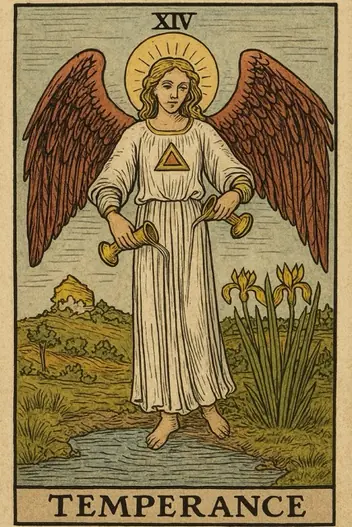

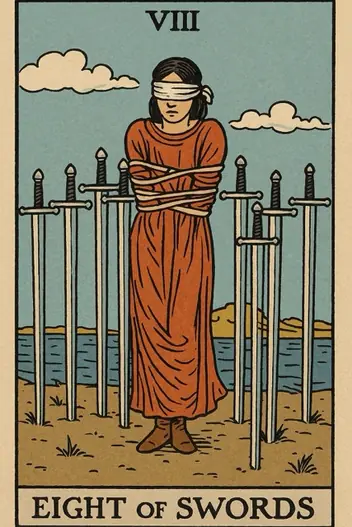
- Arcana
- Temperance — Major Arcana; Eight of Swords — Minor Arcana, Swords
- Elements
- Temperance — Fire; Eight of Swords — Air
- Elemental interaction
- Friendly elements — energies support each other
- Numerology
- 14 + 8 = 22 → 4
The collision of Temperance—the archetype of patience, integration, and the middle path—with the Eight of Swords—the symbol of self-imposed restriction, victimhood, and mental paralysis—creates a powerful psychological paradox. On the surface, one card suggests flow and equilibrium, while the other screams of being trapped. Yet, their union reveals a profound truth: your most oppressive mental bonds can only be loosened by the very discipline you feel you lack.
This combination often appears when a seeker is stuck in a cycle of overthinking, but the solution is not to "think harder." Instead, the path forward requires a pragmatic, step-by-step recalibration of your mindset and environment. The Eight of Swords represents the problem (cognitive distortion and helplessness), while Temperance is the method (measured action and emotional regulation). Together, they challenge you to stop fighting the cage and start adjusting the bars.
Temperance and Eight of Swords Together: Meaning
At the heart of this pairing is a battle between perception and reality. The Eight of Swords depicts a figure blindfolded and bound, surrounded by swords, yet standing on solid ground with water nearby—symbols of emotional depth and unconscious resources. The seeker feels powerless, but the bindings are often self-created. Temperance introduces the missing element: deliberate, conscious moderation. It insists that the way out is not a dramatic escape but a series of small, integrated adjustments.
Psychologically, this is the clash between catastrophic thinking (Eight of Swords) and cognitive flexibility (Temperance). The seeker may be trapped by rigid rules they’ve internalized: "I must be perfect," "I cannot make mistakes," or "I have no options." Temperance counters this by asking: What if you could blend two opposing ideas? For example, "I can feel fear and still take one small step forward." The key insight here is that the solution is not to eliminate fear, but to integrate it with action. This requires a shift from a black-and-white mindset to a nuanced, process-oriented approach.
In practical terms, this combination advises a slow, methodical deconstruction of the problem. Instead of trying to solve everything at once, break the "swords" (limiting beliefs) into manageable pieces. Temperance’s alchemical energy suggests that what feels like a dead end is actually a transformation point—if you can resist the urge to panic or force a resolution. The core dynamic is one of self-rescue through self-regulation.
Your pair is already on the table. Ask your question and draw the clarifying card
or simply focus on it
Temperance and Eight of Swords Love Outcome
If you are single:
This pairing suggests you may be idealizing potential partners or catastrophizing about rejection. The advice is to moderate your expectations by treating each interaction as a data point, not a verdict on your worth.
If you are in a relationship:
You or your partner may be withholding communication out of fear of conflict, creating a silent prison of assumptions. The path forward is structured, calm dialogue about boundaries and needs.
In relationships, the Temperance and Eight of Swords combination often reveals a dynamic of emotional over-control. One partner may feel trapped by the other’s unspoken rules or by their own fear of rocking the boat. The blindfold in the Eight of Swords is a metaphor for willful ignorance of the relationship’s true state. The most important relationship advice here is to stop guessing and start negotiating. Temperance calls for a balanced, give-and-take approach: schedule a time to discuss grievances without blame, and practice active listening to dismantle assumptions. For couples, this is a sign to create a "safe word" for when conversations become emotionally charged, allowing both partners to step back and recalibrate. For singles, it warns against self-sabotage through overanalysis—stop deciding someone isn’t right for you before you’ve had a real conversation.
Temperance and Eight of Swords for Career and Money
Strategic Opportunities:
Use a "triage" system to prioritize tasks, focusing on what you can control rather than what feels overwhelming.
Strategic Opportunities:
Leverage mentorship or collaboration to gain perspective on a problem you’ve been overthinking alone.
Calculated Risks:
Avoid making major financial decisions while feeling trapped or desperate. Wait for clarity before investing or quitting.
In your professional life, this combination often signals analysis paralysis disguised as due diligence. You may be stuck on a project, unable to move forward because you’re trapped by "what if" scenarios. The key strategic tip is to impose strict time limits on decision-making. For example, give yourself 48 hours to gather data, then commit to a course of action, even if imperfect. Temperance’s energy is about blending efficiency with patience—don’t rush, but don’t stall. Financially, beware of "all-or-nothing" thinking that leads to either reckless spending or hoarding. Instead, adopt a balanced budget that allows for both saving and small, calculated investments. The Eight of Swords warns that your biggest obstacle is the story you tell yourself about your lack of options—challenge that narrative by listing three concrete, achievable steps you can take this week.
Your unique Tarot reading
See how these cards interact with your destiny. Start a free personal reading now.
When Temperance and Eight of Swords Signal Trouble
When this energy is blocked or misapplied, the shadow manifests as passive-aggressive control or fatalistic resignation. The seeker may use "patience" (Temperance’s shadow) as an excuse for inaction, convincing themselves that waiting is wisdom when it’s really avoidance. Alternatively, the Eight of Swords’ victim mentality can morph into blaming external circumstances while refusing to see their own role in creating the trap. A common cognitive bias here is the "illusion of transparency"—believing others can read your mind, which prevents you from communicating your needs. The greatest pitfall is mistaking emotional numbness for balance. True Temperance requires feeling the discomfort of the Eight of Swords, not suppressing it. If you find yourself saying "I’ll just go with the flow" while feeling increasingly stuck, you’ve fallen into the shadow trap. The antidote is radical honesty with yourself about what you’re avoiding.
Temperance and Eight of Swords Reversed Meaning
Temperance Reversed:
This is imbalance and recklessness. The energy of Temperance is blocked, and you lose your sense of proportion. Instead of patiently seeking a way out of the Eight of Swords trap, you start to twitch and make chaotic moves that only worsen the situation. Advice: Consciously slow down. Refrain from any decisions for 24 hours. Your "flow" is currently more like a tsunami than a river.
Eight of Swords Reversed:
This is inner resistance to the truth. You have almost freed yourself from illusions, but subconsciously you cling to the victim role. You see the way out but are afraid to take the step. Warning: This state is more dangerous than the direct trap because here you are consciously choosing suffering. You need an honest admission: "I know what to do, but I am afraid."
Both Reversed:
Total imbalance. You are simultaneously in chaos (Temperance Reversed) and in denial of the way out (Eight of Swords Reversed). This is an emotional storm with zero visibility. The logical way to correct this is to return to basics. Disconnect all external stimuli, turn off your phone, spend the day in silence. Only a complete disconnection from the "noise" will allow you to hear your inner voice and find equilibrium.
Temperance and Eight of Swords: The Combined Message
Constructive use of this combination requires strategic passivity from you. The energy of Temperance is not inaction, but active patience. Your task is to take control not of external circumstances, but of your internal narrative. The Eight of Swords says: "You are trapped." Temperance replies: "The trap is in your head. Let's dismantle it brick by brick."
To break free from this dynamic, you need to develop a plan for cognitive defusion. Start with a simple exercise: every time you catch yourself thinking "I can't," add the word "yet." "I can't quit my job — yet." "I can't fix the relationship — yet." This small word is Temperance's tool that breaks the rigid chain of the Eight of Swords.
Your strategic advice is to apply the "one percent principle." Don't try to solve the entire problem. Find one small, safe step you can take today to improve the situation by 1%. It could be one phone call, one email, or one walk. Temperance will grant you the wisdom to see this step, and the Eight of Swords, stripped of its absolute power, will become merely a reminder that you are no longer a victim.
Your Next Step: Personal Context Matters
The Temperance and Eight of Swords combination is a call to stop fighting your own mind and start managing it with precision. The core message is that your prison is real, but the keys are in your hand—you just need to slow down, breathe, and pick them up one at a time. This is not about dramatic transformation, but about small, consistent acts of self-liberation.
While this article provides the general archetype, the true magic happens when Tarot is applied to your unique situation. To get a deep, personalized interpretation of this exact combination for your specific question right now, use the Fortune Cards app. Whether on the web or downloaded, it offers tailored insights that cut through the noise and give you a clear, actionable path forward.
Interpretation by the Fortune Cards editorial team, based on the Rider–Waite tradition and Jungian archetypes. About our methodology · Updated: 2026-08-26
Other Combinations with Temperance
Other Combinations with Eight of Swords
Explore Individual Card Meanings
Table of Contents
- Temperance and Eight of Swords Together: Meaning
- Temperance and Eight of Swords Love Outcome
- Temperance and Eight of Swords for Career and Money
- When Temperance and Eight of Swords Signal Trouble
- Temperance and Eight of Swords Reversed Meaning
- Temperance and Eight of Swords: The Combined Message
- Your Next Step: Personal Context Matters
Ready to find answers to your questions?
Start your first reading now and look at your situation with fresh clarity. The cards are ready to reveal deeper meaning.