Ten of Swords and King of Pentacles Together in Tarot

- Arcana
- Ten of Swords — Minor Arcana, Swords; King of Pentacles — Minor Arcana, Pentacles
- Elements
- Ten of Swords — Air; King of Pentacles — Earth
- Elemental interaction
- Opposing elements — energies create tension
- Numerology
- 10 + 14 = 24 → 6
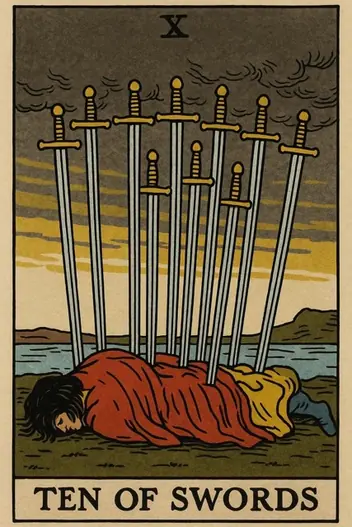
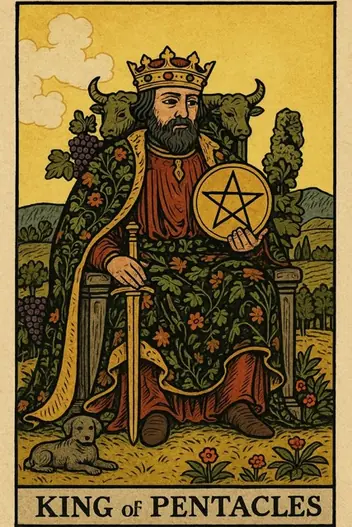
When the Ten of Swords—the archetype of catastrophic endings, betrayal, and mental defeat—collides with the King of Pentacles—the stoic master of material security, slow growth, and pragmatic authority—we witness a profound psychological pivot. This is not a comfortable pairing. It is the moment when a devastating loss meets an unyielding will to rebuild.
The Ten of Swords represents the culmination of a painful mental cycle: a betrayal of trust, a failed project, or a sudden collapse of a belief system. The King of Pentacles, by contrast, embodies the disciplined patience of a builder who measures twice and cuts once. Together, they suggest a scenario where you are forced to accept a complete defeat in one area of life, only to discover that this very ruin provides the raw material for a more grounded, sustainable success. The key insight here is turning a psychological death into a strategic pivot.
What Do Ten of Swords and King of Pentacles Mean Together?
The core dynamic of this pairing is the transition from catastrophic thinking to calculated action. The Ten of Swords often leaves the seeker paralyzed by narratives of victimhood or shame. The King of Pentacles intervenes not with emotional comfort, but with a cold, practical question: "What assets remain? What can I salvage?" This combination demands that you separate objective reality from subjective despair. While your mind may scream "This is the end," the King of Pentacles reminds you that endings are simply the cost of entry for new, more stable structures.
Psychologically, this represents a Jungian integration of the Shadow of defeat. The Ten of Swords is the shadow of the King's success—the fear that all your efforts will fail. By consciously facing this fear, you can transform it into a risk-management tool. The King does not deny the loss; he audits it. He looks at the broken swords on the ground and asks: "Which pieces can be reforged into tools?" This is not about toxic positivity. It is about resourceful realism.
In practical terms, this card pair often appears when you have hit a professional or relational rock bottom, but possess the experience, resources, or reputation (the King's domain) to pivot effectively. The advice is clear: do not waste energy fighting the ending. Instead, inventory your remaining capital—financial, social, emotional—and begin a slow, methodical reconstruction. The pain is real, but it is data, not destiny.
Your pair is already on the table. Ask your question and draw the clarifying card
or simply focus on it
What Do Ten of Swords and King of Pentacles Say About Love?
If you are single:
This pairing suggests you may be carrying the emotional weight of a past betrayal (Ten of Swords) that prevents you from seeing a stable, grounded potential partner (King of Pentacles). Focus on building trust through consistent actions, not dramatic declarations.
If you are in a relationship:
You are likely navigating a major rupture—an infidelity, a financial crisis, or a profound disagreement about values. The King of Pentacles calls for structured, calm negotiations rather than emotional flooding.
In relationships, the Ten of Swords and King of Pentacles combination signals a crisis of reliability. One partner may feel stabbed in the back by a broken promise or hidden debt. The other may feel unfairly blamed for a pragmatic decision. The psychological work here is to move from blame to accountability. The King of Pentacles does not apologize for his boundaries; he explains them clearly. Bold, honest conversations about money, commitment, and long-term goals are non-negotiable. If the relationship is to survive, both partners must agree to a slow, boring rebuild—weekly check-ins, transparent budgets, and a shared plan for the next 12 months. The Ten of Swords warns that without this structure, resentment will fester. The King promises that with it, trust can be rebuilt, albeit scarred.
Deepen your understanding
Find out exactly what this reading means for your current life situation with our oracle.
Career and Finances
Strategic Opportunities:
Leverage your network and reputation. The King of Pentacles suggests you have hidden assets—contacts, savings, or expertise—that can be redeployed after a professional loss (a layoff, a failed launch, a toxic job ending).
Strategic Opportunities:
Focus on high-margin, low-risk ventures. After a crisis, this card pair favors conservative moves: consulting, part-time work, or a pivot within your current industry rather than a radical change.
Calculated Risks:
Avoid the temptation to "win it all back" quickly. The Ten of Swords warns that impulsive decisions born from shame or desperation will lead to a second failure. The King advises patience over pride.
For career and finances, this is a post-mortem analysis card. The Ten of Swords represents a project or job that has definitively ended. The King of Pentacles asks you to audit what went wrong without self-flagellation. Was it poor planning? Over-reliance on one client? Ignoring market signals? The psychological trap is to view this failure as a permanent stain on your competence. Instead, treat it as valuable market research. Bold financial advice: Do not make any major investment or career change for at least 90 days. Use this time to stabilize your cash flow, update your resume, and have low-stakes conversations with former colleagues. The King of Pentacles builds wealth through compounding small, correct decisions, not through heroic gambles.
Ten of Swords and King of Pentacles: Warning Signs
The shadow side of this combination is the danger of emotional suppression. The King of Pentacles, when unhealthy, can become a cold, controlling figure who dismisses the legitimate grief of the Ten of Swords. This leads to a brittle resilience—you appear strong on the outside but are internally disconnected from your feelings. The cognitive bias at play is "sunk cost fallacy": you may hold onto a failing relationship or business because the King's pride cannot accept the loss. Alternatively, the Ten of Swords shadow can manifest as learned helplessness—using the past betrayal as an excuse to avoid any risk or commitment. The worst outcome is a cycle: you endure a painful ending, refuse to process it, then repeat the same pattern with a new partner or project. To avoid this, schedule time for emotional reflection (journaling, therapy) alongside your practical planning. The King must learn to grieve, and the Swords must learn to stop.
Reversed Ten of Swords and King of Pentacles Explained
When cards appear reversed, the dynamic is distorted, but not eliminated.
If the Ten of Swords is reversed:
This indicates a blocked crisis. You refuse to acknowledge the end, clinging to an illusion. Instead of a cleansing collapse, you get a prolonged agony. Advice: Find the courage to end what no longer works. Inaction here is more dangerous than any decision.
If the King of Pentacles is reversed:
An internal resistance to maturity manifests. The person either displays greed and tyranny, or, conversely, becomes irresponsible and wasteful. Warning: Your "stability" is a fragile house of cards built on a denial of reality.
If BOTH are reversed:
Complete imbalance. The person experiences a crisis but fails to learn from it, while simultaneously losing control over resources. Method of correction: A pause is necessary. Step back from your affairs, acknowledge your powerlessness before the chaos, and start from scratch, from the most basic principles of life management.
What Is the Overall Message of Ten of Swords and King of Pentacles?
The core lesson of this card pair is that destruction is not the enemy of stability. On the contrary, it is its necessary precursor. The Ten of Swords tears down the dilapidated structures of your personality or business, while the King of Pentacles offers blueprints for a new, enduring edifice. Key strategy: harness the energy of the crisis to reassess your values. Ask yourself: "What from my past experience truly deserves to be preserved, and what was merely a facade?"
Strategic advice:
do not try to simply "endure" the pain. Move through it consciously. Every defeat is a price paid for knowledge. The King of Pentacles in this combination is not one who avoided the blow, but one who survived and grew wiser. Clarity for decision-making arrives when you stop fearing loss. Accept that something must end to free up resources for the new. Your task is not to save a sinking ship, but to build a new one that can weather any storm.
Your Next Step: Personal Context Matters
The Ten of Swords and King of Pentacles is a stark, powerful combination. Its core message is: accept the ending, audit your assets, and rebuild with discipline. This is not a time for magical thinking or dramatic gestures. It is a time for quiet, methodical work. The pain will not vanish, but it can become the foundation of a more grounded version of yourself.
Want to know exactly how this plays out for your specific situation? The Fortune Cards app uses advanced AI to analyze your unique question and life context, delivering a personalized interpretation of this card pair in seconds. Whether you're on the web or mobile, you can get a deep, nuanced reading that goes beyond generic meanings. Download Fortune Cards now and discover the strategic path forward from your current crisis.
Interpretation by the Fortune Cards editorial team, based on the Rider–Waite tradition and Jungian archetypes. About our methodology · Updated: 2026-08-26
Other Combinations with Ten of Swords
Other Combinations with King of Pentacles
Explore Individual Card Meanings
Table of Contents
- What Do Ten of Swords and King of Pentacles Mean Together?
- What Do Ten of Swords and King of Pentacles Say About Love?
- Career and Finances
- Ten of Swords and King of Pentacles: Warning Signs
- Reversed Ten of Swords and King of Pentacles Explained
- What Is the Overall Message of Ten of Swords and King of Pentacles?
- Your Next Step: Personal Context Matters
Ready to find answers to your questions?
Start your first reading now and look at your situation with fresh clarity. The cards are ready to reveal deeper meaning.