Ten of Swords and Queen of Swords Tarot as Feelings
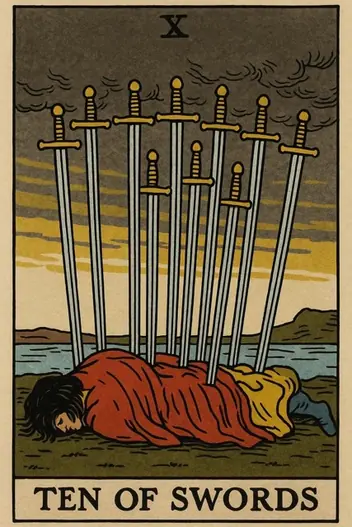

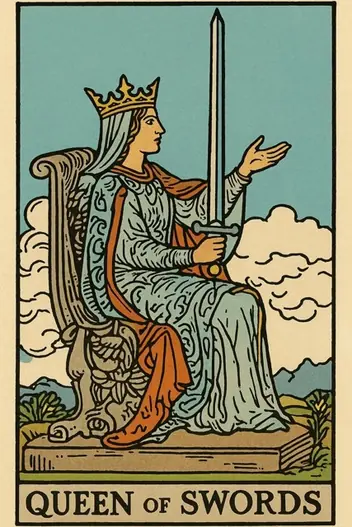
- Arcana
- Ten of Swords — Minor Arcana, Swords; Queen of Swords — Minor Arcana, Swords
- Elements
- Ten of Swords — Air; Queen of Swords — Air
- Elemental interaction
- Same element — energies intensify each other
- Numerology
- 10 + 13 = 23 → 5
This pairing represents the psychological intersection of catastrophic closure and intellectual detachment. The Ten of Swords marks a moment where a painful cycle—often involving betrayal, failure, or harsh endings—has reached its absolute limit. The Queen of Swords arrives not to offer comfort, but to demand clarity. She is the archetype of reasoned analysis, cutting through emotional debris with surgical precision. When these cards collide, the core message is: The wound is real, but the interpretation is yours to control.
The tension here lies between raw experience and cognitive processing. The Ten of Swords leaves you pinned to the ground by circumstance; the Queen of Swords forces you to examine the knife handles rather than the pain. This combination is not about healing—it is about extracting objective lessons from subjective suffering. Pragmatically, it signals a time to stop grieving and start strategizing.
What Do Ten of Swords and Queen of Swords Mean Together?
The psychological state created by this merger is one of defensive clarity. The Ten of Swords represents the subconscious mind’s need to fully complete a trauma cycle—often through a sudden, dramatic low point. The Queen of Swords, however, brings the conscious ego’s demand for rational control. Together, they create a dynamic where you cannot afford to wallow. The energy pushes you to separate what happened from what you made it mean.
In real-world terms, this card pair often appears when someone is processing a major professional failure, a painful breakup, or a betrayal that shattered trust. The key insight is that the Queen of Swords prevents the Ten of Swords from becoming a permanent identity. Instead of “I am a victim,” the energy shifts to “I now know exactly what went wrong.” This is the difference between chronic rumination and actionable insight.
The practical implication is a mandate to document the lesson without reliving the pain. If a relationship ended, the Queen of Swords demands you analyze the communication breakdowns. If a business failed, she asks you to scrutinize the financial decisions. The goal is not emotional numbness, but strategic objectivity. This combination warns against the cognitive bias of catastrophizing—where you generalize one ending into a belief that all future efforts will fail.
Your pair is already on the table. Ask your question and draw the clarifying card
or simply focus on it
Ten of Swords and Queen of Swords in Love Tarot
If you are single:
This combination suggests you are emerging from a painful romantic disappointment, but must be cautious about carrying defensive skepticism into new connections. Your judgment is sharp, but your heart may be unreachable.
If you are in a relationship:
You or your partner may be processing a breach of trust or a harsh truth. The dynamic requires direct, unemotional communication to prevent a cold détente from becoming permanent distance.
In relationships, this pairing often signals a post-crisis power shift. The Ten of Swords indicates that a specific event—an affair, a harsh argument, a major disappointment—has fundamentally altered the relationship’s foundation. The Queen of Swords then dictates the response: intellectual distance as a protective mechanism. The risk is that one partner becomes overly analytical, reducing the other to a case study of flaws rather than a human being. The key relationship advice is to use clarity for boundary-setting, not for punishment.
If you are single, this card pair warns against over-analyzing past rejections. You may have a tendency to create rigid rules for future partners based on one bad experience. Pragmatically, the Queen of Swords encourages you to date with your eyes open, but not with a checklist of suspicion. Channel the energy into identifying non-negotiables rather than red flags.
What Do Ten of Swords and Queen of Swords Indicate for Your Career?
Strategic Opportunities:
Conduct a post-mortem analysis of a recent failure or setback. Document what you would do differently. This information is your most valuable asset.
Strategic Opportunities:
Re-negotiate terms from a position of detached clarity. If a contract or partnership ended poorly, use the lesson to tighten future agreements.
Calculated Risks:
Avoid making major financial decisions while still processing the emotional impact of the loss. The Queen of Swords’ logic is sharp, but it can be hijacked by fear if the Ten of Swords wound is fresh.
Professionally, this combination is a strategic reset. The Ten of Swords may represent a layoff, a failed project, or a public mistake. The Queen of Swords demands you own the data without owning the shame. Pragmatically, this is the time to update your resume, analyze market trends, or seek feedback from a mentor you trust to be brutally honest. A critical financial warning: do not leap into a new venture purely to escape the memory of failure. The Queen of Swords advises patience until you have a clear, cold-eyed plan.
In negotiations or team dynamics, this pairing signals you must lead with logic, not emotion. If you are dealing with a difficult colleague or client, the Ten of Swords suggests a previous interaction reached a breaking point. The Queen of Swords advises you to present your case with evidence and clear outcomes, without apologizing for the past. This is not about winning a fight; it is about establishing new, enforceable boundaries.
Ask your specific question
Don't rely on generic meanings. Get a customized reading tailored specifically to your energies.
What Are the Risks of Ten of Swords and Queen of Swords?
The shadow manifestation of this combination is emotional disconnection masquerading as wisdom. When the Queen of Swords energy is blocked or distorted, it turns into cold cynicism. You may use intellectual analysis to avoid feeling the legitimate grief of the Ten of Swords. This creates a cognitive bias of hyper-rationality, where you dismiss your own pain as “irrelevant” and refuse to process it.
Another pitfall is self-sabotage through perfectionism. The Queen of Swords’ high standards, when combined with the Ten of Swords’ narrative of failure, can lead to a belief that you are fundamentally flawed rather than someone who made a mistake. This distorts into a fixed mindset: “I failed because I am not smart enough,” rather than “I failed because I missed a key variable.” Poor judgment here manifests as cutting off relationships or opportunities prematurely, believing you have already seen the worst outcome.
Finally, be wary of projecting the Ten of Swords onto others. This pairing can tempt you to deliver harsh truths without empathy, treating others as problems to be solved. The Queen of Swords’ shadow is a verbal scalpel used to wound, not to dissect. The red flag is when your analysis feels like revenge.
Reversed Ten of Swords and Queen of Swords Explained
Ten of Swords Reversed:
Blocked potential and refusal of the ending. You are stuck in a cycle of suffering, not allowing yourself to complete the process. The Queen of Swords in this context becomes the voice you are ignoring. Advice: acknowledge the inevitability of the end — resistance only prolongs the pain. You need to deliberately provoke a crisis to break the deadlock.
Queen of Swords Reversed:
Internal resistance to clarity. You refuse to see the obvious facts, replacing analysis with emotional reactions or self-deception. The Ten of Swords here may indicate self-sabotage through impulsive decisions. Warning: do not make important decisions in a state of resentment or panic — give yourself time to "cool down" your mind.
Both Reversed:
Complete imbalance of dynamics. This points to chaotic destruction without strategy or, conversely, to a paralyzing fear of any change. Method for correction: start small — write down three objective facts about your situation and accept them without judgment. Regain control through structure: create a 24-hour action plan based solely on logic, ignoring emotional "noise."
Synthesis: Strategic Conclusion
Constructive use of the Ten of Swords energy in tandem with the Queen of Swords requires understanding one key truth: catastrophe is not the end of the road, but the end of the map you were following. Your task is not to deny the destruction, but to use it as a blank slate for a new strategic plan. The Ten of Swords grants you permission to release the past without guilt, while the Queen of Swords provides the tools to build a future on a solid foundation of facts.
Strategically, this union teaches governance through the acceptance of loss. Instead of wasting energy on regret, channel it into analysis: which specific decisions led to the crisis? Which thought patterns proved erroneous? Your strength lies in the ability to transform the experience of defeat into a database for future victories.
A deep strategic counsel:
do not be afraid to be "harsh" with yourself and others during this period. Establish inviolable boundaries that will protect you from repeating mistakes. Remember: the Queen of Swords does not forgive weakness, but neither does she demand cruelty. She demands honesty. Accept the fact that some doors are closed forever, and focus on building new ones—with a stronger foundation and a clearer blueprint.
Applying This to Your Situation
The core message of Ten of Swords and Queen of Swords is clear: you are at a strategic pivot point where emotional closure must meet intellectual action. The pain is real, but it is not the final chapter. Your next step is to use the lesson as a tool, not as a weight. The specific application—whether in love, career, or self-growth—depends entirely on your unique situation.
While this article provides the general archetype, the true magic happens when Tarot is applied to your personal context. The Fortune Cards app allows you to input your exact question—about a specific relationship, a career decision, or a personal block—and receive a deep, personalized interpretation of this exact combination. You can use it on the web or download it to get the clarity you need, right now.
Interpretation by the Fortune Cards editorial team, based on the Rider–Waite tradition and Jungian archetypes. About our methodology · Updated: 2026-08-26
Other Combinations with Ten of Swords
Other Combinations with Queen of Swords
Explore Individual Card Meanings
Table of Contents
- What Do Ten of Swords and Queen of Swords Mean Together?
- Ten of Swords and Queen of Swords in Love Tarot
- What Do Ten of Swords and Queen of Swords Indicate for Your Career?
- What Are the Risks of Ten of Swords and Queen of Swords?
- Reversed Ten of Swords and Queen of Swords Explained
- Synthesis: Strategic Conclusion
- Applying This to Your Situation
Ready to find answers to your questions?
Start your first reading now and look at your situation with fresh clarity. The cards are ready to reveal deeper meaning.