Three of Swords and Five of Pentacles Together in Tarot

- Arcana
- Three of Swords — Minor Arcana, Swords; Five of Pentacles — Minor Arcana, Pentacles
- Elements
- Three of Swords — Air; Five of Pentacles — Earth
- Elemental interaction
- Opposing elements — energies create tension
- Numerology
- 3 + 5 = 8
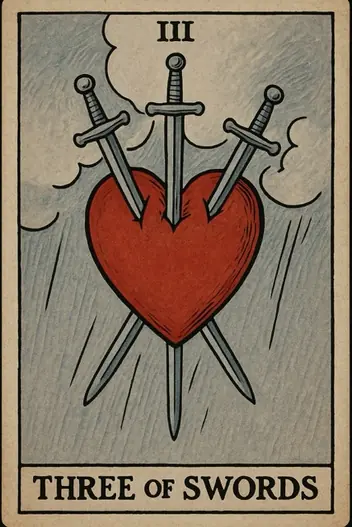
When the Three of Swords—the card of heartbreak, betrayal, and piercing truth—collides with the Five of Pentacles—the archetype of material lack, social exclusion, and spiritual desolation—the result is a psychological state of compounded vulnerability. This is not a gentle pairing. It represents a moment where emotional wounds are directly tied to tangible losses: a breakup that costs you your home, a career failure that shatters your self-worth, or a period of deep loneliness where both your bank account and your support network feel empty.
In Jungian terms, this combination activates the Wounded Healer and the Orphan archetypes. The seeker is forced to confront a reality where their pain is not just internal—it has material consequences. The key insight here is that this is a crisis of both meaning and resources. The mind (Swords) and the body/finances (Pentacles) are signaling the same urgent message: something fundamental must change. The danger lies in catastrophizing—assuming that because one area is broken, all areas are lost. The strategic opportunity is to recognize that acknowledging the full scope of the problem is the first step toward a realistic, non-magical solution.
Core Dynamics & Interpretation
The core psychological dynamic is learned helplessness meets acute grief. The Three of Swords represents a sudden, sharp pain—a truth or betrayal that cuts deep. The Five of Pentacles represents a chronic, grinding sense of lack—the slow erosion of security. Together, they create a feedback loop: emotional pain impairs your ability to manage resources, and resource scarcity amplifies your emotional pain. This is the classic "downward spiral" pattern, where a single setback (a job loss, a divorce) snowballs into a full-blown life crisis if not interrupted.
From a cognitive-behavioral perspective, this pairing highlights confirmation bias in action. The seeker may interpret every neutral event as further proof that they are "unlovable" or "doomed to fail." The Five of Pentacles reinforces the Three of Swords' narrative of isolation—the belief that "I am alone in my suffering." The pragmatic truth is that this combination often appears when a person has been ignoring a slow-burn problem (Five of Pentacles) until a sudden event (Three of Swords) forces them to see it. The psychological task is to separate the event from the story you tell yourself about it. You can feel heartbroken and still manage your budget. You can experience loss and still reach out for help.
Your pair is already on the table. Ask your question and draw the clarifying card
or simply focus on it
What Do Three of Swords and Five of Pentacles Say About Love?
If you are single:
This pairing warns against seeking a relationship to "rescue" you from financial or emotional hardship. A new partner cannot fix a broken foundation. It suggests you may be attracting or attracted to unavailable, critical, or emotionally distant individuals who mirror your own fear of intimacy.
If you are in a relationship:
The combination signals a crisis of trust and security. One partner may feel emotionally betrayed while the other feels financially burdened. The relationship is being tested by external pressures (money, health, family) that reveal internal fractures.
In a relationship context, the Three of Swords and Five of Pentacles together often represent a period of painful honesty about the practical foundations of the partnership. This is not about simple romantic disagreements; it is about whether the relationship can survive a real-world crisis. The emotional pain (Three of Swords) may stem from feeling unsupported or betrayed by a partner who is struggling with their own scarcity mindset (Five of Pentacles). The key is to avoid weaponizing your pain. One partner may use their suffering to guilt the other, while the other may use financial difficulties as an excuse for emotional withdrawal. Healthy conflict resolution here requires both partners to name their specific, non-negotiable needs: "I need to feel safe sharing my feelings" (Three of Swords work) and "I need us to create a realistic budget together" (Five of Pentacles work). If you are single, this combination is a strong signal to stop looking for validation in others and instead address your own internal sense of lack first.
Ask your specific question
Don't rely on generic meanings. Get a customized reading tailored specifically to your energies.
What Do Three of Swords and Five of Pentacles Indicate for Your Career?
Strategic Opportunities:
Audit your losses objectively. List exactly what you lost, what you still have, and what is recoverable. This turns emotional pain into actionable data.
Strategic Opportunities:
Leverage the pain as a filter. A job or project that makes you feel this combination is not a "test"—it is a sign to pivot. Use the clarity of the Three of Swords to cut ties with toxic environments.
Calculated Risks:
Do not make major financial decisions while in acute emotional distress. The risk of "fleeing" a job without a plan or "cutting losses" too early is high. Delay any irreversible moves by 72 hours.
In a career context, this is a red flag for burnout, exploitation, or a toxic workplace culture. The Three of Swords may represent a specific betrayal—a colleague taking credit, a layoff, a harsh performance review. The Five of Pentacles suggests the underlying problem is systemic undervaluation: you are not being paid what you are worth, or your skills are not being utilized. Financially, this combination warns against "survival mode" thinking. The scarcity mindset (Five of Pentacles) can make you cling to a job or client that is actively harming you (Three of Swords), because you fear having nothing. The strategic move is to treat this as a wake-up call to renegotiate your value. Update your resume, research market rates, and consider whether your current role is a stepping stone or a dead end. Do not confuse loyalty with obligation. If the pain of staying outweighs the fear of leaving, it is time to plan an exit.
Reversed Three of Swords and Five of Pentacles Explained
When the Three of Swords is reversed, acute pain transforms into protracted, viscous suffering. It is a state of "stagnation" within trauma, where a person refuses to let go of the past. In combination with the upright Five of Pentacles, this creates a paradox: the person has resources but refuses to use them, preferring the role of the "eternal sufferer." Advice: stop ruminating on the past—it blocks the flow of money and opportunities.
If the Five of Pentacles is reversed, it points to a denial of material problems. The person lives beyond their means, ignoring debts and risks, trying to "fill" the inner void (Three of Swords) with external glitter. Warning: this is a dangerous illusion. Recovery will only begin with an honest inventory of your finances.
When BOTH cards are reversed, the situation becomes paradoxical. The pain is denied ("everything is fine"), and the deficit is ignored. This is a complete imbalance, leading to psychosomatic issues and sharp crises. The logical way to correct it: urgent contact with reality. Start keeping a journal of facts (income, expenses, events), excluding emotional evaluations. Only dry analysis will break this cycle of self-deception.
Three of Swords and Five of Pentacles: Warning Signs
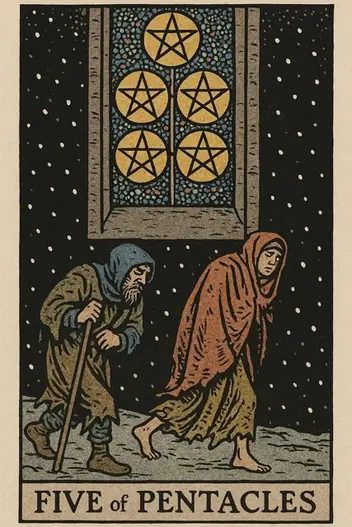
The shadow of this combination is victimhood as a strategy. The seeker may unconsciously need the pain and scarcity to feel justified in their inaction. This is a form of secondary gain—the emotional payoff of being "the one who suffered." The cognitive bias at play is the just-world hypothesis: the belief that if you suffer enough, you will eventually be rewarded. This pairing shatters that illusion. The shadow also manifests as hoarding—clinging to resources (money, time, energy) out of fear, which only deepens the isolation. Another pitfall is emotional masochism: replaying the painful memory (Three of Swords) to avoid the harder work of rebuilding (Five of Pentacles). Beware of using your pain as an excuse to refuse help. The Five of Pentacles shows two figures outside a church—help is available, but only if you are willing to ask for it. The shadow refuses to ask, preferring the comfort of familiar suffering.
Three of Swords and Five of Pentacles Combined Message
How to constructively utilize the energy of this pair? The Three of Swords is a surgical instrument that cuts toxic illusions out of your life. The Five of Pentacles is an indicator of genuine deficit. Your task is to use the pain of the first card as motivation for a pragmatic audit of the second.
Strategic advice: act by contraries. The paradox of this combination is that it points to the path of least resistance. The Three of Swords says: "You fear being betrayed." The Five of Pentacles replies: "You have already isolated yourself." The solution lies at the intersection: vulnerability must become your resource. Share your pain (Three of Swords) with someone who can provide real support (the antidote to the Five of Pentacles), not with someone who will merely pity you.
In financial terms, the energy of this pair demands a "minimum guarantee" strategy. Do not try to earn a lot quickly. Focus on building a 3-6 month safety net. This will reduce the existential anxiety of the Five of Pentacles and create space for healing from the trauma of the Three of Swords. The main takeaway: you are not obligated to go through this crisis alone. Acknowledging your vulnerability is not weakness, but the first step toward restoring your resources.
Your Next Step: Personal Context Matters
The core message of the Three of Swords and Five of Pentacles is this: your pain is real, but it is not the whole story. The combination demands that you stop separating your emotional life from your practical life. Healing your heart will require concrete action—budgeting, networking, setting boundaries. And managing your resources will require emotional honesty—naming what hurts and why. This is not a time for magical thinking; it is a time for methodical recovery.
While this article provides a detailed map of the archetypes, the true power of Tarot lies in its application to your specific situation. The Fortune Cards app allows you to input your exact question—about a relationship, a job, a financial decision—and receive a personalized interpretation of this card combination in real-time. You can use it on the web or download it to get a deep, tailored reading that accounts for your unique context, your other cards, and the specific dynamics at play. Stop guessing—start understanding.
Interpretation by the Fortune Cards editorial team, based on the Rider–Waite tradition and Jungian archetypes. About our methodology · Updated: 2026-08-26
Other Combinations with Three of Swords
Other Combinations with Five of Pentacles
Explore Individual Card Meanings
Table of Contents
- Core Dynamics & Interpretation
- What Do Three of Swords and Five of Pentacles Say About Love?
- What Do Three of Swords and Five of Pentacles Indicate for Your Career?
- Reversed Three of Swords and Five of Pentacles Explained
- Three of Swords and Five of Pentacles: Warning Signs
- Three of Swords and Five of Pentacles Combined Message
- Your Next Step: Personal Context Matters
Ready to find answers to your questions?
Start your first reading now and look at your situation with fresh clarity. The cards are ready to reveal deeper meaning.