Death and Ten of Swords Reversed in Tarot
- Arcana
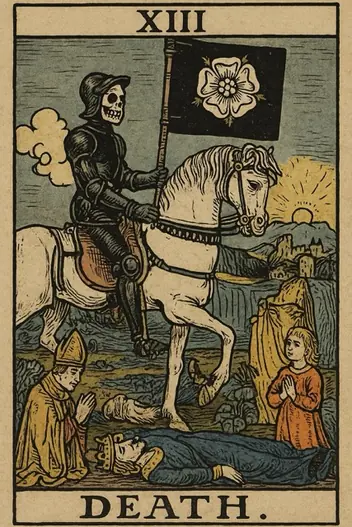
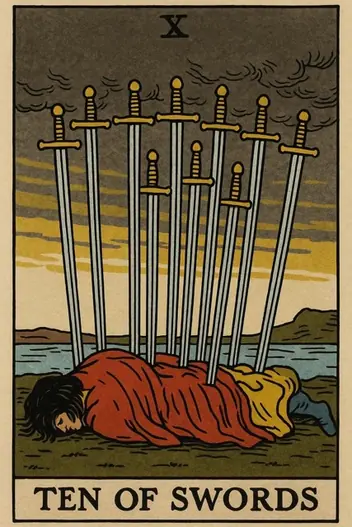
- Death — Major Arcana; Ten of Swords — Minor Arcana, Swords
- Elements
- Death — Water; Ten of Swords — Air
- Elemental interaction
- Neutral elements — energies coexist without conflict
- Numerology
- 13 + 10 = 23 → 5
When the Death card—a symbol of radical transformation and inevitable endings—collides with the Ten of Swords—the final, catastrophic defeat of the mind—the result is a profound psychological reset. This is not a card pair for the faint of heart. It represents the moment when a painful reality becomes so undeniable that denial is no longer an option. The Death card clears the rubble, while the Ten of Swords provides the brutal, clear-eyed vision of what has been lost.
This combination forces a confrontation with the shadow of learned helplessness. The seeker may feel they have hit rock bottom, but the truth is that this is the ground floor of a new structure. The psychological work here is to distinguish between a necessary death (of a belief, a role, a relationship) and a self-inflicted martyrdom. The strategic move is to stop resisting the fall and instead, use the impact as leverage to stand up in a new direction.
Death and Ten of Swords: How These Energies Interact
The core dynamic of Death and Ten of Swords is cataclysmic closure. The Ten of Swords represents the final, piercing insight that a situation is beyond repair. The Death card then steps in to ensure that this ending is not just a temporary setback, but a permanent transformation of the landscape. Psychologically, this mirrors the process of cognitive restructuring after a major trauma or failure. The old mental model—the "story" the seeker was telling themselves—must be completely dismantled before a new one can be built.
This is not a passive experience. The seeker is not simply "waiting for things to pass." The Ten of Swords demands action: the conscious acceptance of loss. The Death card demands a second action: the strategic planning of what comes next. The mindset required is that of a pragmatic survivor, not a victim. The key insight is that the pain of the Ten of Swords is the exact price of admission to the transformation of the Death card. You cannot have the rebirth without the death, and you cannot have the death without the final, decisive cut.
This combination warns against the cognitive bias of sunk cost fallacy—clinging to a failing project, relationship, or identity because of the time and energy already invested. The cards are clear: the investment is lost. The only rational move is to cut losses, extract lessons, and pivot immediately. The psychological state is one of controlled surrender—letting go of the need to control the outcome, while fiercely controlling your response.
Your pair is already on the table. Ask your question and draw the clarifying card
or simply focus on it
Death and Ten of Swords for Career and Money
Strategic Opportunities:
Complete a failed project or close a toxic business relationship. The ending is a resource—use it to free up capital, time, and mental energy.
Strategic Opportunities:
Use the "rock bottom" moment to renegotiate your own value. The destruction of your previous role or income stream is a chance to build a more resilient one.
Calculated Risks:
Avoid "heroic" attempts to save a sinking ship. Do not take on debt or additional risk to prop up a failing venture. The loss is already accounted for.
In a career context, this pair signals a systemic failure that requires a complete exit, not a repair. The Ten of Swords suggests a public or humiliating defeat—a layoff, a failed launch, a professional reputation damaged beyond immediate repair. The Death card then shifts the focus from the event itself to the transformation of your professional identity. This is the moment to ask: What part of my career identity was actually a prison? The answer will guide your next move.
The financial warning here is critical: do not throw good money after bad. This is the worst possible time to double down on a losing strategy. Instead, treat the loss as a tax write-off of the soul. Use the crash to reset your financial baseline. If you are self-employed, this may mean dissolving a business entity. If you are an employee, this may mean accepting a severance package and walking away without a fight. The strategic play is to preserve your remaining resources—energy, reputation, capital—for the next cycle. The Death card ensures that the next cycle will be radically different, but only if you let the old one die completely.
Get a personalized interpretation
Unlock the combined meaning of your cards in the context of your unique question — for free.
Death and Ten of Swords in Love and Relationships
If you are single:
This combination strongly suggests that a recent heartbreak or rejection is a final, necessary closure to a chapter. Do not attempt to rekindle or analyze what went wrong; the lesson is in accepting the ending.
If you are in a relationship:
This indicates a relationship that has reached a terminal crisis. A core dynamic—such as trust, respect, or shared goals—has been irreparably damaged. The healthiest path is to manage the separation with dignity and clear boundaries.
In a relationship context, Death and Ten of Swords is a brutal but liberating signal. It points to a dynamic where one or both partners have been "killing themselves" emotionally—over-giving, over-compromising, or enduring chronic disrespect—until a final, dramatic blowout occurs. The psychological work here is to identify the pattern of self-sacrifice that led to this point. The key relationship advice is to stop trying to heal the wound and instead, amputate the limb. This is not about forgiveness; it is about survival.
The cards often appear when a relationship has become a psychological trap, where the fear of being alone (the "death" of the partnership) outweighs the daily pain of staying. The Ten of Swords forces the issue by making the pain unavoidable. The strategic action is to prioritize your own emotional sovereignty. If you are single, this means recognizing that the "perfect partner" who just rejected you was actually a projection of your own unmet needs. If you are in a relationship, it means acknowledging that the relationship has already died, and you are now just living in the ruins.
Death and Ten of Swords Reversed Meaning
Reversed cards in this pair shift the focus from an external event to internal resistance, making the situation more protracted and less obvious.
If Death is Reversed:
This indicates a blocked potential for transformation. The person is desperately clinging to the past, fearing change. The Ten of Swords in its upright position shows that reality has already dealt a crushing blow, but the individual refuses to acknowledge it. Advice: Artificially prolonging the agony will lead to clinical depression. Urgent psychotherapy is needed to break the resistance to change.
If the Ten of Swords is Reversed:
This is an internal resistance to the finale. Subjectively, the person does not feel "at rock bottom"; they continue to hope for a miracle. This is a state of denial. Externally, everything is collapsing, but internally, there is an illusion of control. Warning: This position is extremely dangerous as it delays the inevitable and depletes the last remaining resources. You need to forcibly turn off the "optimism" mode and switch to "analysis" mode.
If BOTH are Reversed:
Total imbalance and a chronic crisis without resolution. This is a "swamp" situation: neither an end nor a beginning. The person is in a state of permanent stress but does nothing to escape it. The logical way to correct this: External intervention is required—a tough coach, mentor, or crisis manager who can "activate" the energy of the upright Death to break through the stagnation.
The Shadow Side of Death and Ten of Swords
The shadow side of this combination is catastrophizing and victim identity. The seeker may become addicted to the drama of the "final blow," using the Ten of Swords as a narrative to justify inaction. They might say, "Everything is ruined, so why try?" This is a cognitive bias known as learned helplessness—the belief that no action will change the outcome, even when it can. The Death card's transformative energy is then blocked, and the seeker remains stuck in the emotional corpse of the situation.
Another pitfall is premature rebirth—trying to "move on" or "find meaning" before fully processing the loss. The Ten of Swords requires a period of mourning and clear-eyed accounting. If the seeker skips this step, they will carry the toxic patterns into the next chapter. The shadow also includes vengeful or spiteful actions—trying to "win" the ending by inflicting pain on others. This is a misuse of the Death card's power, turning transformation into destruction. The most dangerous path is to deny the severity of the ending and attempt to resurrect a dead situation. This leads to chronic cycles of false hope and repeated failure.
Overall Meaning of Death and Ten of Swords
Constructive use of this pair's energy requires cold pragmatism. Your task is to separate facts from emotions. The Ten of Swords is a fact: losses exist, they are real, and they must be acknowledged. Death is a strategy: abandoning everything that led to these losses. Do not try to console yourself with illusions of a "light at the end of the tunnel" at this stage. First, you must go through the tunnel.
The strategic advice is to apply the tactic of "controlled collapse". Instead of waiting for the situation to destroy you completely, take the initiative into your own hands. Announce the project's end yourself. Initiate the difficult conversation yourself. Close the account yourself. This shifts you from a passive victim (Ten of Swords) into an active agent of change (Death). The energy of Death, directed by you rather than against you, becomes not destructive but cleansing and structuring.
The deeper meaning of this union is liberation through total acceptance. When you stop fighting the inevitable and say "yes" to your own collapse, you strip it of its power over you. You do not conquer death; you pass through it and become someone new on the other side. The only correct step is a step into the void, with the full understanding that the old foundation is gone, and you are ready to build a new one from scratch.
Applying This to Your Situation
The Death and Ten of Swords combination is a powerful directive to end what is already over and begin the work of rebuilding from the ground up. The core message is not about pain, but about precision. The pain is the data; the ending is the strategy. You cannot negotiate with the inevitable, but you can control how you respond. This is a moment of radical honesty and ruthless prioritization of your own well-being.
While this article provides the general archetype, the true magic happens when Tarot is applied to your unique situation. The specific people, timelines, and emotions involved change the entire equation. That is why you need a personalized reading. The Fortune Cards app gives you a deep, AI-powered interpretation of this exact combination for your specific question—right now. Use it on the web or download it to get the strategic clarity you need to turn this ending into your most powerful new beginning.
Interpretation by the Fortune Cards editorial team, based on the Rider–Waite tradition and Jungian archetypes. About our methodology · Updated: 2026-09-17
Other Combinations with Death
Other Combinations with Ten of Swords
Explore Individual Card Meanings
Table of Contents
- Death and Ten of Swords: How These Energies Interact
- Death and Ten of Swords for Career and Money
- Death and Ten of Swords in Love and Relationships
- Death and Ten of Swords Reversed Meaning
- The Shadow Side of Death and Ten of Swords
- Overall Meaning of Death and Ten of Swords
- Applying This to Your Situation
Ready to find answers to your questions?
Start your first reading now and look at your situation with fresh clarity. The cards are ready to reveal deeper meaning.