Five of Cups and Five of Swords Together in Tarot
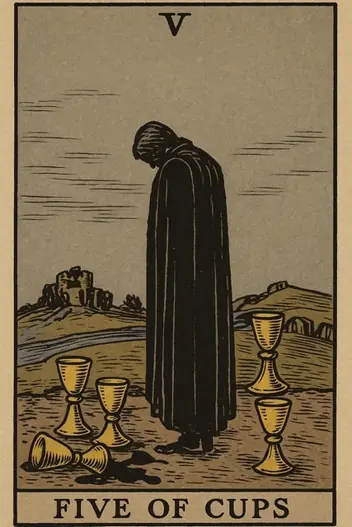

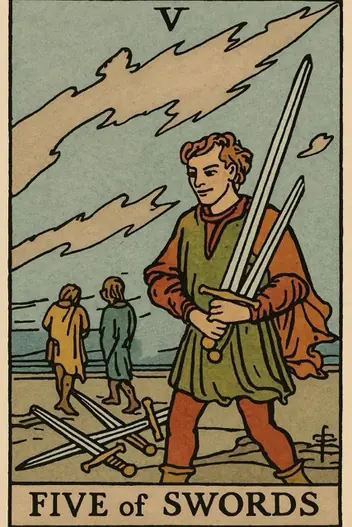
- Arcana
- Five of Cups — Minor Arcana, Cups; Five of Swords — Minor Arcana, Swords
- Elements
- Five of Cups — Water; Five of Swords — Air
- Elemental interaction
- Neutral elements — energies coexist without conflict
- Numerology
- 5 + 5 = 10 → 1
When the Five of Cups meets the Five of Swords, you are looking at a psychological landscape defined by loss and conflict. The Five of Cups represents grief over what has been spilled—emotional disappointment, missed opportunities, and a focus on what is missing. The Five of Swords, by contrast, is the card of victory at a price—a win that leaves others defeated, resentful, or isolated. Together, they describe a situation where you have either won a battle but lost something meaningful, or you are so consumed by past losses that you are engaging in self-destructive confrontations. The core question here is: Are you fighting for closure, or are you fighting to prove a point that only deepens the wound?
What Do Five of Cups and Five of Swords Mean Together?
The central dynamic of this combination is a feedback loop between grief and aggression. The Five of Cups creates a psychological state of rumination—you replay past failures, rejections, or betrayals. This emotional pain, if not processed, often triggers the defensive, combative energy of the Five of Swords. You may lash out, argue to "win," or try to regain control by dominating a conversation or negotiation. The result is a hollow victory: you get what you think you want (vindication, an apology, a concession), but the relational cost is high, and the underlying grief remains unresolved.
The key psychological insight is that this pairing often signals a failure of emotional differentiation. You cannot separate your current identity from a past loss. As a result, every new conflict feels like a life-or-death battle to reclaim your self-worth. In practical terms, this means you are fighting the wrong battles. The Five of Cups wants you to mourn and release; the Five of Swords wants you to choose your conflicts wisely. When these energies merge, the smartest move is often to pause, acknowledge the loss, and refuse to engage in a fight that only adds more casualties to your emotional ledger.
Your pair is already on the table. Ask your question and draw the clarifying card
or simply focus on it
What Do Five of Cups and Five of Swords Say About Love?
If you are single:
This combination warns against entering new connections while still nursing a recent wound. You risk projecting past betrayal onto a new partner, or picking fights over minor issues that are actually about old hurt.
If you are in a relationship:
Be alert to a dynamic where one partner "wins" arguments at the expense of the other's emotional safety. This creates a power imbalance where resentment builds beneath the surface.
In relationships, the Five of Cups and Five of Swords together point to a communication pattern driven by unprocessed grief. One partner may feel perpetually disappointed (Five of Cups) and uses cutting remarks or cold logic to "win" disagreements (Five of Swords). The most important relationship advice here is to stop keeping score. If you find yourself cataloging past slights to justify a current argument, you are in the shadow of this combination. Healthy conflict resolution requires vulnerability, not victory. Ask yourself: Am I trying to understand my partner, or am I trying to prove I was right? If the answer is the latter, you are sacrificing intimacy for ego. The pragmatic step is to schedule a time to talk about the original loss that is fueling the conflict, separate from any immediate argument.
Uncover hidden insights
Let our advanced Tarot system interpret these archetypes specifically for your personal path.
Career and Finances
Strategic Opportunities:
This pairing can indicate a necessary, though painful, professional separation. Leaving a toxic job or ending a failed partnership may feel like a loss, but it clears the path for better opportunities.
Strategic Opportunities:
Use the Five of Swords' analytical energy to audit your professional relationships. Identify who is a drain on your resources and who is a genuine ally.
Calculated Risks:
Beware of burning bridges in a fit of frustration. A "win" in a negotiation that humiliates a colleague or client will damage your reputation and future prospects.
In your career, this combination signals a high-stakes decision-making environment where emotions are running high. You may feel you have already lost a promotion, a project, or a client, and are now tempted to fight aggressively for scraps—demanding credit, arguing over blame, or pushing for a severance package that feels like a pyrrhic victory. The strategic financial warning is clear: do not let a short-term win cost you long-term goodwill. If you are in a negotiation, separate the emotional value from the monetary value. The Five of Cups cloud your judgment with feelings of unfairness; the Five of Swords tempts you to win at all costs. The practical approach is to ask for a cooling-off period before making any final decisions. Write down your objective goals (severance, new role, contract terms) and compare them to what you would lose in relationships, references, and future opportunities. If the "victory" leaves you isolated or bitter, it is not worth the price.
What If Five of Cups or Five of Swords Appears Reversed?
When the Five of Cups is reversed and the Five of Swords is upright, we see a refusal to mourn and a shift toward reckless vengeance. The person has not processed their grief but has suppressed it, making their aggression particularly chaotic and destructive. Warning: do not make important decisions in a state of false calm.
If the Five of Swords is reversed and the Five of Cups is upright, the dynamic shifts toward internal resistance and weakness. The person feels the pain (Cups) but cannot find the strength for conflict or defense (Swords). This leads to self-flagellation and passive acceptance of injustice. Advice: in this position, the most important thing is to seek support, rather than trying to cope alone.
When BOTH cards are reversed, a complete imbalance arises: neither the processing of feelings nor constructive action. This is a state of apathy and denial of reality. The logical way to correct this is to start small: acknowledge at least one specific loss (the reversed Five of Cups becomes upright) and take one simple action to protect your interests (the reversed Five of Swords becomes upright).
Five of Cups and Five of Swords: Warning Signs
The shadow of this combination is learned helplessness disguised as aggression. You may believe you are fighting for justice, but you are actually acting out of a cognitive bias called the "sunk cost fallacy" —you have invested so much emotional energy in a past loss that you cannot walk away, even when it is clearly harmful. This leads to self-sabotage: you pick fights you cannot win, or you win fights that destroy what you actually value. Another common pitfall is projection—you accuse others of betraying you or acting unfairly, but you are the one holding onto a grudge and refusing to see your own role in the conflict. The most dangerous manifestation is when this energy turns inward: you become your own harshest critic, "winning" against yourself by punishing your own mistakes with relentless self-blame. In this state, you are both the victor and the victim, and the only real outcome is emotional exhaustion.
What Is the Overall Message of Five of Cups and Five of Swords?
Constructive use of this energy requires a paradoxical approach: accept the loss (Five of Cups) to strip it of its power over you, and direct intellectual aggression (Five of Swords) not at others, but at solving the problem. Your task is not to win the war, but to end it with minimal losses.
The strategic advice is to separate facts from emotions. Make two lists: "What I have objectively lost" (money, time, resources) and "What stories I tell myself about this loss" (resentment, sense of injustice). The first list demands pragmatic action. The second requires conscious work with a psychologist or through journaling. The energy of the Five of Swords should be directed at analyzing the first list, not at proving you are right about the second.
A deep understanding of this pair provides the key to strategic humility — the ability to acknowledge reality without falling into despair or rage. This is not passivity, but a higher form of control: you choose where to invest your psychic energy. The combination teaches that true victory is not victory over others, but victory over your own reactivity.
Applying This to Your Situation
The core message of the Five of Cups and Five of Swords is this: you cannot heal a wound by reopening it in every new confrontation. The grief is real, but the fight you are in right now may be a distraction. Your next step is to identify the original loss—what did you actually lose? And then ask: Is this current battle helping me recover that loss, or is it just making me lose more? The answer will tell you whether to stand down, or to fight for something that truly matters.
For a deep, personalized interpretation of how this combination applies to your specific question—whether about a relationship, career decision, or personal struggle—use the Fortune Cards app. While this article explains the general archetype, the real insight comes when Tarot speaks directly to your situation. You can use the app on the web or download it to get a tailored reading that accounts for your unique context, right now.
Interpretation by the Fortune Cards editorial team, based on the Rider–Waite tradition and Jungian archetypes. About our methodology · Updated: 2026-08-26
Other Combinations with Five of Cups
Other Combinations with Five of Swords
Explore Individual Card Meanings
Table of Contents
- What Do Five of Cups and Five of Swords Mean Together?
- What Do Five of Cups and Five of Swords Say About Love?
- Career and Finances
- What If Five of Cups or Five of Swords Appears Reversed?
- Five of Cups and Five of Swords: Warning Signs
- What Is the Overall Message of Five of Cups and Five of Swords?
- Applying This to Your Situation
Ready to find answers to your questions?
Start your first reading now and look at your situation with fresh clarity. The cards are ready to reveal deeper meaning.