Five of Swords and Three of Pentacles Tarot as Feelings

- Arcana
- Five of Swords — Minor Arcana, Swords; Three of Pentacles — Minor Arcana, Pentacles
- Elements
- Five of Swords — Air; Three of Pentacles — Earth
- Elemental interaction
- Opposing elements — energies create tension
- Numerology
- 5 + 3 = 8
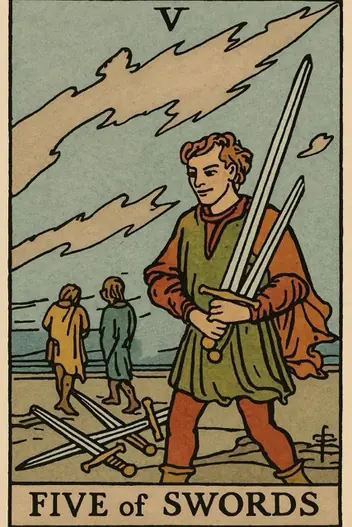
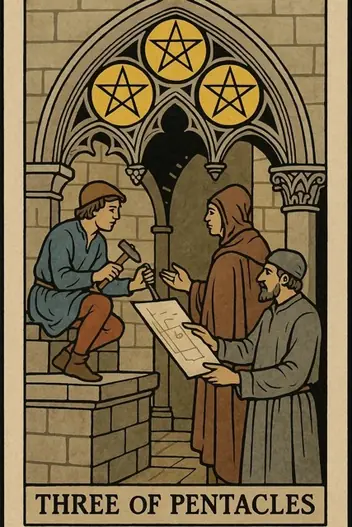
This combination represents a critical tension between individual victory and collective progress. The Five of Swords embodies a Pyrrhic victory—a win achieved through conflict, cunning, or ruthless competition that often leaves the winner isolated. The Three of Pentacles, in contrast, represents the quiet power of collaboration, skill-building, and shared mastery. When these two energies collide, the core question becomes: Are you sacrificing long-term trust and teamwork for a short-term, hollow win?
Psychologically, this pairing reveals a conflict between the ego’s need for validation and the Self’s need for belonging. You may be highly competent (Three of Pentacles) but are using that competence to dominate rather than contribute. The result is a classic Jungian shadow play: the Hero archetype (fighting for personal glory) versus the Community archetype (building something sustainable with others). The real work is to recognize that true mastery often requires shared success, not solitary conquest.
What Do Five of Swords and Three of Pentacles Mean Together?
The Five of Swords and Three of Pentacles together create a strategic paradox: you have the skills to succeed, but you’re applying them in a way that alienates your allies. The Five of Swords brings a win-lose mentality—a belief that someone must be defeated for you to advance. This often stems from a scarcity mindset where resources, recognition, or status are seen as limited. Meanwhile, the Three of Pentacles represents apprenticeship, teamwork, and craftsmanship. It thrives on feedback, iteration, and shared goals. When these cards combine, you may find yourself in a situation where you are technically right but relationally wrong.
The key insight here is that competence without cooperation breeds resentment. In a work or creative setting, this might look like a brilliant employee who hoards information or undermines colleagues to secure a promotion. In a personal context, it could manifest as someone who “wins” an argument but damages the relationship beyond repair. The psychological cost is high: you gain a short-term advantage but lose the social capital needed for long-term growth. The mature response is to ask yourself: Am I fighting to be right, or am I building to be effective?
Your pair is already on the table. Ask your question and draw the clarifying card
or simply focus on it
What Do Five of Swords and Three of Pentacles Say About Love?
If you are single:
This combination warns against approaching new connections as a competition. You may be trying to “win” someone’s affection by outshining rivals, but this creates a dynamic based on ego, not intimacy. Focus on genuine collaboration—find a partner who respects your skills, not one you have to defeat.
If you are in a relationship:
You may be caught in a power struggle where one partner constantly “wins” arguments or decisions. The Three of Pentacles calls for shared projects—rebuild your relationship as a team, not a battlefield. Compromise is not a loss; it’s a strategic investment.
In relationships, this card pair often signals a toxic cycle of scorekeeping. One partner may feel they are “carrying” the relationship (Three of Pentacles) while the other uses conflict to assert dominance (Five of Swords). The psychological trap is equating winning with love. Instead, the Three of Pentacles suggests you co-create a shared vision—whether it’s a home, a business, or a family. Bold move: apologize for a past victory. Acknowledge where your need to be right hurt the partnership. This isn’t weakness; it’s strategic humility that rebuilds trust.
Your unique Tarot reading
See how these cards interact with your destiny. Start a free personal reading now.
What Do Five of Swords and Three of Pentacles Indicate for Your Career?
Strategic Opportunities:
Use your technical expertise to mentor others—this builds loyalty and reduces competition. Look for collaborative projects where your skills can shine without alienating teammates.
Strategic Opportunities:
Focus on negotiating win-win outcomes in contracts or promotions. Your competence gives you leverage; use it to elevate the whole team, not just yourself.
Calculated Risks:
Avoid undercutting colleagues for personal gain. The cost of damaged reputation often outweighs the short-term reward. Be wary of “burning bridges”—you may need these people later.
Professionally, the Five of Swords and Three of Pentacles combination is a red flag for office politics. You may be in a situation where your individual performance is stellar, but your interpersonal skills are toxic. The Three of Pentacles represents the apprentice-journeyman-master path—true career growth comes from learning and teaching, not from defeating rivals. Financially, this pair warns against zero-sum thinking. A deal that makes you look smart but alienates a partner is a poor long-term strategy. Bold financial warning: Avoid legal battles or aggressive negotiations where the outcome is a “win” that costs you future opportunities. Instead, invest in collaborative ventures where your skills are appreciated, not feared.
What Are the Risks of Five of Swords and Three of Pentacles?
The shadow of this combination is arrogance disguised as ambition. The Five of Swords’ victory complex can blind you to the Three of Pentacles’ lesson: mastery requires community. When blocked, this energy manifests as cognitive biases like the Dunning-Kruger effect—overestimating your own competence while undervaluing others’ contributions. You may rationalize selfish behavior as “just being strategic” or “playing to win.” Self-sabotage occurs when you isolate yourself through your own victories. Jung would call this inflation of the ego—a state where the conscious mind becomes so identified with its own power that it forgets the unconscious need for connection. The result is a hollow success: you have the trophy, but no one to share it with.
Reversed Five of Swords and Three of Pentacles Explained
Five of Swords Reversed:
Aggression retreats into the shadow. You aren't arguing openly, but you are engaging in passive sabotage. You are dragging your feet, "forgetting" to pass on important information, or doing sloppy work to prove you are right. Advice: Stop playing the silent game. Your resistance is destroying the project faster than an open quarrel would.
Three of Pentacles Reversed:
Loss of professional ethics and standards. You or your team are doing shoddy work. The conflict (Five of Swords) arose because someone failed to meet their obligations. Warning: Do not try to justify poor work quality with external circumstances. This is a path to reputational disaster.
Both Cards Reversed:
Complete imbalance. This is a state of learned helplessness. You feel you have lost the battle before it even began. You are angry at yourself for your incompetence but take no action to correct it. Method for Correction: Acknowledge your defeat in this specific matter and start learning anew. This is the only way to regain control.
Five of Swords and Three of Pentacles Combined Message
How can the energy of the Five of Swords be constructively used to activate the Three of Pentacles? The answer is paradoxical: direct the combative spirit toward fighting imperfection, not people. The Five of Swords grants you the will to win and sharpness of mind. Use these qualities to champion standards of quality, not your ego. Become the "devil's advocate" on your team—one who points out project weaknesses not to humiliate a colleague, but to improve the outcome.
Deep strategic advice:
You need to channel aggression into ambitious goals. If you feel the urge to fight someone, ask yourself: "Am I willing to invest this energy into creating something so excellent that it will silence all critics on its own?" That is the true victory—when your work speaks louder than your words.
The synthesis of these archetypes is the path from lone warrior to warrior-master. You are not merely fighting for survival; you are fighting for excellence. You are not simply proving you are right; you are proving it through flawless quality. Embrace the challenge, but do not lose your humanity. A victory that destroys your reputation or relationships is a defeat.
Applying This to Your Situation
The core message of the Five of Swords and Three of Pentacles is this: skills without collaboration create isolation, and victories without allies are Pyrrhic. To move forward, you must decide if your goal is to be right or to be effective. The most powerful strategy is to use your competence to build bridges, not burn them.
Want to know exactly how this applies to your situation? The Fortune Cards app can give you a personalized reading for this exact combination, tailored to your specific question—whether it’s about a relationship, career move, or personal challenge. Don’t rely on generic advice; get a deep, Jungian-informed interpretation that considers your unique context. Use the app on the web or download it now to turn these archetypes into actionable insight for your life.
Interpretation by the Fortune Cards editorial team, based on the Rider–Waite tradition and Jungian archetypes. About our methodology · Updated: 2026-08-26
Other Combinations with Five of Swords
Other Combinations with Three of Pentacles
Explore Individual Card Meanings
Table of Contents
- What Do Five of Swords and Three of Pentacles Mean Together?
- What Do Five of Swords and Three of Pentacles Say About Love?
- What Do Five of Swords and Three of Pentacles Indicate for Your Career?
- What Are the Risks of Five of Swords and Three of Pentacles?
- Reversed Five of Swords and Three of Pentacles Explained
- Five of Swords and Three of Pentacles Combined Message
- Applying This to Your Situation
Ready to find answers to your questions?
Start your first reading now and look at your situation with fresh clarity. The cards are ready to reveal deeper meaning.