Five of Wands and Five of Cups Meaning in Tarot
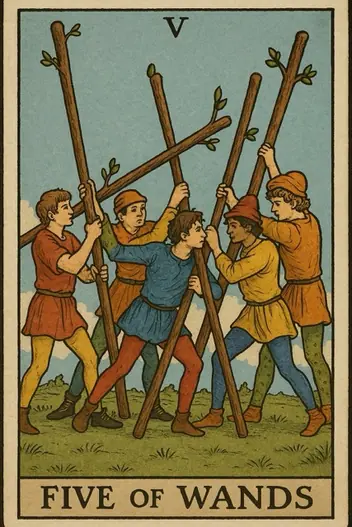

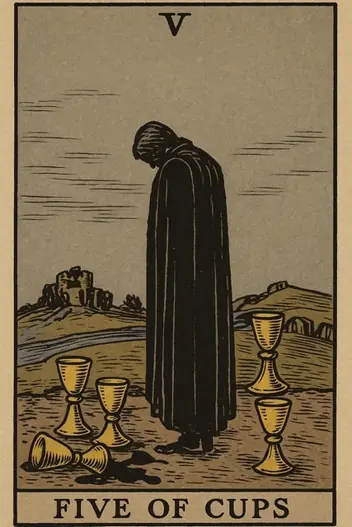
- Arcana
- Five of Wands — Minor Arcana, Wands; Five of Cups — Minor Arcana, Cups
- Elements
- Five of Wands — Fire; Five of Cups — Water
- Elemental interaction
- Opposing elements — energies create tension
- Numerology
- 5 + 5 = 10 → 1
The combination of the Five of Wands and the Five of Cups presents a powerful psychological clash: the raw, competitive energy of conflict meeting the heavy, introspective weight of disappointment. In real life, this often manifests as a situation where you are fighting to hold onto something that is already gone, or where your sense of personal loss is fueling a bitter, defensive struggle with others. The core dynamic is a tension between external friction and internal grief.
From a Jungian perspective, this pairing highlights the Shadow of the Victim colliding with the Shadow of the Warrior. The Five of Cups represents a fixation on what has been lost—a selective memory that ignores what remains. The Five of Wands represents the ego's reflexive need to defend, compete, and prove itself. When these energies merge, the seeker may find themselves in a pointless argument, not about the present issue, but about the unresolved pain of the past. The strategic insight here is to recognize that your current external struggle is likely a projection of your internal grief. The real battle is not with others, but with your own narrative of loss.
Five of Wands and Five of Cups: How These Energies Interact
The psychological state created by Five of Wands and Five of Cups is one of reactive defensiveness. You are not just fighting; you are fighting because you feel you have already lost something important. This could be a relationship, a job, a reputation, or a cherished belief. The mind is caught in a loop: you replay the loss (Five of Cups) and then immediately look for someone to blame or compete with (Five of Wands). This creates a self-fulfilling prophecy of isolation.
The key to breaking this cycle is to understand that the conflict is a symptom, not the root cause. The Five of Wands energy is a raw, undifferentiated drive for survival. When combined with the Five of Cups' grief, it becomes a frantic effort to reclaim control over an uncontrollable past. The most important psychological insight here is that you are likely misdirecting your energy. The fight you are engaging in—whether at work, in love, or with yourself—is not solving the underlying loss. In fact, it is often making it worse by alienating potential allies and exhausting your emotional reserves. The pragmatic path forward is to stop fighting long enough to fully grieve. Only then can you see what remains and what new battle is worth fighting.
Five of Wands and Five of Cups in Love and Relationships
If you are single:
This combination suggests you may be projecting past disappointments onto new connections. You are entering the dating scene with a defensive posture, ready for a fight before you've even been hurt. The advice is to acknowledge your grief from a previous relationship before seeking a new one, or you will sabotage the potential for genuine intimacy.
If you are in a relationship:
You and your partner may be locked in a cycle of petty arguments that are actually about deeper, unspoken losses. One or both of you is holding onto past grievances, using current conflicts as a proxy for unresolved pain.
In a relationship, this pairing is a red flag for emotional gridlock. The Five of Wands brings competitive energy—who is right, who is more hurt, who is to blame. The Five of Cups brings a sense of hopelessness and withdrawal. The result is a dynamic where every disagreement feels like a referendum on the entire relationship's worth. The practical advice is to create a "no-fault" zone for communication. Instead of fighting about who caused the last argument, ask: "What are we both afraid of losing here?" Boldly state your own grief without blaming your partner. For example, "I feel like I've lost the connection we used to have," is more productive than "You never listen to me." The goal is to transform the conflict from a competition into a shared exploration of loss and hope.
Your pair is already on the table. Ask your question and draw the clarifying card
or simply focus on it
Five of Wands and Five of Cups in Career Readings
Strategic Opportunities:
Use the competitive drive of the Five of Wands to re-enter the job market or pitch for a promotion, but only after you have accepted the loss of a previous role or project. This energy can be a powerful catalyst for ambition.
Strategic Opportunities:
Identify what you are truly fighting for. Is it money, recognition, or security? Clarifying this will prevent you from wasting energy on battles that don't serve your long-term financial goals.
Calculated Risks:
Avoid making major financial decisions or starting new business disputes while you are still in a state of grief. The Five of Cups distorts risk assessment, making you either overly reckless (to fill the void) or overly conservative (out of fear of more loss).
Professionally, this combination warns against "fighting for a sinking ship." You may be pouring your energy into a project, a team, or a client relationship that is already fundamentally broken. The Five of Wands energy is tempting you to "win" the argument, but the Five of Cups asks: "Is this battle even worth the cost of your future?" A critical financial warning: Do not throw good money after bad. The sunk cost fallacy is at its peak here. You may feel that if you just fight a little harder, you can reclaim what you've lost. This is a cognitive bias. The strategic move is to cut your losses, grieve the outcome, and redirect your competitive energy toward a new, viable opportunity. Use the Five of Wands' aggression to network, negotiate a severance, or outmaneuver a competitor—but only after you have emotionally detached from the past.
Five of Wands and Five of Cups Reversed: What Changes?
When cards appear in a reversed position, the dynamics become more complex and less obvious, but no less intense.
If the Five of Wands is reversed:
The conflict goes underground. Instead of open struggle, you face passive aggression, sabotage, and internal resistance. The energy finds no outlet, which exacerbates the apathetic state of the Five of Cups. Advice: Do not try to "drag" the conflict out into the open. Focus on finding indirect methods of resolution — through intermediaries, written requests, or a change of scenery.
If the Five of Cups is reversed:
This is a subtle moment of "false acceptance." The person says they have "let go" of the situation, but in reality, they have suppressed their grief. The inner child is still crying, but no one hears it. This can lead to sudden, uncontrollable outbursts of anger (Five of Wands) over nothing. Warning: Do not confuse "acceptance" with "repression." Give yourself time for legitimate mourning, otherwise it will erupt at the most inopportune moment.
If BOTH are reversed:
Complete imbalance. You are simultaneously unable to fight or to grieve. This is a state of emotional paralysis, where a person gets stuck in a "gray zone." They do not leave a toxic job, do not end a dead-end relationship, but also do not try to improve it. Correction: The only way out is to force a crisis. Consciously create a situation that will compel you to make a choice. Arrange a "heart-to-heart talk" or set yourself a deadline for making a decision. Acute pain is better than chronic apathy.
Deepen your understanding
Find out exactly what this reading means for your current life situation with our oracle.
When Five of Wands and Five of Cups Signal Trouble
The shadow manifestation of this pairing is bitter self-sabotage. The seeker becomes consumed by a narrative of victimhood, using past losses as justification for aggressive, irrational behavior. The cognitive bias at work is confirmation bias: You will only see evidence that confirms you have been wronged, ignoring any opportunity for reconciliation or growth. This can lead to a cycle of toxic competition where you alienate friends, colleagues, and partners. The deep pitfall is mistaking pain for power. You may feel strong because you are fighting, but you are actually fighting a ghost. The real danger is that you will burn bridges you will later need to cross, all because you could not stop grieving long enough to see the present situation clearly.
Five of Wands and Five of Cups: Tarot Advice
Constructive use of this combination requires ruthless intellectual honesty. Your primary task is to separate the two energies and channel them into different streams. The energy of the Five of Wands (competition, drive, will) cannot be used to "win back" the past. It must be directed toward creating a new battlefield.
Imagine you lost an important tennis match (Five of Cups). You could spend hours arguing with the umpire (Five of Wands), insisting the ball was "in." Or, accepting the defeat, you could go to the gym and start practicing a new serve. The energy of anger and frustration is fuel. The question is which engine you pour it into.
The strategic recipe is as follows:
- Accept the loss as an irreversible fact. This is not surrender, but resource conservation. Tell yourself: "Yes, I lost X. It hurts. Grief time: 24 hours."
- Transform resentment into ambition. Ask yourself: "What do I want to achieve now to compensate for this loss?" Not "get back," but "compensate."
- Use the Five of Wands to set boundaries for the future. Your experience of pain is the best teacher. Now you know exactly which conditions, contracts, or partner behaviors you will never tolerate again.
Your strength is not in winning every fight. Your strength lies in the ability to choose the right battle and accept inevitable defeat in order to conserve strength for the next, victorious, campaign.
Applying This to Your Situation
The core message of the Five of Wands and Five of Cups is this: Your current conflict is a distraction from your unprocessed loss. To move forward, you must first stop fighting and start grieving. Only then can you choose a battle that is truly worth your energy. This combination is not a curse; it is a call to integrate your pain with your ambition.
While this analysis provides a deep, archetypal understanding, the true power of Tarot lies in its application to your unique life. The Fortune Cards app allows you to input your specific question and receive a personalized, nuanced interpretation of this exact combination. Whether you are navigating a relationship conflict, a career pivot, or a personal crisis, the app translates these universal symbols into actionable advice for your situation. Download Fortune Cards now or use it on the web to unlock a tailored reading that speaks directly to your current crossroads.
Interpretation by the Fortune Cards editorial team, based on the Rider–Waite tradition and Jungian archetypes. About our methodology · Updated: 2026-08-26
Other Combinations with Five of Wands
Other Combinations with Five of Cups
Explore Individual Card Meanings
Table of Contents
- Five of Wands and Five of Cups: How These Energies Interact
- Five of Wands and Five of Cups in Love and Relationships
- Five of Wands and Five of Cups in Career Readings
- Five of Wands and Five of Cups Reversed: What Changes?
- When Five of Wands and Five of Cups Signal Trouble
- Five of Wands and Five of Cups: Tarot Advice
- Applying This to Your Situation
Ready to find answers to your questions?
Start your first reading now and look at your situation with fresh clarity. The cards are ready to reveal deeper meaning.