Love Tarot: Five of Wands and Five of Swords

- Arcana
- Five of Wands — Minor Arcana, Wands; Five of Swords — Minor Arcana, Swords
- Elements
- Five of Wands — Fire; Five of Swords — Air
- Elemental interaction
- Friendly elements — energies support each other
- Numerology
- 5 + 5 = 10 → 1
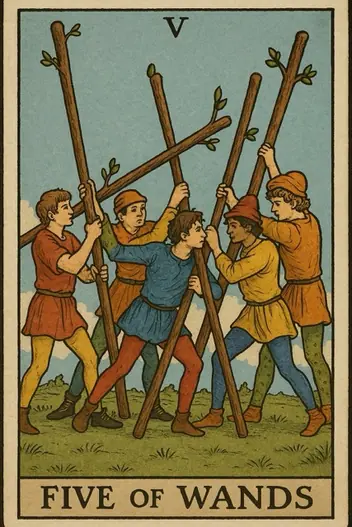
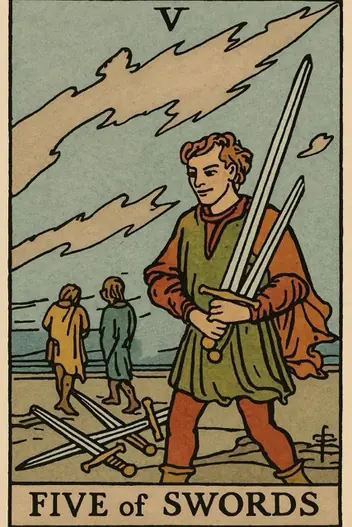
When the Five of Wands (competition, friction, chaotic energy) collides with the Five of Swords (victory at a cost, mental defeat, Pyrrhic triumph), you are looking at a psychological state where struggle has become an end in itself. This isn’t just a temporary disagreement; it is a pattern of engagement where the seeker feels compelled to "win" every interaction, often at the expense of their own peace or long-term goals.
From a Jungian perspective, this combination represents the Shadow’s need for dominance overriding the ego’s capacity for collaboration. The Five of Wands provides the raw, competitive fuel, while the Five of Swords supplies the ruthless, calculating strategy. The result is a mindset that mistakes aggression for assertiveness and victory for value.
What Do Five of Wands and Five of Swords Mean Together?
The core dynamic of this pairing is strategic escalation. The Five of Wands introduces friction and multiple competing agendas, while the Five of Swords dictates that only one agenda can survive. Psychologically, this creates a zero-sum game mentality: the seeker believes that for them to win, someone else must lose—and they are willing to accept collateral damage to achieve that win.
This combination often surfaces when a person is over-identifying with their "warrior" archetype. They are not fighting for a principle or a boundary; they are fighting to prove their superiority. The danger here is that the Five of Swords’ victory is often hollow. The seeker may "win" the argument, the negotiation, or the competition, but they lose the relationship, the trust, or the future opportunity. The key insight is to ask: Is this battle worth the cost of the war? The energy is high, but the returns are diminishing.
Your pair is already on the table. Ask your question and draw the clarifying card
or simply focus on it
What Do Five of Wands and Five of Swords Indicate for Your Career?
Strategic Opportunities:
Use the competitive drive of the Five of Wands to master a new skill or outperform a clear benchmark—not a specific person. Channel the energy into internal improvement.
Strategic Opportunities:
The Five of Swords can be used for sharp, analytical negotiation in contracts or budgets, provided you prioritize a win-win outcome. Use logic to cut waste, not to cut throats.
Calculated Risks:
Beware of burning bridges. A short-term win achieved through manipulation or public humiliation will create long-term career enemies. Avoid office politics where you "expose" a colleague. The cost to your reputation will exceed the value of the victory.
For career and finances, this is a high-risk, high-conflict combination. It suggests a professional environment filled with territorial disputes, backstabbing, or aggressive competition for limited resources. The pragmatic approach is to become an observer of the conflict, not a participant. If you must engage, frame your actions around objective data and clear contracts rather than personal vendettas. Financially, this card pair warns against litigation or aggressive debt collection that could spiral into legal fees exceeding the amount recovered. The bold strategic tip: If you feel the urge to "teach someone a lesson" at work, step back. This is the Shadow of the Five of Swords speaking, and it will cost you more than you think.
Ask your specific question
Don't rely on generic meanings. Get a customized reading tailored specifically to your energies.
Five of Wands and Five of Swords in Love Tarot
If you are single:
This pairing warns against treating dating as a conquest. You may be attracting partners who are combative or you may be creating unnecessary drama to feel engaged. Seek mutual respect over competitive banter.
If you are in a relationship:
You are likely in a power struggle. One partner may be "keeping score" or using past victories to control the narrative. The relationship is at risk of becoming a cold war of resentments.
In relationships, the Five of Wands and Five of Swords combination signals a breakdown of partnership into rivalry. The emotional intelligence required here is to recognize when you are fighting to be "right" rather than fighting to be connected. The bold truth is that winning an argument with your partner often means losing the relationship. This energy manifests as passive-aggressive comments, superiority complexes, or a refusal to compromise. The antidote is to consciously surrender the need for dominance and reframe the conflict as a shared problem to solve, not a battle to win. Practical advice: Take a 10-minute pause before responding to any emotionally charged statement. This breaks the reactive loop of the Five of Wands and prevents the calculated, hurtful retorts of the Five of Swords.
Shadow Side & Pitfalls
The Shadow side of this combination is cognitive distortion at its peak. The seeker may suffer from the "illusion of control" bias, believing they can manage the chaos they are creating. They may also exhibit confirmation bias, only seeing evidence that justifies their aggressive stance while ignoring the mounting social or emotional costs. Self-sabotage manifests as a refusal to de-escalate even when a graceful exit is available. The deepest pitfall is the Pyrrhic victory complex: achieving a goal only to find it empty, leading to a hollow sense of triumph and a damaged sense of self. The ego becomes addicted to the adrenaline of conflict, mistaking it for passion.
Reversed Positions: What Changes?
When one or both cards appear in a reversed position, the dynamics of the conflict transform from external to internal, or conversely, lose their intensity.
Five of Wands Reversed:
This points to blocked aggression and suppressed rivalry. You are avoiding conflicts, but your silence is not peace—it is an accumulation of tension. Instead of open struggle, you engage in passive aggression and sabotage. Advice: find a safe way to release this energy—sports, debates, public speaking. Do not allow the tension to escalate into psychosomatic issues.
Five of Swords Reversed:
This is a sign of internal defeat and capitulation. You have acknowledged your powerlessness, but not for the sake of peace—out of fear. You surrendered the victory without even entering the fight. This state is more dangerous than losing, as it forms a habit of self-deprecation. Advice: reassess your evaluation of the situation. Perhaps you have overestimated the opponent's strength and underestimated your own resources.
BOTH Reversed:
Complete imbalance. The conflict has retreated into the shadows but continues to destroy from within. You are in a state of "cold war" with yourself or those around you. The energy finds no outlet, and the intellect is used for self-flagellation. The logical way to correct this: bring the problem to light. Acknowledge that the conflict exists and choose one of two paths—either open confrontation or conscious retreat. Half-measures are destructive here.
Five of Wands and Five of Swords Combined Message
Constructive use of this combination requires you to shift from a reactive to a proactive stance. The Five of Wands provides you with the energy for action, but without the strategic focus of the Five of Swords, this energy will be wasted on petty skirmishes. Your task is to direct aggression not at others, but at solving the problem.
The first step is to depersonalize the conflict. Stop perceiving the situation as a personal insult. The Five of Swords in its healthy aspect is not a thirst for revenge, but cold analysis. Look at the situation as a chess game: where are your weak points? Which of the opponent's pieces can be neutralized without a fight? Use the energy of the Five of Wands to find unconventional solutions, not for a frontal assault.
The second step is to determine the price of victory. Write down on a piece of paper what you are willing to lose to achieve your goal. If items like "relationships with loved ones," "self-respect," or "health" appear on the list, stop. A victory that destroys your personality is a defeat. A strategically wise move is to switch to a different goal where the stakes are not so high.
The third step is to apply the principle of "limited war". Establish clear boundaries for the conflict: time frames, permissible methods, clear criteria for victory and defeat. As soon as one of these parameters is violated, you must stop and reconsider the strategy. This is not weakness; it is the highest level of strategic thinking.
Ultimately, this combination teaches us that true strength lies not in the ability to destroy an opponent, but in the ability to choose your battles. The energy of the Five of Wands is invaluable, but only when directed by the clear mind of the Five of Swords, not by its shadowy thirst for destruction.
Your Next Step: Personal Context Matters
The core message of the Five of Wands and Five of Swords is a stark warning: Not every battle needs a champion. This combination asks you to examine your motives. Are you fighting for growth, or are you fighting for ego? Are you defending a boundary, or are you attacking a perceived threat? The energy is potent, but it requires ruthless self-honesty to wield it wisely.
While this analysis provides the archetypal blueprint, the true power of Tarot lies in personal application. To understand exactly how this combative energy is playing out in your specific situation—whether in a relationship, at work, or within your own psyche—you need a customized reading. Use the Fortune Cards app on the web or download it today. Ask a direct question about your current challenge, and receive a deep, personalized interpretation of this exact card combination, tailored to your unique context and guided by the principles of psychological insight.
Interpretation by the Fortune Cards editorial team, based on the Rider–Waite tradition and Jungian archetypes. About our methodology · Updated: 2026-08-26
Other Combinations with Five of Wands
Other Combinations with Five of Swords
Explore Individual Card Meanings
Table of Contents
- What Do Five of Wands and Five of Swords Mean Together?
- What Do Five of Wands and Five of Swords Indicate for Your Career?
- Five of Wands and Five of Swords in Love Tarot
- Shadow Side & Pitfalls
- Reversed Positions: What Changes?
- Five of Wands and Five of Swords Combined Message
- Your Next Step: Personal Context Matters
Ready to find answers to your questions?
Start your first reading now and look at your situation with fresh clarity. The cards are ready to reveal deeper meaning.