Five of Wands and Six of Cups Tarot Combination
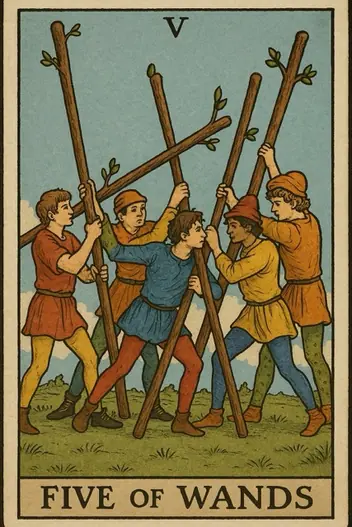
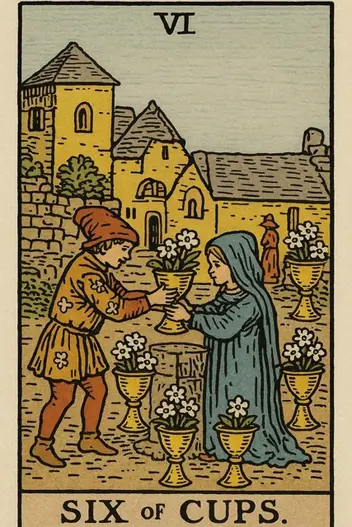
- Arcana
- Five of Wands — Minor Arcana, Wands; Six of Cups — Minor Arcana, Cups
- Elements
- Five of Wands — Fire; Six of Cups — Water
- Elemental interaction
- Opposing elements — energies create tension
- Numerology
- 5 + 6 = 11 → 2
The intersection of the Five Of Wands and Six Of Cups presents a compelling psychological paradox: the drive to compete and defend your position clashes with a deep, often unconscious pull toward past comforts and idealized memories. In pragmatic terms, this combination suggests you are in a conflict that is not purely external—it is fueled by unresolved emotional baggage from your personal history. You may be fighting for a win that, deep down, feels more like a regression than a progression.
This pairing forces a critical evaluation of your motivations. Are you battling to protect a past version of yourself or an outdated relationship dynamic? The Six Of Cups energy softens the raw aggression of the Five Of Wands, but it can also distort your perception. You must ask: Is the struggle worth the emotional cost, or are you merely replaying a script from your childhood or a previous chapter of your life? The key is to bring conscious awareness to the hidden nostalgia driving your current conflicts.
Five of Wands and Six of Cups: How These Energies Interact
When the Five Of Wands meets the Six Of Cups, the core dynamic is a tension between forward momentum and emotional regression. The Five Of Wands represents raw, competitive energy—the clash of egos, the scramble for resources, and the friction of differing opinions. It is the archetype of the struggle for individual identity within a group. The Six Of Cups, conversely, represents the comfort of the familiar, the sweetness of shared memories, and the tendency to idealize the past. Psychologically, this creates a state where you are fighting for something that no longer exists.
This combination often appears when a person is embroiled in a conflict that feels intensely personal, yet the root cause is a misplaced attachment to an earlier time. For example, a professional rivalry might be fueled by a desire to reclaim a past status, or a family argument might be a reenactment of sibling dynamics from decades ago. The practical implication is clear: you cannot win a future-oriented battle using past-oriented ammunition. To resolve the friction, you must first identify which "ghost" from your history is currently holding the reins of your behavior. Boldly acknowledging this psychological projection is the first step toward turning chaotic conflict into productive negotiation.
Five of Wands and Six of Cups for Career and Money
Strategic Opportunities:
Use the competitive drive of the Five Of Wands to reclaim a niche or skill you previously mastered but abandoned. Your past experience is a tactical advantage.
Strategic Opportunities:
Channel the Six Of Cups nostalgia into networking with former colleagues or mentors. Revive old professional relationships that provide trust and insider knowledge.
Calculated Risks:
Avoid re-entering a market or role that you left for good reasons. Do not let sentimental attachment to a past success cloud your judgment about current market conditions.
In the professional realm, this combination warns against fighting for a seat at a table that no longer exists. You may feel a strong urge to compete for a promotion, a project, or a client, but the motivation is rooted in wanting to prove something to your past self rather than your current capabilities. Financially, beware of investing in ventures or assets based on nostalgic value (e.g., a family business or a "sure thing" that worked in a different economy). The strategic path forward is to use your historical knowledge as data, not as a blueprint. Apply the Five Of Wands energy to rigorous market analysis and direct competition, but only after you have objectively assessed whether the prize is genuinely valuable to your future self. Bold financial warning: Do not let the comfort of a past success story lead you into a costly, ego-driven battle.
Your pair is already on the table. Ask your question and draw the clarifying card
or simply focus on it
Five of Wands and Six of Cups Love Outcome
If you are single:
This pairing suggests you may be attracted to people who remind you of a past relationship, leading to repetitive conflicts. Evaluate if the "spark" you feel is genuine chemistry or a familiar sense of drama.
If you are in a relationship:
You and your partner may be arguing about the same unresolved issues from your early history together. The current conflict is a proxy for a deeper, unhealed wound.
The relationship dynamics here are complex. The Five Of Wands brings a competitive edge to intimacy, where partners may feel they are fighting for emotional territory or for who gets to define the "truth" of the relationship. The Six Of Cups introduces a yearning for a simpler, more innocent time—often the honeymoon phase. This creates a dangerous loop: you fight because you are disappointed that the present does not match the idealized past. The most important relationship advice is to separate the past narrative from the present reality. You must stop using history as a weapon in current arguments. Instead, use the Six Of Cups energy to recall what originally bonded you, but apply the Five Of Wands energy to constructively negotiate new terms for the relationship. Boldly commit to creating new, positive memories rather than trying to resurrect old ones.
Ask your specific question
Don't rely on generic meanings. Get a customized reading tailored specifically to your energies.
The Shadow Side of Five of Wands and Six of Cups
The shadow manifestation of this combination is emotional regression masked as ambition. When blocked, the seeker may become passive-aggressive, using nostalgia to avoid direct confrontation. They might say "I miss how things used to be" as a way to criticize the present without taking responsibility for it. The cognitive bias at play is the rosy retrospection effect, where past events are remembered as more positive than they actually were. This leads to self-sabotage through unrealistic comparisons. For example, you might quit a promising new job because it doesn't feel as "magical" as a previous one, forgetting the very real conflicts that existed there. The ultimate pitfall is using the past as a fortress, refusing to adapt to the present's demands. This creates a cycle of repetitive, unresolved conflict where you keep fighting the same battles, with the same people, for the same reasons, expecting different results.
Five of Wands and Six of Cups Reversed: How to Read It
When cards appear reversed, the imbalance intensifies, and the traps become more pronounced.
Five of Wands Reversed:
Blocked Potential and Passive Aggression. The conflict goes underground. You are not fighting openly, but rather sabotaging, gossiping, or retreating into silent disregard. The Six of Cups in its upright position here becomes a dangerous comfort—you justify your passivity by claiming you are "preserving old connections." Advice: you need to provoke an honest conflict, otherwise the energy will destroy you from within.
Six of Cups Reversed:
Internal Resistance and Refusal of Support. The past is perceived not as a resource, but as a trauma. You do not want to remember past successes because you fear they will not be repeated. In combination with the upright Five of Wands, this creates an aggressive loner who burns bridges. Warning: you are refusing help and repeating mistakes because you are not learning from experience.
BOTH Reversed:
Complete Imbalance of Dynamics and Regression. This is a state of "frozen conflict." You can neither fight nor find comfort. You feel simultaneously like a victim of circumstances and an aggressor. The logical way to correct this: return to the basic rituals of the Six of Cups (re-establish connection with the body, with nature, with a close friend) and only then, having accumulated resources, enter into open confrontation. Heal the past first, then wage war in the present.
Five of Wands and Six of Cups: Tarot Advice
Constructive use of this combination requires transforming nostalgia from a "refuge" into a "tool." The energy of the Five of Wands is your will to win, your life force. The Six of Cups is your emotional intelligence and your root system. To balance them, you must stop perceiving the past as an alternative to the present and start using it as a foundation for the future.
Your strategic advice is the "Archaeologist" method. Imagine your current struggle (Five of Wands) as an excavation. You are not merely fighting obstacles; you are searching within them for "gold"—those valuable lessons and states from the past (Six of Cups) that can be applied here and now. For example, if you are arguing with a partner, ask yourself: "What specific feelings from our past am I trying to protect right now?" If you are in a competitive struggle at work, ask: "What old, time-tested strategy can help me win this tender?"
Deep Insight:
The Five of Wands without the Six of Cups degenerates into meaningless aggression, while the Six of Cups without the Five of Wands becomes a swamp of stagnation. Their union is a sign of maturity. You acknowledge that conflict is inevitable, but you refuse to lose your humanity and connection to your roots within that conflict. Your correct course of action is to act assertively, yet with respect for history. Acknowledge that you have changed, and that past patterns no longer work. Create a new ritual that unites the energy of struggle and warmth: for example, a weekly "Strategy Council" where you (or you and your partner) discuss plans and conflicts (Five of Wands) over a cup of tea (Six of Cups).
Your Next Step: Personal Context Matters
The core message of Five Of Wands and Six Of Cups is this: Your current struggle is a mirror of your past attachments. To move forward, you must distinguish between a fight worth having and a ghost you are chasing. The solution lies in conscious integration—use the energy of the Six Of Cups to honor your history without being controlled by it, and use the Five Of Wands to assert your present needs with clarity and courage. The general archetype is powerful, but its true meaning depends entirely on your unique story.
Your specific situation deserves a tailored analysis. While this article provides the psychological framework, the real insight comes when you apply these principles to your exact question. Use the Fortune Cards app to get a deep, personalized interpretation of this exact combination for your specific love, career, or personal query. Available on the web and for download, the app uses advanced AI to map these archetypes to your unique context, turning general wisdom into actionable, personal guidance. Start your reading now and uncover the hidden narrative driving your life.
Interpretation by the Fortune Cards editorial team, based on the Rider–Waite tradition and Jungian archetypes. About our methodology · Updated: 2026-08-26
Other Combinations with Five of Wands
Other Combinations with Six of Cups
Explore Individual Card Meanings
Table of Contents
- Five of Wands and Six of Cups: How These Energies Interact
- Five of Wands and Six of Cups for Career and Money
- Five of Wands and Six of Cups Love Outcome
- The Shadow Side of Five of Wands and Six of Cups
- Five of Wands and Six of Cups Reversed: How to Read It
- Five of Wands and Six of Cups: Tarot Advice
- Your Next Step: Personal Context Matters
Ready to find answers to your questions?
Start your first reading now and look at your situation with fresh clarity. The cards are ready to reveal deeper meaning.