Five of Wands and Six of Swords Tarot as Feelings
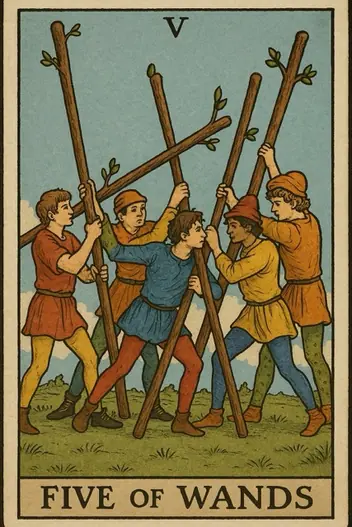
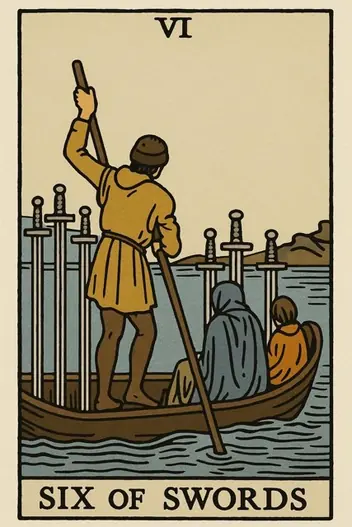
- Arcana
- Five of Wands — Minor Arcana, Wands; Six of Swords — Minor Arcana, Swords
- Elements
- Five of Wands — Fire; Six of Swords — Air
- Elemental interaction
- Friendly elements — energies support each other
- Numerology
- 5 + 6 = 11 → 2
When the Five of Wands—the card of competitive friction, scattered energy, and chaotic struggle—collides with the Six of Swords—the card of intentional transition, mental passage, and emotional release—you are looking at a psychological pivot point. This combination describes a situation where the noise of external conflict has become unsustainable, forcing a strategic withdrawal. It is not about surrender; it is about recalibrating your battlefield.
The core tension here is between reactivity and reflection. The Five of Wands pushes you to engage, to fight for your position, and to prove your worth through struggle. The Six of Swords pulls you toward the cold, clear logic of moving on. Together, they signal a moment where you must decide whether to continue the fight or to redirect your energy toward a more promising horizon. This is the archetype of the "strategic retreat"—a conscious choice to leave a losing battle to win a larger war.
Five of Wands and Six of Swords Combination Meaning
The psychological state created by this pairing is one of productive tension. You are likely feeling the burn of multiple competing demands, interpersonal friction, or a chaotic environment (Five of Wands). Yet, simultaneously, a part of you is already mentally checking out, planning an exit route, or calculating the cost of staying (Six of Swords). This is not passive escapism; it is a survival mechanism of the ego trying to preserve its integrity.
The key insight here is that conflict is not the problem; staying in the wrong conflict is. The Five of Wands energy is raw and vital—it can fuel innovation and drive. However, when paired with the Six of Swords, the message is clear: this specific struggle is no longer productive. Your mind is already in the future, scanning for safer waters. The most intelligent action is to acknowledge the emotional cost of the fight and use that data to guide your next move. This is about converting chaotic energy into directed intent.
Bold text is used to highlight crucial psychological concepts and strategic actions. The challenge is to avoid the shadow of the Six of Swords—which can manifest as avoidance or denial—and instead use its energy for deliberate disengagement. You are not running away; you are choosing which battles deserve your finite resources.
Career and Finances
Strategic Opportunities:
Leverage your competitive drive to exit gracefully. Use the skills you honed in conflict to negotiate a severance, a lateral move, or a project handoff that benefits you.
Strategic Opportunities:
Identify which team dynamics are toxic and which are merely challenging. The Six of Swords helps you see the difference between a salvageable situation and a sinking ship.
Calculated Risks:
Avoid making a snap decision to quit out of frustration. The Five of Wands can cloud your judgment with heat-of-the-moment emotions. Wait for the "clarity of the crossing."
In your professional life, this combination is a powerful signal for strategic career management. You are likely facing a period of intense office politics, competitive pressure, or resource scarcity (Five of Wands). The Six of Swords advises you to stop fighting for scraps on a sinking platform and instead focus on positioning yourself for a better opportunity. Bold strategic tip: Your next promotion may not come from winning the current argument, but from changing the entire game you are playing.
Financially, this is a time for liquidity and caution. The Five of Wands warns against over-leveraging or entering into high-stakes negotiations without a clear exit plan. The Six of Swords suggests that moving your assets to a safer harbor—paying down debt, building an emergency fund, or diversifying investments—is the smartest move. Do not let the chaos of the market or workplace pressure you into a costly mistake. The goal is to secure your resources for the journey ahead, not to win a temporary financial skirmish.
Your pair is already on the table. Ask your question and draw the clarifying card
or simply focus on it
Love and Relationships
If you are single:
This combination suggests you are emerging from a period of romantic competition or confusing dating dynamics. You may be mentally exhausted by the "game" and are now ready to seek a connection that offers genuine peace and alignment, rather than drama.
If you are in a relationship:
This pairing indicates a power struggle or recurring argument pattern that has lost its purpose. The solution is not to win the fight, but to agree on a new direction for the relationship that leaves the old conflict behind.
In relationships, the Five of Wands and Six of Swords together signal a critical juncture. The conflict (Five of Wands) has become a stagnant loop, and the only way forward is to change the conversation entirely. This is not about who is right or wrong; it is about whether the relationship’s current structure can hold both partners’ growth. Bold key relationship advice: You must separate the person from the problem. The Six of Swords offers a path to a "new shore"—a fresh emotional contract or a shared goal that transcends the current squabble.
Emotional intelligence is paramount here. If you are single, this card pair warns against carrying the baggage of past conflicts into new connections. The journey (Six of Swords) is useless if you keep reliving the battles (Five of Wands) in your head. For couples, the advice is to schedule a "no-blame" conversation focused on future solutions, not past grievances. The relationship can survive the storm if both parties are willing to navigate toward calmer waters together.
Reversed Five of Wands and Six of Swords Explained
If the Five of Wands is reversed, internal conflict blocks action. You are not fighting external circumstances but wasting energy on self-criticism and doubt. This is a state of paralysis of the will, where a person wants to leave (Six of Swords) but cannot even begin to argue. Warning: the risk of depression and apathy is high. Advice: start small — win one micro-argument (e.g., return a defective item to the store) to "jumpstart" the engine.
If the Six of Swords is reversed, movement is sabotaged by fear. You are actively fighting (Five of Wands upright) but afraid to take the final step. You quit your job but don't look for a new one; you argue with your partner but don't leave. Warning: this is a path to neurosis and chronic stress. Advice: set a hard deadline for the transition and burn your bridges.
If BOTH cards are reversed — this is a complete imbalance of chaos and inertia. The person simultaneously fears conflict and fears change. They get stuck in a "swamp" of uncertainty, where there is neither struggle nor movement. Logical method of correction: artificially create an external crisis (e.g., take out a loan or break a contract) that forces action. Therapy or coaching is mandatory here.
Your unique Tarot reading
See how these cards interact with your destiny. Start a free personal reading now.
Five of Wands and Six of Swords: Warning Signs
The shadow of this combination is a dangerous cognitive bias known as "sunk cost fallacy." You may feel that because you have invested so much time, energy, or emotion into a conflict or situation, that you must see it through to the end—even if it is destroying you. The Five of Wands energy can become self-destructive stubbornness, while the Six of Wands can twist into chronic escapism—always planning the next move but never actually taking it.
Another pitfall is rationalization of avoidance. You might convince yourself that you are "strategically retreating" when you are actually just running from a necessary confrontation. The key question to ask yourself is: Am I leaving this situation because it is truly harmful, or because it is uncomfortable? The shadow Six of Wands can also manifest as emotional coldness—cutting ties so cleanly that you fail to process the grief or anger from the Five of Wands, which then festers below the surface.
Poor judgment in this state often leads to a pattern of "fighting and fleeing"—repeating the cycle of entering chaotic situations, then abruptly abandoning them without resolving the underlying issues. The antidote is mindful transition: acknowledging the lessons of the conflict before you cross the water.
What Is the Overall Message of Five of Wands and Six of Swords?
How can the energy of the Five of Wands be used constructively to balance the Six of Swords? The key insight is that conflict must be strictly dosed and subordinated to the logistics of transition. Imagine you are a ship captain stuck in the ice. The Five of Wands is the dynamite you use to blast the ice. The Six of Swords is the course you chart toward open water. If you blast too much ice, you damage the hull. If you simply sail without blasting, you remain stuck forever.
Your strategy:
Use a "conflict timer." Allocate exactly one week for active combat operations (arguments, negotiations, competitive struggle). After that—a mandatory period of "silence" and evacuation. Do not allow the drama to drag on. The principle of "one battle—one transition." Each conflict must end with a clear change in reality: a change of residence, signing a new contract, ending a relationship.
A deep strategic piece of advice: integrate the "shadow of the warrior" into your personality. Do not suppress your aggression—it is fuel. But direct it not at people, but at circumstances. Instead of arguing with your boss (Five of Wands), channel that energy into finding a new employer (Six of Swords). Instead of hashing things out with your partner, use the anger to finally pack your bags. Make your struggle not against an adversary, but for new territory.
Your Next Step: Personal Context Matters
The Five of Wands and Six of Swords combination is a call to stop fighting the wrong battles and start navigating toward the right ones. It is a sophisticated psychological maneuver that requires both the courage to engage and the wisdom to disengage. The core message is that your energy is finite, and your mind is already pointing the way to a better shore. Listen to that inner compass, but do not abandon the lessons of the conflict behind you.
While this analysis provides a deep understanding of the archetypes, the true power of Tarot lies in its application to your unique life. The Fortune Cards app can give you a personalized, context-aware interpretation of this exact combination for your specific question. Whether you are navigating a career crisis, a relationship crossroad, or a personal dilemma, the app uses your input to deliver practical, Jungian-based insights tailored just for you. Use it on the web or download it now to turn this strategic insight into your next decisive action.
Interpretation by the Fortune Cards editorial team, based on the Rider–Waite tradition and Jungian archetypes. About our methodology · Updated: 2026-08-26
Other Combinations with Five of Wands
Other Combinations with Six of Swords
Explore Individual Card Meanings
Table of Contents
Ready to find answers to your questions?
Start your first reading now and look at your situation with fresh clarity. The cards are ready to reveal deeper meaning.