Five of Wands and Ten of Wands Together in Tarot

- Arcana
- Five of Wands — Minor Arcana, Wands; Ten of Wands — Minor Arcana, Wands
- Elements
- Five of Wands — Fire; Ten of Wands — Fire
- Elemental interaction
- Same element — energies intensify each other
- Numerology
- 5 + 10 = 15 → 6
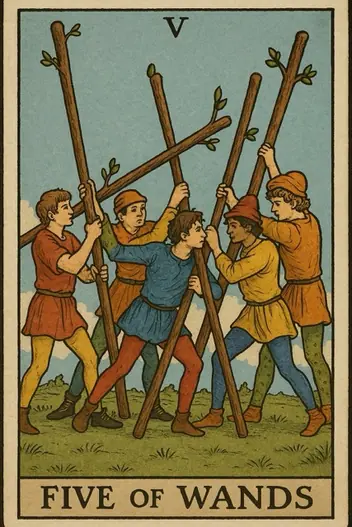
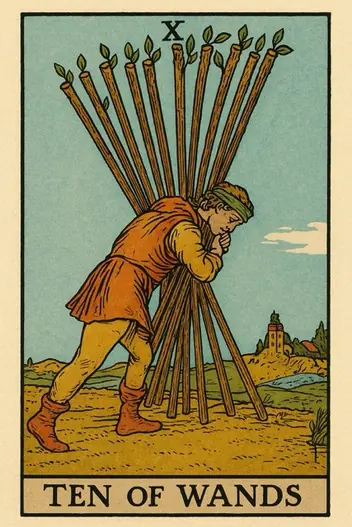
When the Five of Wands meets the Ten of Wands, the intersection is one of competitive burnout. The Five of Wands represents the raw, chaotic energy of conflict—a clash of ideas, egos, or ambitions. The Ten of Wands, conversely, embodies the crushing burden of overcommitment and exhaustion. Together, they paint a picture of a person who is not just fighting battles, but carrying the weight of every unresolved skirmish. This is not a time for more struggle; it is a signal to examine why you are still holding onto conflicts that should have been resolved or abandoned. The psychological state here is one of defensive exhaustion—you are too tired to fight effectively, yet too stubborn to put down the load.
Five of Wands and Ten of Wands Combination Meaning
The core dynamic of this pairing is a feedback loop of friction and fatigue. The Five of Wands introduces friction—disagreements, competition, or a sense that everyone is working against you. Instead of resolving these clashes, the seeker internalizes them, adding each small conflict to an already overflowing pile of responsibilities. The Ten of Wands then amplifies the stress, making every new problem feel like the one that will break you. The key insight here is that the burden is not solely external; it is compounded by a mindset of scarcity and defensiveness. You may be fighting battles that don't need to be fought, or holding onto tasks and grudges that drain your energy without offering any strategic advantage.
This combination suggests a critical need for prioritization and delegation. The psychological archetype at play is the Overburdened Warrior—someone who mistakes constant struggle for productivity. In real-world terms, this means you are likely over-functioning in areas where you should be setting boundaries or walking away. Your most important action is to audit your commitments and conflicts. Ask yourself: Which of these fights are actually mine to fight? Which tasks can be shared, deferred, or dropped? The answer will directly reduce the weight you are carrying.
Your pair is already on the table. Ask your question and draw the clarifying card
or simply focus on it
Career Meaning of Five of Wands and Ten of Wands
Strategic Opportunities:
Identify the one project or relationship that, if resolved, would reduce your stress by 50%. Focus your energy there.
Strategic Opportunities:
Look for opportunities to delegate or automate repetitive tasks. Your time is too valuable for low-impact battles.
Calculated Risks:
Avoid taking on new clients, projects, or debts until you have cleared your existing load. The risk of overextension is high.
In a career context, this combination warns against a "hero mentality" where you believe you must handle every problem alone. The Five of Wands suggests office politics, turf wars, or competitive colleagues. The Ten of Wands indicates you are taking on too much responsibility as a result. A key financial warning: do not use debt or overtime to compensate for poor prioritization. Instead, conduct a ruthless audit of your tasks. Which commitments are producing results, and which are just noise? The strategic move is to negotiate boundaries with your manager or clients—clearly state what you can deliver and what must be deprioritized. This is not weakness; it is resource management.
What Do Five of Wands and Ten of Wands Say About Love?
If you are single:
This pairing suggests you may be attracting partners who are either overly competitive or emotionally demanding. Evaluate whether the initial excitement of a new connection is masking a pattern of conflict or one-sided effort.
If you are in a relationship:
The dynamic here likely involves power struggles or a sense of unequal burden. One partner may feel they are doing all the emotional labor while the other focuses on winning arguments.
In relationships, the Five of Wands and Ten of Wands combination points to a toxic cycle of petty arguments and accumulated resentment. You or your partner may be keeping score, turning minor disagreements into evidence of a larger imbalance. The most critical relationship advice is to stop fighting to win and start fighting to understand. If you feel exhausted by your partnership, examine whether you are carrying the emotional weight of every past conflict. This is a strong signal to implement a "no re-litigation" rule—once an issue is discussed, it should not be weaponized later. Bold action here means scheduling a calm, structured conversation about boundaries and workload, not another heated debate.
Deepen your understanding
Find out exactly what this reading means for your current life situation with our oracle.
What If Five of Wands or Ten of Wands Appears Reversed?
If the Five of Wands is reversed, chaos transforms into suppressed aggression. You avoid conflicts, but internal tension builds up, increasing the burden of the Ten. Warning: passive aggression is more destructive than an open argument. Advice: start small — express one dissatisfaction directly today.
If the Ten of Wands is reversed, this indicates resistance to responsibility. You shed the burden, but do so chaotically, creating new conflicts. Advice: instead of abruptly refusing obligations, smoothly delegate tasks to others, explaining the reason.
If BOTH are reversed, a complete imbalance arises: you neither fight nor carry the burden, leading to stagnation. Correction: start with one small victory (e.g., complete a minor project) to regain a sense of control.
What Are the Risks of Five of Wands and Ten of Wands?
The shadow side of this pairing is the Martyr Complex—a cognitive bias where you unconsciously seek validation through suffering and overload. You may believe that if you are not exhausted, you are not working hard enough. This leads to self-sabotage through overcommitment. Another pitfall is paranoid defensiveness: the Five of Wands energy can make you interpret neutral feedback as attack, prompting you to fight battles that don't exist. This combination also feeds analysis paralysis—you are so burdened by the weight of past conflicts that you cannot make clear decisions about the future. The most dangerous behavior is refusing to ask for help because you see it as a sign of weakness, when in reality, it is the most strategic move available.
Five of Wands and Ten of Wands Combined Message
To constructively channel the energy of the Five of Wands into balancing the Ten, you must redefine the goal of the struggle. Instead of competing for resources (who can do more), compete for quality of outcome and speed of recovery. This shifts the focus from quantity to efficiency.
A deep strategic counsel:
use the Five of Wands as a tool for auditing your load. Every time the urge to engage in conflict arises, ask yourself: "Will this add another stone to my backpack, or remove one?" If the answer is "adds," step back. In this scenario, the Ten of Wands is not an enemy but an indicator of overload. Learn to read its signals: fatigue, irritability, decreased concentration—these are a call for delegation.
Key takeaway:
the only way to win in this combination is to stop carrying the whole world on your shoulders. Acknowledge that some battles can be lost to win the war for your well-being. Lower the control bar from 100% to 70%—and you will see that the system hasn't collapsed but has become more resilient.
Applying This to Your Situation
The core message of Five of Wands and Ten of Wands is clear: you are carrying too much, and you are fighting too many battles that don't serve you. The path forward requires ruthless prioritization, honest communication, and the courage to let go of what is not essential. But this is a general archetype—your specific situation may involve a particular relationship, a work project, or an internal conflict that only you can identify.
To unlock the full power of this reading, use the Fortune Cards app. While this article provides the psychological framework, the true insight comes when Tarot is applied to your unique question and life context. Open the app on the web or download it now to receive a deep, personalized interpretation of the Five of Wands and Ten of Wands for your specific situation. Your next step is just a tap away.
Interpretation by the Fortune Cards editorial team, based on the Rider–Waite tradition and Jungian archetypes. About our methodology · Updated: 2026-08-26
Other Combinations with Five of Wands
Other Combinations with Ten of Wands
Explore Individual Card Meanings
Table of Contents
- Five of Wands and Ten of Wands Combination Meaning
- Career Meaning of Five of Wands and Ten of Wands
- What Do Five of Wands and Ten of Wands Say About Love?
- What If Five of Wands or Ten of Wands Appears Reversed?
- What Are the Risks of Five of Wands and Ten of Wands?
- Five of Wands and Ten of Wands Combined Message
- Applying This to Your Situation
Ready to find answers to your questions?
Start your first reading now and look at your situation with fresh clarity. The cards are ready to reveal deeper meaning.