The Hanged Man and Ten of Swords Tarot Combination
- Arcana
- The Hanged Man — Major Arcana; Ten of Swords — Minor Arcana, Swords
- Elements
- The Hanged Man — Water; Ten of Swords — Air
- Elemental interaction
- Neutral elements — energies coexist without conflict
- Numerology
- 12 + 10 = 22 → 4
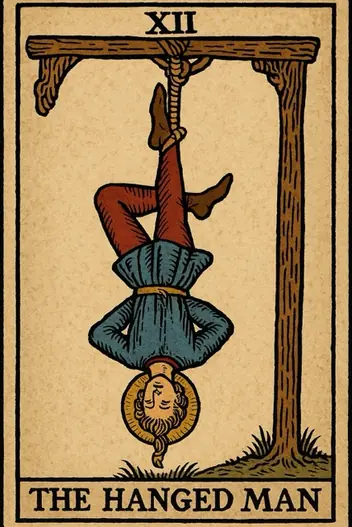
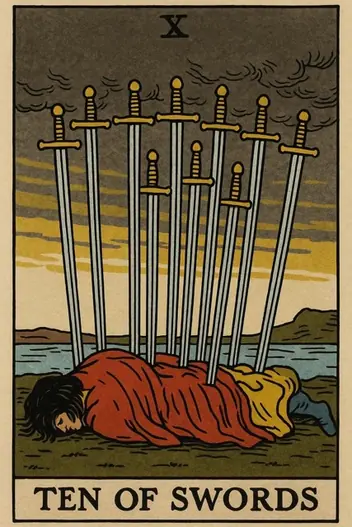
The intersection of The Hanged Man and Ten of Swords represents a profound psychological turning point. The Hanged Man embodies the archetype of suspension—a voluntary pause, a sacrifice of control, and a shift in perspective. The Ten of Swords, conversely, depicts an involuntary collapse—a brutal ending, a betrayal, or a mental defeat. When these cards collide, the message is clear: You have hit rock bottom, but only by fully accepting this defeat can you find the clarity to rise again.
This combination asks you to distinguish between a strategic retreat and a victimized collapse. The Hanged Man’s energy is about choosing to stop fighting to see the bigger picture, while the Ten of Swords signals that the fight has already ended—often painfully. In real life, this manifests as a scenario where external circumstances (the Ten of Swords) force you into a state of forced reflection (the Hanged Man). The key psychological insight is that resistance to this ending only prolongs suffering; acceptance accelerates transformation.
The Hanged Man and Ten of Swords: How These Energies Interact
At its core, this pairing is a masterclass in cognitive reframing. The Ten of Swords represents the moment when your ego’s narrative of control is shattered—a job loss, a breakup, or a public failure. The Hanged Man then steps in not as a rescuer, but as a guide to reframe the defeat as a necessary sacrifice. The psychological state created is one of post-traumatic growth: the mind must first process the shock (Ten of Swords) before it can adopt a new, suspended perspective (Hanged Man) that sees the broader pattern.
The real-world implication is that you cannot skip the mourning phase. Trying to immediately “stay positive” or “see the lesson” without fully acknowledging the pain is a form of denial. The Hanged Man’s wisdom is that true perspective comes from hanging upside down—from seeing the situation from a completely inverted angle. This means accepting that what looks like a catastrophic end is actually the death of a limiting belief. The energy here is not passive; it is an active practice of letting go of the need for immediate answers.
The most important takeaway is that this combination demands strategic surrender. Do not confuse this with giving up. It means consciously choosing to stop fighting the inevitable, so that your energy can be redirected toward the next cycle. The Ten of Swords’ dawn in the background reminds you that the worst is over, even if the light has not yet reached you.
Your pair is already on the table. Ask your question and draw the clarifying card
or simply focus on it
The Hanged Man and Ten of Swords for Career and Money
Strategic Opportunities:
Reevaluate your entire career trajectory. The Hanged Man suggests that a pause—even an unpaid one—may yield insights that propel you into a more aligned field.
Strategic Opportunities:
Use this setback to build a new skill. The Ten of Swords signals the death of an old role; the Hanged Man advises learning from a different vantage point, such as consulting or part-time study.
Calculated Risks:
Do not make major financial decisions for 30 days. The shock of the Ten of Swords can lead to panic moves. The Hanged Man’s suspension is your cue to wait for clarity.
Professionally, this combination is a strategic retreat indicator. You may have experienced a public failure, a layoff, or a project that ended catastrophically. The worst financial move now is to grasp for the first solution. The Hanged Man teaches that true leverage comes from doing nothing—but doing nothing intentionally. This is the time to audit your professional identity. What part of your career narrative needs to die? If you were the “always reliable” employee who was just let go, that identity must be sacrificed.
The bold financial warning here is: avoid debt to maintain appearances. The Ten of Swords often brings a hit to your reputation or income. The Hanged Man’s wisdom is to accept a temporary status loss to avoid a permanent financial wound. This is a moment to prioritize liquidity and flexibility over ego-driven spending. If you are in a negotiation, the advice is to stay silent and observe. Your opponent may overplay their hand if you refuse to react.
The Hanged Man and Ten of Swords in Love and Relationships
If you are single:
This pair suggests you are likely recovering from a painful romantic disappointment. Do not rush into a new connection; instead, use this time to analyze what belief patterns led to the collapse. The Hanged Man warns that seeking validation now will repeat the cycle.
If you are in a relationship:
There has been a significant betrayal, argument, or emotional breakdown. The relationship is at a critical juncture where one partner must sacrifice their ego for the other to be heard. If both refuse, the Ten of Swords will finalize the split.
In relationships, this combination signals a crisis of trust that demands a radical shift in perspective. The Ten of Swords often represents a “final straw”—a moment where words or actions cut deeply. The Hanged Man’s role here is to suspend judgment and see the pain from the other person’s point of view. However, this is not about accepting abuse. The key relationship advice is bold: you must discern between a necessary sacrifice of pride and an unhealthy sacrifice of self-respect. If the relationship is to survive, both partners must be willing to “hang” their defensive positions and acknowledge the shared wound.
For singles, this combination is a psychological reset. It advises you to stop analyzing what went wrong from the same old angle. Instead, ask yourself: “What am I willing to let go of in my concept of love to attract a healthier partnership?” The answer may involve releasing a fantasy of rescue or a fear of abandonment.
Uncover hidden insights
Let our advanced Tarot system interpret these archetypes specifically for your personal path.
When The Hanged Man and Ten of Swords Signal Trouble
The shadow of this combination is self-martyrdom and learned helplessness. The seeker may romanticize their suffering (Hanged Man’s shadow) while feeling powerless to change it (Ten of Swords’ shadow). This leads to a cognitive bias where pain becomes identity: “I am the one who always gets stabbed in the back.” The pitfall is confusing the Hanged Man’s active surrender with passive victimhood. You may stay in a toxic situation, believing you are “sacrificing for the greater good,” when in reality you are avoiding the hard work of rebuilding.
Another risk is paralysis from over-analysis. The Hanged Man’s upside-down perspective can become a trap if you endlessly dissect the meaning of the Ten of Swords without taking action. The shadow of this pair is intellectualization as a defense mechanism. You may understand the psychology of your collapse but fail to implement the necessary change. Watch for patterns of rumination—replaying the betrayal or failure instead of integrating the lesson. The Ten of Swords’ dawn is a call to action, not a call to perpetual reflection.
The Hanged Man and Ten of Swords Reversed Meaning
When cards appear in a reversed position, the dynamic becomes more complex and less fatal, but no less intense.
If The Hanged Man is reversed:
This indicates blocked potential or reckless resistance. The person refuses to "hang" and reconsider their point of view. They continue to act in the old way, ignoring obvious signals of a crisis. Warning: such stubbornness will accelerate the arrival of the Ten of Swords, making the blow even more painful. Advice: consciously stop and acknowledge that your current approach is not working.
If the Ten of Swords is reversed:
This speaks to internal resistance to the finale. The collapse has already occurred, but the person refuses to accept it. They cling to the ruins, trying to "glue together" what is already dead. This is a state of denial and prolonged suffering. Advice: acknowledge the loss. The energy of The Hanged Man here can help you see that clinging to the past is a new form of sacrifice that prevents you from moving forward.
If BOTH are reversed:
This is a complete imbalance of the dynamic. The person is simultaneously unwilling to sacrifice (does not see the point in changing perspective) and unwilling to let go of the past (denies the ending). This is a chaotic state of stagnation, where nothing changes, but everything is falling apart. The logical way to correct this: it is necessary to artificially create a crisis. Make a decisive choice: either completely stop and reconsider your strategy (The Hanged Man upright), or resolutely cut all ties (Ten of Swords upright). You cannot continue to "hang" in a half-dead state.
The Hanged Man and Ten of Swords: Tarot Advice
How can the energy of The Hanged One be constructively used to balance the destructive force of the Ten of Swords? The answer is paradoxical: acknowledge the inevitability of collapse and consciously accelerate it. Instead of waiting for the final blow, take on the role of "executioner" for your old self. The energy of The Hanged One grants you the wisdom to see what exactly must die. The energy of the Ten of Swords is the tool for an ecologically sound completion.
Your strategic conclusion: stop being a victim of circumstances and become the author of your own crisis. If you understand that a project is doomed, a relationship is toxic, and a job is dead-end — strike first. Close the company, leave the relationship, resign. This transforms the "blow of fate" into a conscious act of will. You are not waiting to be "finished off"; you yourself put an end to it.
This is not a defeat, but the highest form of strategic mastery. You use the energy of The Hanged One (a shift in perspective) to see that the "death" of the old is the only path to new life. In this context, the Ten of Swords becomes not a tragedy, but a liberation. You shed the burden of past mistakes, illusions, and futile efforts. The main advice: act decisively and without regret. The pain you feel now is the pain of growth, not the pain of agony.
Where to Go From Here
The Hanged Man and Ten of Swords together deliver a single, profound message: to be reborn, you must first fully die—and then wait in the dark. Your core task is to distinguish between the pain that teaches and the pain that traps. The general archetype advises surrender, but only you know if that surrender is a wise retreat or a fear of moving forward. The true magic of Tarot is not in the card meanings, but in how they illuminate your unique path.
Your unique situation demands a personalized reading. While this article explains the archetypes, your specific question—whether about a relationship, career, or personal crisis—deserves a tailored answer. Use the Fortune Cards app to get a deep, personalized interpretation of this exact combination for your specific question. The app applies Jungian psychology and pragmatic Tarot analysis to your context, giving you actionable steps, not generic advice. Try it on the web or download it now to uncover the precise sacrifice you must make and the exact dawn that awaits you.
Interpretation by the Fortune Cards editorial team, based on the Rider–Waite tradition and Jungian archetypes. About our methodology · Updated: 2026-08-26
Other Combinations with The Hanged Man
Other Combinations with Ten of Swords
Explore Individual Card Meanings
Table of Contents
- The Hanged Man and Ten of Swords: How These Energies Interact
- The Hanged Man and Ten of Swords for Career and Money
- The Hanged Man and Ten of Swords in Love and Relationships
- When The Hanged Man and Ten of Swords Signal Trouble
- The Hanged Man and Ten of Swords Reversed Meaning
- The Hanged Man and Ten of Swords: Tarot Advice
- Where to Go From Here
Ready to find answers to your questions?
Start your first reading now and look at your situation with fresh clarity. The cards are ready to reveal deeper meaning.