Nine of Wands and Ten of Swords Meaning in Tarot
- Arcana
- Nine of Wands — Minor Arcana, Wands; Ten of Swords — Minor Arcana, Swords
- Elements
- Nine of Wands — Fire; Ten of Swords — Air
- Elemental interaction
- Friendly elements — energies support each other
- Numerology
- 9 + 10 = 19 → 1
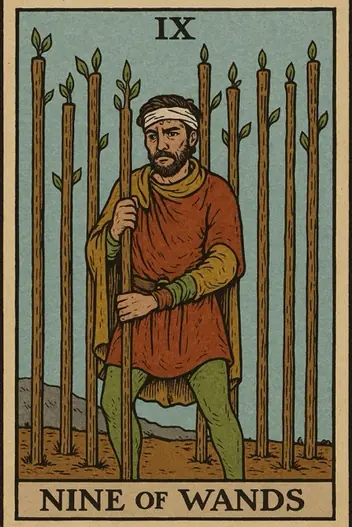
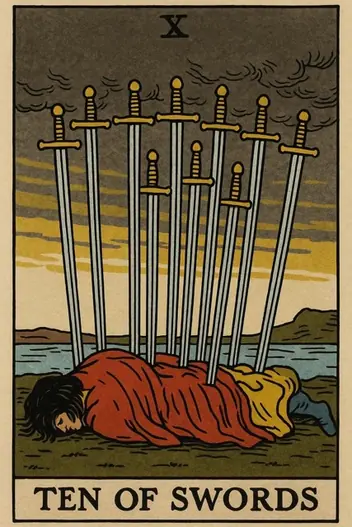
The intersection of the Nine of Wands and Ten of Swords represents a pivotal psychological moment: the point where chronic defensiveness meets a definitive, painful ending. The Nine of Wands embodies the vigilant survivor—wounded, weary, but still standing guard. The Ten of Swords depicts the inevitable conclusion—a crisis that cannot be ignored or fought off any longer.
When these cards appear together, they reveal a person who has been bracing for impact for so long that the actual blow feels both devastating and strangely relieving. The core tension here is between hyper-vigilance (Nine of Wands) and surrender to closure (Ten of Swords) . Pragmatically, this combination signals that the fight is over—not because you lost, but because continuing to guard against an already-landed blow drains resources needed for recovery.
Nine of Wands and Ten of Swords Card Meaning Explained
This pairing creates a cognitive dissonance between the instinct to keep fighting and the reality that the battle has already ended. The Nine of Wands mindset says, "I must remain on high alert," while the Ten of Swords reality counters, "The worst has already happened." The psychological state here is one of post-traumatic vigilance—your nervous system remains locked in survival mode even after the threat has passed.
The key insight is that resilience now requires a different strategy: not more defense, but deliberate acceptance and triage. The Ten of Swords often represents a necessary death—of a project, relationship, identity, or belief system. The Nine of Wands energy, if misapplied, keeps you propping up a broken wall. The healthy response is to assess what was actually lost versus what can be salvaged, then redirect your remaining energy toward recovery, not resistance.
Practically, this combination demands that you distinguish between protective wisdom and paranoid exhaustion. The Nine of Wands brings valuable lessons about boundaries and caution, but the Ten of Swords forces the realization that some outcomes are beyond your control. The merged energy asks: What would it mean to stop guarding a fortress that has already fallen?
Your pair is already on the table. Ask your question and draw the clarifying card
or simply focus on it
Nine of Wands and Ten of Swords: Career and Money
Strategic Opportunities:
Identify what is definitively over—a failed project, a toxic client, a dead-end role—and redirect your energy toward what still has potential. The Ten of Swords clears the path for new beginnings.
Strategic Opportunities:
Leverage your hard-won experience. The Nine of Wands has taught you what doesn't work, what warning signs to watch for, and how to set better boundaries. Use this knowledge to negotiate stronger terms in your next role or contract.
Calculated Risks:
Avoid the sunk cost fallacy. Do not invest more time, money, or emotional energy into a professional situation that has clearly ended. The Nine of Wands' persistence becomes self-destructive when applied to a lost cause.
In career readings, this combination often appears when a professional has been over-functioning to compensate for systemic problems—working overtime to save a failing project, covering for an incompetent colleague, or propping up a business model that no longer works. The Ten of Swords represents the inevitable collapse that occurs when individual effort cannot overcome structural failure.
Financially, this pairing warns against throwing good money after bad. The Nine of Wands instinct to "fight harder" can lead to risky investments or excessive spending to maintain appearances. Instead, the Ten of Swords calls for a strategic retreat: cut losses, consolidate resources, and focus on liquidating what no longer serves you. Bold financial warning: The most expensive mistake you can make right now is refusing to accept a loss that has already happened.
Ask your specific question
Don't rely on generic meanings. Get a customized reading tailored specifically to your energies.
Nine of Wands and Ten of Swords Love Outcome
If you are single:
This combination suggests you may be approaching new connections with excessive wariness from past wounds. The ending you fear has already occurred in a previous relationship—don't project it onto someone new. Focus on rebuilding trust gradually rather than expecting betrayal.
If you are in a relationship:
A significant conflict or betrayal may have occurred, and one partner is still in defense mode while the other sees the relationship as fundamentally over. Both partners must acknowledge the rupture honestly before deciding whether to rebuild or part ways.
In relationships, the Nine of Wands and Ten of Swords together signal a critical juncture where emotional exhaustion meets clarity. One partner may feel they've been fighting for the relationship alone (Nine of Wands), while the other feels the connection has already died (Ten of Swords). The danger is a stalemate of resentment: the wounded partner keeps re-litigating past hurts, preventing any genuine resolution.
The pragmatic path forward requires radical honesty about what each person actually wants. If the goal is reconciliation, both must agree to stop re-fighting old battles and instead address the root cause of the breakdown. If the goal is closure, the Nine of Wands energy must be channeled into setting firm boundaries for the separation, not into endless arguments about who was right. Bold relationship advice: Ask yourself—are you protecting a relationship that exists, or a memory of one that doesn't?
Nine of Wands and Ten of Swords Reversed: What Changes?
When cards appear in a reversed position, the dynamic becomes distorted, but does not disappear. This is not a "cancellation" of events, but a shift to the internal plane.
If the Nine of Wands is reversed:
This indicates blocked potential or, conversely, recklessness. The person is either so exhausted they cannot even assume a defensive stance (apathy), or, on the contrary, they rush headlong into things, ignoring real threats. Advice: you need not to defend, but to find external support. Delegate, ask for help, admit that you cannot cope alone.
If the Ten of Swords is reversed:
This is a classic case of internal resistance and prolonged agony. The blow has already been struck, but the person refuses to fall. They cling to the wreckage of the past, experiencing chronic pain instead of a single, definitive crisis. Warning: you are prolonging the inevitable. Your resistance to change is extending your suffering. Allow yourself to "fall" so you can rise anew.
If BOTH are reversed:
Complete imbalance — paralysis of the will. The energy of defense (Nine) is directed inward (self-analysis), while the energy of crisis (Ten) cannot be resolved. The person is in a state of "freeze," where there is neither the strength to defend nor the strength to surrender. The logical way to correct this: take a micro-step. Break out of the cycle of rumination. Perform any physical action that shatters the stasis — quit your job, write a statement, throw away old things.
The Shadow Side of Nine of Wands and Ten of Swords
The shadow manifestation of this combination is paralyzing pessimism disguised as realism. The Nine of Wands' vigilance can twist into chronic suspicion, while the Ten of Swords' finality can become a self-fulfilling prophecy of defeat. A seeker stuck in this shadow might interpret every minor setback as proof that "everything always ends badly," using past wounds to justify avoiding future risks.
Another pitfall is martyrdom: the Nine of Wands energy can create a narrative of being the sole survivor fighting against impossible odds, while the Ten of Swords validates the belief that "I always get stabbed in the back." This cognitive distortion prevents the seeker from seeing when they are perpetuating their own suffering by refusing to let go. The unconscious payoff is that remaining in crisis mode feels safer than facing the vulnerability of starting over.
The core cognitive bias here is catastrophizing—assuming the worst outcome is inevitable and over-preparing for disasters that never materialize. This combination can also trigger learned helplessness, where past failures convince the seeker that their actions no longer matter. The shadow side demands a hard question: Are you truly a victim of circumstance, or are you clinging to a wounded identity because it feels more familiar than healing?
Nine of Wands and Ten of Swords: Tarot Advice
Constructive use of this combination requires a rare quality from you — the courage to be defeated. The energy of the Nine of Wands is your will and resilience. The energy of the Ten of Swords is a reality stronger than your will. The strategic synthesis lies in directing your resilience not toward resisting the blow, but toward surviving it.
Imagine you are a general whose army has been routed. Continuing to defend a ruined fortress is madness. Your task is to preserve the lives of your soldiers (your resources) and retreat to regroup. The Nine of Wands gives you the strength not to die from your wounds, while the Ten of Swords provides the clear understanding that the old battle is lost. The deep strategy here is "planned defeat." You consciously cease struggle on one front to free up energy for another.
Your main asset in this situation is the capacity for radical acceptance. Do not try to "replay" the past or find someone to blame. Acknowledge: "Yes, I lost this round. My defensive strategy has exhausted itself." Once you do this, the weight of the Nine of Wands (constant tension) will dissolve, and the sharpness of the Ten of Swords (pain) will transform into the purity of a clean slate. The right decision now is not to rebuild the walls, but to step beyond them. Use the energy of defeat as fuel to explore new territory, where you will not have to constantly wait for a blow from behind.
Where to Go From Here
The Nine of Wands and Ten of Swords together deliver a stark but liberating message: the fight is over, and your survival now depends on acceptance, not resistance. You have been tested, wounded, and pushed to your limits—but the energy required to keep guarding a fallen position is energy you need for recovery. The core task is to honor your resilience while releasing the need to control outcomes already decided.
While this analysis provides the universal archetype, the true meaning of this combination depends entirely on your specific situation. Are you being asked to end a relationship, leave a job, or simply stop punishing yourself for a past failure? The Fortune Cards app can give you a deeply personalized interpretation of this exact pairing, tailored to your question and unique context. Use it on the web or download it now to discover what the Nine of Wands and Ten of Swords are revealing about your next move—because general advice is useful, but personal insight is what transforms knowledge into action.
Interpretation by the Fortune Cards editorial team, based on the Rider–Waite tradition and Jungian archetypes. About our methodology · Updated: 2026-08-26
Other Combinations with Nine of Wands
Other Combinations with Ten of Swords
Explore Individual Card Meanings
Table of Contents
- Nine of Wands and Ten of Swords Card Meaning Explained
- Nine of Wands and Ten of Swords: Career and Money
- Nine of Wands and Ten of Swords Love Outcome
- Nine of Wands and Ten of Swords Reversed: What Changes?
- The Shadow Side of Nine of Wands and Ten of Swords
- Nine of Wands and Ten of Swords: Tarot Advice
- Where to Go From Here
Ready to find answers to your questions?
Start your first reading now and look at your situation with fresh clarity. The cards are ready to reveal deeper meaning.