Seven of Swords and Ten of Swords Reversed in Tarot
- Arcana
- Seven of Swords — Minor Arcana, Swords; Ten of Swords — Minor Arcana, Swords
- Elements
- Seven of Swords — Air; Ten of Swords — Air
- Elemental interaction
- Same element — energies intensify each other
- Numerology
- 7 + 10 = 17 → 8
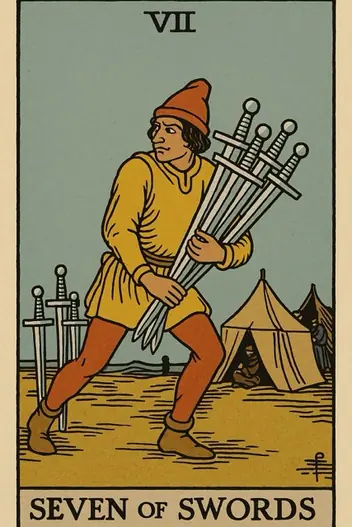
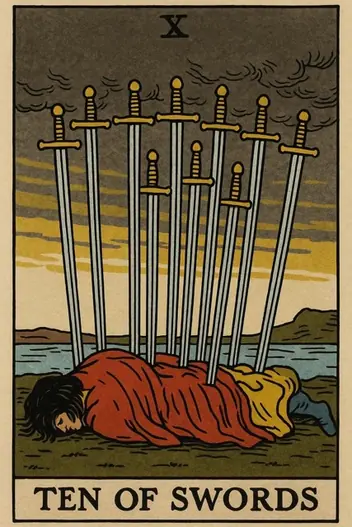
When the Seven of Swords—the card of cunning, stealth, and strategic withdrawal—meets the Ten of Swords—the card of painful endings, rock bottom, and inevitable defeat—we witness a psychological drama of cause and effect. This pairing often reveals a situation where deception or avoidance has reached its logical conclusion. The seeker may have attempted to "get away with something" or avoid a difficult truth, only to find that the consequences have caught up in a dramatic, albeit necessary, fashion.
This combination is less about fortune-telling and more about accountability and the end of a psychological game. The Seven of Swords represents the mind’s capacity for self-protection through misdirection, while the Ten of Swords signifies the moment when the truth cannot be denied any longer. Together, they point to a critical juncture where the cost of a lie—whether told to others or oneself—becomes undeniable. The question is not whether the pain is real, but what the seeker will choose to learn from it.
Seven of Swords and Ten of Swords Together: Meaning
The core dynamic here is a feedback loop between strategy and consequence. The Seven of Swords energy is about calculated risk—taking a shortcut, hiding information, or acting unilaterally to gain an advantage. However, the Ten of Swords reveals that this strategy has backfired. The psychological state is one of shock, exhaustion, and the bitter taste of defeat. The seeker may feel "stabbed in the back," but the cards suggest they may have been complicit in their own downfall through poor judgment or ethical lapses.
This pairing forces a confrontation with cognitive dissonance: the gap between what the seeker believed they could get away with and the harsh reality of the outcome. The Ten of Swords is not a punishment, but a reset mechanism. It strips away the illusions that the Seven of Swords tried to maintain. The key insight here is that the pain is finite. The Ten of Swords, despite its dramatic imagery, represents a low point from which recovery is possible—provided the seeker stops trying to manipulate the situation further.
In practical terms, this combination demands radical honesty. The seeker must assess: What did I try to avoid or conceal? And how did that avoidance lead to this collapse? The path forward is not about fighting the ending, but about surrendering the need to control the narrative. The psychological growth lies in accepting that some battles are lost so that a more authentic path can begin.
Seven of Swords and Ten of Swords as Feelings
If you are single:
This combination suggests you may be attracted to someone who is emotionally unavailable or dishonest, or you are hiding your true intentions. The lesson is to stop chasing people who require you to play games. A clean break is better than a drawn-out deception.
If you are in a relationship:
There is a high probability of betrayal, hidden resentments, or a significant breach of trust coming to light. The relationship may be ending, or it must undergo a painful but necessary transformation. Avoid blaming games; focus on accountability.
In relationships, this pairing often indicates a power struggle where one partner has been secretly undermining the other, or where both have been avoiding a difficult truth. The Seven of Swords can represent passive-aggressive behavior, infidelity, or withholding information, while the Ten of Swords shows the emotional fallout—a dramatic argument, a breakup, or a deep wound that cannot be ignored.
The most critical advice is to stop the cycle of retaliation. If you have been hurt, the temptation may be to "get even" or to prove you were right. This only deepens the wound. Instead, use this moment to set clear boundaries and accept the end of the current dynamic. For couples willing to work through it, this combination demands complete transparency and a willingness to rebuild from scratch. For singles, it warns against entering situations where you feel you have to hide your true self or settle for less than honesty.
Your pair is already on the table. Ask your question and draw the clarifying card
or simply focus on it
Seven of Swords and Ten of Swords in Career Readings
Strategic Opportunities:
Identify the weak point in your current strategy. The collapse reveals exactly where your plan was flawed. This is data, not failure.
Strategic Opportunities:
Use the "reset" to renegotiate terms. The Ten of Swords clears the board; you can now propose a simpler, more honest arrangement with stakeholders.
Calculated Risks:
Avoid covering up mistakes or blaming others. The Seven of Swords energy is tempting here, but it will only lead to a second, more painful fall.
In a professional context, this combination often signals the end of a project, a job, or a business relationship that was built on shaky foundations. The Seven of Swords might represent cutting corners, intellectual property theft, or office politics, while the Ten of Swords shows the inevitable exposure and collapse. This can be a scandal, a layoff, or a major financial loss.
The pragmatic interpretation is that this is a time for damage control, not for spinning the narrative. Do not attempt to "smooth things over" with half-truths. The most strategic move is to accept responsibility for your part in the failure and focus on what can be salvaged. Financially, this combination warns against investing more money or energy into a losing proposition. The Ten of Swords says: Stop throwing good money after bad. Instead, cut your losses, learn the lesson, and pivot to a more ethical or sustainable approach. The long-term career gain comes from the reputation for integrity you build by handling this collapse with honesty.
Seven of Swords and Ten of Swords Reversed: What Changes?
The reversed position of the cards shifts the focus from external action to the internal state.
Seven of Swords Reversed:
This is blocked potential. You cannot or are afraid to use your cunning and intellect for protection. Instead of active maneuvering, you freeze, making you vulnerable. Advice: stop waiting for the perfect moment to escape — act right now, even if it feels uncomfortable.
Ten of Swords Reversed:
This is internal resistance and weakness. The collapse has already occurred, but you refuse to acknowledge it. You lie there "playing dead," hoping everything will resolve on its own. Warning: this is a state of apathy and denial. You need to get up and start clearing the rubble, otherwise you will become stuck in depression.
BOTH Reversed:
A complete imbalance of dynamics. This is paralysis of the will combined with denial of reality. You are simultaneously afraid to deceive and afraid to admit defeat. The logical way to correct this: seek external, objective help (a coach, a psychologist). You need an "external brain" that can see the situation without your distortions.
Get a personalized interpretation
Unlock the combined meaning of your cards in the context of your unique question — for free.
Negative Meaning of Seven of Swords and Ten of Swords
The shadow side of this combination is self-sabotage through cynicism and victimhood. The seeker may have used the Seven of Swords' cleverness to justify unethical behavior, telling themselves "everyone does it" or "I have no other choice." When the Ten of Swords hits, the shadow response is to play the victim and blame external circumstances, rather than acknowledging their own agency in the collapse.
Another pitfall is cognitive bias known as "sunk cost fallacy" —the belief that because you have invested so much (time, money, emotion), you must continue the deception or the struggle. This pairing warns that persisting in a flawed strategy will only increase the pain. The shadow also includes paranoia: after being betrayed or experiencing a dramatic failure, the seeker may become overly suspicious, unable to trust anyone, and tempted to use the Seven of Swords' tactics of secrecy to protect themselves. This only creates a cycle of isolation and further deception.
The greatest danger is refusing to learn the lesson. If the seeker simply "moves on" without understanding how their own mindset (the Seven of Swords) contributed to the outcome (the Ten of Swords), they are likely to repeat the pattern in a different context. The shadow asks: Are you willing to see your own role in this story, or will you remain a character in a drama you claim not to have written?
Seven of Swords and Ten of Swords: Tarot Advice
How to constructively use the energy of the Seven of Swords to balance the Ten of Swords? The key lies in changing the goal. Instead of using your intellect to circumvent rules (Seven), direct it toward preventive avoidance of collapse (Ten). Your cunning should serve not escape, but strategic planning.
A profound strategic advice: accept the "worst-case scenario" as a given. Psychologically, this exercise is called "Stoicism." Imagine the Ten of Swords has already happened—you've lost money, relationships, or reputation. What will you do? Once you accept this reality, fear vanishes, and the Seven of Swords transforms from a tool of deception into a tool of damage control.
Your new strategy: "I know I can lose. Now I build a plan to minimize losses, not to avoid them." This is the only way to break the cycle of "illusion—collapse." Use your analytical mind to create escape routes and safety nets, not to build houses of cards.
Where to Go From Here
The core message of Seven of Swords and Ten of Swords is accountability through crisis. This is not a card of permanent doom, but of necessary endings that clear the path for renewal. The pain you feel is the price of the illusion you were holding onto. Your next step is to stop running, stop hiding, and face the truth with clarity. The only way out is through, and the only way through is with radical honesty.
While this analysis provides a deep archetypal understanding, every situation is unique. The true power of Tarot lies in applying these insights to your specific question, your personal history, and your current emotional state. To get a personalized, in-depth reading of how the Seven of Swords and Ten of Swords apply to your life—whether in love, career, or personal growth—use the Fortune Cards app. You can access it directly on the web or download it to receive a custom interpretation tailored to your exact circumstances, right now. Don't just read about the archetypes; let them speak directly to you.
Interpretation by the Fortune Cards editorial team, based on the Rider–Waite tradition and Jungian archetypes. About our methodology · Updated: 2026-09-17
Other Combinations with Seven of Swords
Other Combinations with Ten of Swords
Explore Individual Card Meanings
Table of Contents
- Seven of Swords and Ten of Swords Together: Meaning
- Seven of Swords and Ten of Swords as Feelings
- Seven of Swords and Ten of Swords in Career Readings
- Seven of Swords and Ten of Swords Reversed: What Changes?
- Negative Meaning of Seven of Swords and Ten of Swords
- Seven of Swords and Ten of Swords: Tarot Advice
- Where to Go From Here
Ready to find answers to your questions?
Start your first reading now and look at your situation with fresh clarity. The cards are ready to reveal deeper meaning.