Love Tarot: Six of Cups and Three of Swords
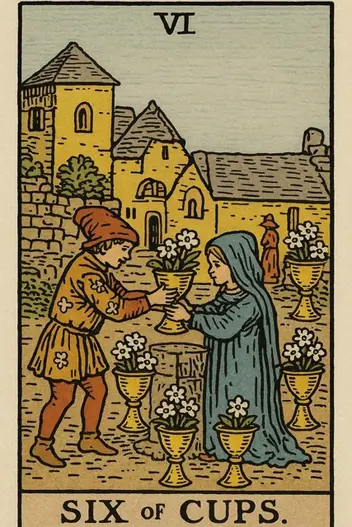
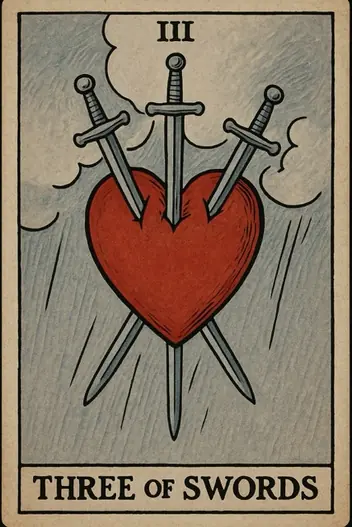
- Arcana
- Six of Cups — Minor Arcana, Cups; Three of Swords — Minor Arcana, Swords
- Elements
- Six of Cups — Water; Three of Swords — Air
- Elemental interaction
- Neutral elements — energies coexist without conflict
- Numerology
- 6 + 3 = 9
These two cards create a powerful psychological collision. The Six of Cups represents a return to innocence, past memories, and the comfort of familiar emotional patterns. The Three of Swords represents heartbreak, cognitive dissonance, and the piercing clarity that comes from acknowledging painful truths. When they appear together, they signal a moment where cherished memories must be re-examined through the lens of reality.
This combination often appears when you are holding onto a version of the past that no longer serves you. The key psychological tension here is between the comfort of nostalgia and the necessity of emotional honesty. You may be romanticizing a person, situation, or identity from your past, while the Three of Swords demands you see it clearly—even if that clarity stings.
Six of Cups and Three of Swords Combination Meaning
The Six of Cups activates the archetype of the "Inner Child" and the ego's tendency to seek safety in familiarity. When combined with the Three of Swords, which represents the "Wounded Healer" archetype, the result is a confrontation between emotional comfort and objective truth. The mind wants to retreat to a safer, simpler time, but reality insists on exposing the flaws in that narrative.
This combination is not about wallowing in pain, but about using that pain as a diagnostic tool. The Three of Swords cuts through the illusion of the "perfect past" that the Six of Cups presents. The practical implication is clear: you must identify which memories are fueling your current decisions and whether those memories are accurate or distorted. This is a moment for cognitive reframing—not abandoning the past, but integrating its lessons without being controlled by its emotional pull.
Expect a period of emotional recalibration. You may feel torn between honoring a positive memory and acknowledging how that situation actually hurt you. The healthy resolution is to accept that both truths can coexist: the sweetness of the past and the pain of its ending. Your next strategic move is to stop using nostalgia as a shield against present responsibility.
Your pair is already on the table. Ask your question and draw the clarifying card
or simply focus on it
Career Meaning of Six of Cups and Three of Swords
Strategic Opportunities:
Leverage your institutional memory and past experience to solve a current problem. Your history gives you a unique perspective that newer colleagues lack. Use this to negotiate for a leadership role in a project requiring deep context.
Strategic Opportunities:
Reconnect with a former mentor, client, or colleague who can provide a fresh, honest perspective. The Three of Swords here suggests that a constructive critique from someone who knows your history will be invaluable for your next career move.
Calculated Risks:
Do NOT return to a previous job, business partner, or investment strategy out of sentimentality. The Six of Cups can tempt you to "go back to what worked," but the Three of Swords warns that the same conditions that caused the original pain will recur. Objectively assess why you left in the first place.
Financially, this combination is a red flag for emotional spending. You may be tempted to spend money on "retro" experiences, rekindling old business relationships, or buying assets associated with a happier time in your life. Bold financial warning: Treat any financial decision tied to a memory as a high-risk emotional investment. Subject all such decisions to a 72-hour cooling-off period and run them past a trusted, objective advisor. The Three of Swords demands that you cut ties with any financial commitment that is based on hope rather than data.
Strategic tip: Use this energy to audit your professional network. Identify which relationships are based on genuine mutual benefit and which are held together by shared history alone. Prune the latter without guilt. Your career will advance faster when you stop investing energy in connections that only exist because of past comfort.
Six of Cups and Three of Swords in Love Tarot
If you are single:
Evaluate whether you are comparing new connections to an idealized ex or past relationship. This combination warns that your attachment to a memory may be blocking you from seeing a real, available partner clearly. Let go of the "what could have been" to make room for "what is."
If you are in a relationship:
A past wound is likely resurfacing in your current dynamic. You or your partner may be projecting unresolved pain from a previous relationship onto the present. Identify the specific trigger—a word, a gesture, a situation—and discuss it without blame.
The core relationship advice here is about emotional honesty without martyrdom. The Six of Cups can create a dynamic where one partner romanticizes the "good old days" of the relationship, while the Three of Swords reveals that those days were not as good as remembered. This is a call to renegotiate the relationship's narrative. Ask: "What are we holding onto that no longer serves us?" and "What painful truth have we been avoiding?"
Bold action: Schedule a non-negotiable conversation where both partners share one "uncomfortable truth" about the relationship's past. The goal is not to assign blame, but to update your shared story so it aligns with reality. This combination predicts that avoiding this conversation will lead to passive-aggressive resentment and emotional distance.
Ask your specific question
Don't rely on generic meanings. Get a customized reading tailored specifically to your energies.
What If Six of Cups or Three of Swords Appears Reversed?
If the Six of Cups is reversed:
This indicates a blocked potential of the past or, conversely, a reckless denial of one's own experience. You either cannot access the resources of the past (forgotten your skills, burned bridges) or you are so afraid of pain that you refuse any positive memories. Advice: find one thing that used to bring you joy and do it today. This will restore the flow.
If the Three of Swords is reversed:
This is a signal of internal resistance to healing. The pain is there, but you are suppressing it, not allowing yourself to experience and release it. This leads to chronic fatigue and psychosomatic issues. Warning: ignoring the pain will not make it disappear. You need to create a safe space for "legal suffering"—for example, set aside 15 minutes a day to consciously feel sad.
If BOTH are reversed:
Complete imbalance. The past is forgotten, but the pain remains. This is a state of emotional amnesia—you feel anxiety but don't understand its cause. Method for correction: start keeping an emotion journal. Write down what you feel throughout the day and look for triggers. Re-establish the connection between the cause (past experience) and the effect (current pain) to begin conscious work.
What Are the Risks of Six of Cups and Three of Swords?
The shadow manifestation of this combination is emotional masochism. The seeker may unconsciously seek out situations that re-create their original wound, believing that re-experiencing the pain will somehow heal it. This is the repetition compulsion at its most destructive—you keep returning to the same toxic person, job, or pattern because the familiarity feels safer than the unknown, even when it hurts.
Cognitive biases to watch for: The rosy retrospection bias (believing the past was better than it actually was) and the sunk cost fallacy (staying in a bad situation because you've already invested so much time or emotion). The Three of Swords here is not a punishment—it is a signal that your brain is lying to you about the past. If you ignore this signal, you risk making a major life decision based on a fantasy.
Poor judgment manifests as "rescuer" behavior. You may feel compelled to "fix" a person or situation from your past, believing that this time you can make it right. This is a trap. The Six of Cups' innocence combined with the Three of Swords' pain creates a dangerous narrative: "If I just try harder, I can heal this old wound." You cannot heal the past by repeating it. The only path forward is to accept the loss, grieve it, and move on.
Synthesis: Strategic Conclusion
The main strategic task of this combination is to transform nostalgia from a source of pain into a source of strength. The Six of Cups should not be an anchor dragging you down. It must become the foundation upon which you build a new structure. To do this, you need to separate the essence of past experience from its form.
The essence is the feeling of security, joy, creativity. The form is a specific person, place, or job. Your task is to understand exactly which essence you are seeking and find a new, healthy form for it in the present. The Three of Swords in this process is your ally. It shows where the form no longer works. The pain is a signal that you are holding onto something it is time to let go.
Constructive algorithm for action:
Diagnosis:
Identify which feeling from the past you are trying to reclaim (security, recognition, excitement).Acknowledgment:
Acknowledge that the old form of this feeling is destroyed. Allow yourself to experience the pain of this loss (working with the Three of Swords).Integration:
Take the "essence" from the past and ask yourself: "In what new endeavor or relationship can I experience this feeling today?"Action:
Take one small step in this new direction.
This combination does not accuse you of being stuck in the past. It offers you the intellectual and emotional courage to admit that the bridge is burned, but on the other shore, you are not facing an abyss, but new land. Use the lessons of the past as a map, but walk forward along it, not backward.
Where to Go From Here
The Six of Cups and Three of Swords together deliver a clear message: honor your past without being imprisoned by it. The pain you feel is not a reason to retreat—it is a signal to update your internal map. Your memories are data points, not destinations. The goal is to integrate the sweetness of what was with the clarity of what is, and then make decisions based on the present, not the past.
While this article provides the general archetype, the true magic happens when Tarot is applied to your unique situation. Your specific question, your personal history, and the surrounding cards in your spread will dramatically shift the meaning of this combination. To get a deep, personalized interpretation of the Six of Cups and Three of Swords for your exact question right now, use the Fortune Cards app. You can access it on the web or download it—it will give you the clarity and strategic direction you need to move forward with confidence.
Interpretation by the Fortune Cards editorial team, based on the Rider–Waite tradition and Jungian archetypes. About our methodology · Updated: 2026-08-26
Other Combinations with Six of Cups
Other Combinations with Three of Swords
Explore Individual Card Meanings
Table of Contents
- Six of Cups and Three of Swords Combination Meaning
- Career Meaning of Six of Cups and Three of Swords
- Six of Cups and Three of Swords in Love Tarot
- What If Six of Cups or Three of Swords Appears Reversed?
- What Are the Risks of Six of Cups and Three of Swords?
- Synthesis: Strategic Conclusion
- Where to Go From Here
Ready to find answers to your questions?
Start your first reading now and look at your situation with fresh clarity. The cards are ready to reveal deeper meaning.