Ten of Swords and Knight of Swords Meaning in Tarot
- Arcana
- Ten of Swords — Minor Arcana, Swords; Knight of Swords — Minor Arcana, Swords
- Elements
- Ten of Swords — Air; Knight of Swords — Air
- Elemental interaction
- Same element — energies intensify each other
- Numerology
- 10 + 12 = 22 → 4
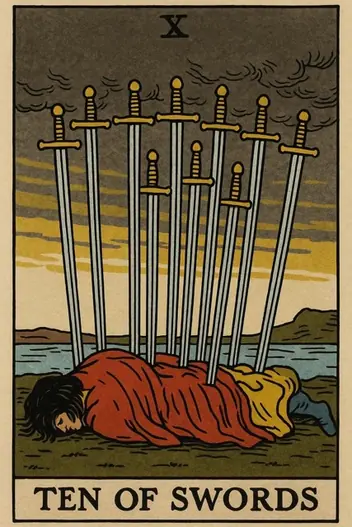
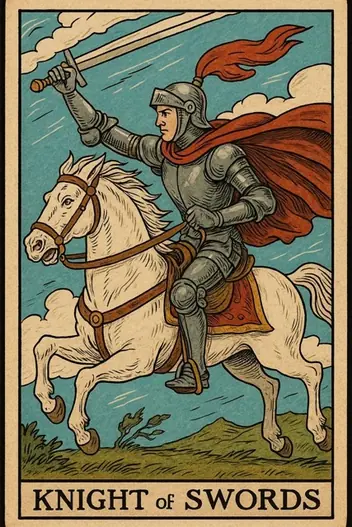
When the Ten of Swords—the card of painful endings, rock bottom, and unavoidable defeat—meets the Knight of Swords—the archetype of rapid, assertive, and often reckless action—we witness a collision of finality and forward momentum. This combination suggests a situation where a decisive blow has been struck, but the mind is already racing toward the next battle. The core psychological tension here is between accepting a necessary loss and impulsively charging into a new conflict without processing the trauma of the last one.
In practical terms, this pairing often appears when someone has been "cut down" by an idea, a relationship, or a career setback, yet their ego refuses to pause. The Knight of Swords energy wants to immediately reframe the defeat as a "lesson learned" and sprint toward a new goal. However, the Ten of Swords warns that true growth requires a period of stillness to analyze what just happened, rather than simply swapping one battlefield for another.
Ten of Swords and Knight of Swords Card Meaning Explained
The Ten of Swords represents the psychological nadir—the moment when cognitive dissonance collapses and the seeker can no longer deny the reality of a situation. It is often linked to betrayal, burnout, or a mental breakdown that forces a complete reset. In Jungian terms, this is the "dark night of the soul," where the ego must confront its own limitations and the shadow of victimhood. The Knight of Swords, conversely, embodies the air element in its most aggressive state: logic without empathy, speed without reflection, and a relentless drive to cut through obstacles. Together, they create a volatile mix of post-traumatic stress and manic defense.
The key insight here is that the Knight of Swords is not a healing force—it is a survival mechanism. When these cards appear together, the seeker may be using intellectual activity (planning, arguing, strategizing) to avoid feeling the pain of the Ten of Swords. This is a red flag for burnout. The mind is trying to outrun the body's exhaustion. The most pragmatic interpretation is that you have already been defeated in one arena, and your next move must be calculated, not reactive. The Knight's speed must be tempered by the Ten's wisdom: some battles are not meant to be re-fought.
Your pair is already on the table. Ask your question and draw the clarifying card
or simply focus on it
Ten of Swords and Knight of Swords Love Outcome
If you are single:
This combination warns against jumping into a new relationship immediately after a painful breakup. The Knight of Swords energy may make you feel ready to "win" at dating, but you risk repeating the same patterns. Take three to six months of intentional solitude to process the past.
If you are in a relationship:
You or your partner may be using arguments or intellectual debates to avoid addressing a deeper wound. The Ten of Swords indicates a past betrayal or hurt that has not been fully healed. Do not let the Knight's sharp tongue escalate a conflict that needs quiet repair.
In relationships, this pairing often signals a toxic cycle of crisis and rebound. One partner (the Knight) may have caused a painful ending (the Ten) through impulsive words or actions, then immediately tries to "fix" things with grand gestures or logical explanations. The core problem is a lack of emotional integration. The Knight of Swords cuts off feelings to stay in control, while the Ten of Swords represents the emotional wreckage left behind. The most sophisticated advice here is to stop trying to "solve" the relationship with your mind. Instead, practice radical acceptance of what has ended. Only then can a new, healthier dynamic emerge—if at all. If you are the one holding the sword, ask yourself: Am I trying to win an argument, or am I trying to heal a wound?
Ask your specific question
Don't rely on generic meanings. Get a customized reading tailored specifically to your energies.
Ten of Swords and Knight of Swords in Career Readings
Strategic Opportunities:
Use the Knight's clarity to identify exactly which project or role ended and why. This is a moment to cut dead weight from your portfolio—fire clients, quit toxic teams, or abandon failing strategies.
Strategic Opportunities:
The Ten of Swords provides a clean slate. The Knight's energy can be channeled into aggressively networking or applying for roles that are a complete departure from your previous failure. Pivot, don't persist.
Calculated Risks:
Avoid making any major financial moves for 30 days. The Knight of Swords is prone to overestimating resources and underestimating competition. Do not invest in "revenge projects" or impulsive business expansions designed to prove others wrong.
In a career context, this combination is a double-edged sword. On one hand, the Knight of Swords brings the mental agility to see a new path forward after a professional setback (layoff, failed pitch, public mistake). On the other hand, the Ten of Swords warns that your judgment is currently compromised by adrenaline and ego. The pragmatic strategy is to use the first week after a defeat purely for data gathering: review what went wrong without self-blame, collect feedback, and map out three possible next moves. Then, and only then, deploy the Knight's speed. A critical financial warning: Do not take out loans or make speculative bets to "recover" lost income. The Ten of Swords symbolizes a bottom that must be touched before recovery begins. Let the bankruptcy of the old idea be complete.
Ten of Swords and Knight of Swords Reversed Meaning
If the Ten of Swords is Reversed:
The crisis is not completed, but blocked. The person does not allow themselves to experience the pain of defeat, suppressing their emotions. The Knight of Swords in the upright position then becomes reckless denial of reality. You act aggressively, but do not see that the situation has not yet been resolved. Advice: close the gestalt — acknowledge the losses and only then act.
If the Knight of Swords is Reversed:
The energy for action is paralyzed by fear. The person knows they need to cut to the quick, but cannot bring themselves to do it. The Ten of Swords in the upright position exerts pressure through feelings of guilt and hopelessness. Warning: this state of stagnation is dangerous for the psyche. External support or a hard deadline is necessary to get moving from a standstill.
If BOTH are Reversed:
Complete imbalance — neither is the crisis acknowledged, nor are any actions taken. This is a stalemate situation where the person lives in the illusion that "everything is not so bad," yet changes nothing. The logical way to correct this: force the crisis — deliberately create a situation that compels action (e.g., a public promise, resigning of one's own accord).
The Shadow Side of Ten of Swords and Knight of Swords
The shadow of this combination is manic denial—a state where the seeker refuses to grieve and instead doubles down on the same flawed logic that caused the crisis. The Knight of Swords, when unintegrated, becomes a bully or a fanatic, using sharp words to blame others for the Ten of Swords' defeat. This leads to a cognitive bias called "sunk cost fallacy" : the belief that because you've already suffered, you must keep fighting. In reality, the Ten of Swords demands surrender. Another pitfall is self-sabotage through over-analysis: the Knight's relentless thinking can churn the Ten's trauma into a narrative of victimhood, preventing any real action. The shadow manifests as cutting off support systems ("I don't need anyone") or engaging in high-risk behaviors (reckless driving, gambling, aggressive confrontation) to feel alive again. The ultimate risk is a complete nervous system crash—the Knight's charge burns out the body, while the Ten's despair overwhelms the mind.
Ten of Swords and Knight of Swords: The Combined Message
How can the energy of the Ten of Swords be used constructively to balance the Knight of Swords? The answer is paradoxical: you must acknowledge your defeat in order to earn the right to a new battle. The Ten of Swords is not a curse, but a starting point. It says: "The old is dead. Do not try to revive it." Your task is not to fight the past, but to use it as a launching pad.
The Knight of Swords in its healthy form is speed without haste. Imagine you are a surgeon in an operating room: your movements are swift, yet precise, because you know the anatomy (the lessons of the past). The main strategic advice: make a list of 3 things you have lost and 3 lessons you have learned. Then make a decision: "I will never make these mistakes again." This will transform blind aggression into conscious strategy.
Your strength now lies in uncompromising honesty with yourself. Do not waste energy blaming others or engaging in self-flagellation. The Ten of Swords has already shown you the bottom—there is nowhere lower to fall. This means any movement forward is growth. Act like a samurai after defeat: accept the death of your ego, rise, and move on without looking back. Clarity, not speed, is your main resource.
Your Next Step: Personal Context Matters
The core message of the Ten of Swords and Knight of Swords is this: You have hit a wall, but your mind is already trying to climb it. Stop. The wall is telling you to change direction, not just try harder. The Knight's speed is a gift, but only if it is directed toward a new horizon, not a futile attempt to undo the past. Honor the ending. Then, move with precision.
While this article provides a deep archetypal analysis, the true power of Tarot lies in how these cards speak to your specific question. The Fortune Cards app allows you to enter your exact situation—a relationship conflict, a career crossroads, a financial decision—and receive a personalized interpretation of this combination. No generic advice. Just the insight you need, tailored to your context. Use it on the web or download it now to get your unique reading.
Interpretation by the Fortune Cards editorial team, based on the Rider–Waite tradition and Jungian archetypes. About our methodology · Updated: 2026-09-17
Other Combinations with Ten of Swords
Other Combinations with Knight of Swords
Explore Individual Card Meanings
Table of Contents
- Ten of Swords and Knight of Swords Card Meaning Explained
- Ten of Swords and Knight of Swords Love Outcome
- Ten of Swords and Knight of Swords in Career Readings
- Ten of Swords and Knight of Swords Reversed Meaning
- The Shadow Side of Ten of Swords and Knight of Swords
- Ten of Swords and Knight of Swords: The Combined Message
- Your Next Step: Personal Context Matters
Ready to find answers to your questions?
Start your first reading now and look at your situation with fresh clarity. The cards are ready to reveal deeper meaning.