Ten of Swords and Seven of Pentacles Together in Tarot
- Arcana
- Ten of Swords — Minor Arcana, Swords; Seven of Pentacles — Minor Arcana, Pentacles
- Elements
- Ten of Swords — Air; Seven of Pentacles — Earth
- Elemental interaction
- Opposing elements — energies create tension
- Numerology
- 10 + 7 = 17 → 8
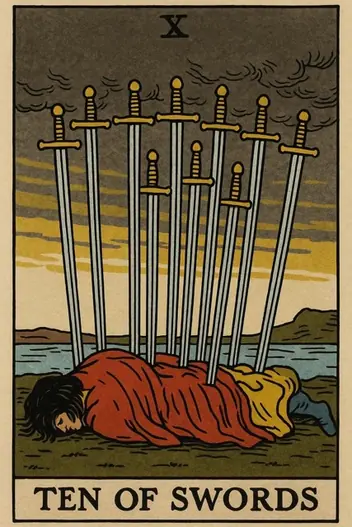
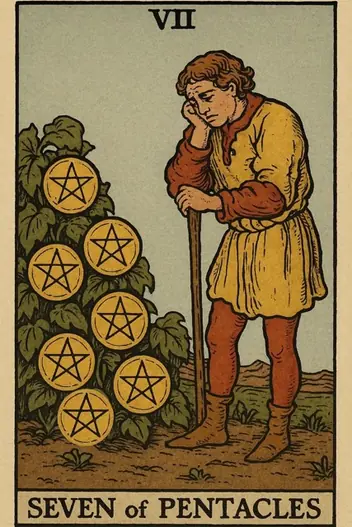
When the Ten of Swords—the card of painful endings, betrayal, and rock-bottom mental defeat—crosses paths with the Seven of Pentacles—the card of patient cultivation, assessment, and delayed harvest—a powerful psychological tension emerges. This combination speaks to a moment where you are forced to evaluate the debris of a collapse while simultaneously questioning whether your long-term efforts were ever worth the pain.
The intersection here is not about immediate recovery. It is about strategic grief: acknowledging the loss without abandoning the discipline of tending to what remains. Pragmatically, this pairing suggests that a major chapter has ended, but the seeds of your next growth phase are still in the ground—waiting for you to decide if they are worth watering.
Ten of Swords and Seven of Pentacles Combination Meaning
The psychological state created by the Ten of Swords and Seven of Pentacles is one of exhausted evaluation. You have just endured a sharp, decisive blow—perhaps a betrayal, a project failure, or a relationship collapse. The Ten of Swords represents the mental narrative that “it’s over.” Yet the Seven of Pentacles pulls you back from despair into a state of calculated patience. It asks: What did this pain teach you about your investments?
This is not a time for rash action. Instead, the mind must shift from catastrophic thinking (Ten of Swords) to strategic reflection (Seven of Pentacles). The key insight here is that the ending is not the final verdict—it is the data point. You are being asked to separate the emotional wound from the practical lesson. The combination warns against two extremes: dwelling in victimhood or rushing to plant new seeds before the soil has been assessed.
The real work is in the pause. You must resist the urge to either collapse into despair or prematurely pivot to a new venture. Instead, inventory what remains: your skills, your resources, your boundaries. The Seven of Pentacles gives you permission to take a season to review before committing to the next cycle.
Your pair is already on the table. Ask your question and draw the clarifying card
or simply focus on it
Ten of Swords and Seven of Pentacles in Love Tarot
If you are single:
This combination suggests you are emerging from a painful romantic ending—perhaps a betrayal or a clear rejection. Do not rush into dating. Use this time to evaluate what you truly need from a partner, not just what you want to avoid.
If you are in a relationship:
You may be in a period of emotional exhaustion after a major conflict or breach of trust. The relationship is not dead, but it requires a sober assessment of whether the effort is sustainable.
In relationships, the Ten of Swords and Seven of Pentacles points to a crisis of investment. One partner may feel deeply wounded (Ten of Swords), while the other is quietly assessing whether the relationship is worth the ongoing work (Seven of Pentacles). This creates a power imbalance where one person is grieving and the other is calculating.
The critical advice here is to avoid demanding immediate resolution. The wounded partner needs validation of their pain, not a quick fix. The assessing partner needs space to observe without pressure. Bold key relationship advice: Separate the emotional narrative from the practical reality. Ask: Is this a relationship that can be rebuilt with new boundaries, or is the foundation too damaged to support future growth? The answer lies in honest, non-defensive communication about what each person is willing to invest.
Career and Finances
Strategic Opportunities:
Use the post-crisis lull to audit your professional network and skill set. The Seven of Pentacles favors reflection over action right now.
Strategic Opportunities:
Consider a “sabbatical” or reduced workload to process the failure without making impulsive career changes.
Calculated Risks:
Avoid doubling down on a failing project or relationship with a client. The Ten of Swords warns that further investment here will only deepen the loss.
In your career, this combination often appears after a major professional setback: a layoff, a failed launch, a public mistake, or a toxic work environment that finally broke you. The Ten of Swords signals that the situation is truly over—do not try to resurrect it. The Seven of Pentacles shifts your focus to long-term sustainability. Instead of scrambling for the next job or project, take a deliberate pause to review your career trajectory.
Financially, this is a time for conservation, not expansion. Bold important financial warnings: Do not invest new capital into old ventures that have already shown signs of failure. The Seven of Pentacles warns that some crops are not worth harvesting. Instead, cut your losses cleanly (Ten of Swords) and redirect your energy toward low-risk, high-patience assets like skill development, networking, or saving. The combination suggests that the next six months should be about stabilization, not growth.
Deepen your understanding
Find out exactly what this reading means for your current life situation with our oracle.
Shadow Side & Pitfalls
The shadow of this pairing is a paralyzing cycle of rumination and inaction. The Ten of Swords can trap you in a victim narrative—“I was betrayed, I am powerless”—while the Seven of Pentacles can feed procrastination disguised as patience—“I’ll just wait a little longer before deciding.” This creates a cognitive bias called the sunk cost fallacy: you may cling to a failed relationship or career because you’ve already invested so much time and emotion.
Another pitfall is emotional numbness. The Ten of Swords delivers a blow so sharp that you may dissociate from your feelings, while the Seven of Pentacles encourages you to “just keep working.” This can lead to burnout masked as productivity. You might throw yourself into busywork to avoid processing the grief, which only delays the necessary healing.
The most dangerous shadow is misinterpreting patience as passivity. The Seven of Pentacles is not about doing nothing—it is about observing, measuring, and planning. Without conscious reflection, you risk repeating the same patterns that led to the Ten of Swords in the first place.
Reversed Ten of Swords and Seven of Pentacles Explained
If the Ten of Swords is Reversed:
This is a sign of a protracted crisis or a refusal to accept defeat. Instead of experiencing the finale and moving on, the person gets stuck in fear and paranoia. Warning: you may be afraid to finish what is already dead, prolonging the agony. Advice: find the courage to deliver a "controlled blow" and sever the ties that are destroying you.
If the Seven of Pentacles is Reversed:
Internal resistance and laziness manifest. The person does not want to audit their investments, preferring self-deception. The weakness here is procrastination at a critical moment. Advice: apply the Pareto principle — find the 20% of efforts you are wasting and stop them immediately.
If BOTH are Reversed:
Complete imbalance — paralysis of will. You are simultaneously unable to finish the old and unwilling to start the new. This is a state of deep apathy. A logical way to correct this: start small. Choose one area of life (e.g., finances) and conduct a one-hour audit. Complete one micro-project to break the vicious cycle of inaction.
Synthesis: Strategic Conclusion
Constructive use of this pair requires the courage to acknowledge losses and cold calculation for the future. The Ten of Swords is not a verdict, but a liberation from illusions. It cuts away everything superfluous, leaving you bare before the fact: "This didn't work." The Seven of Pentacles gives you a tool for analysis — "What exactly did I do wrong? Where did I overestimate my strength?"
Your main task is to transform the energy of defeat into fuel for a new start. To do this, you need to take three steps:
- Accept the ending. Stop mentally returning to what could have been. Bury it.
- Conduct an audit. With a cool head, write down what you gained (experience, skills, connections) and what you lost (time, money, relationships).
- Place your bet on a different field. The Seven of Pentacles is a card of choice. Now you know in which soil not to plant seeds. Strategic advice: use this crisis for a radical shift in priorities. Do not try to "force" the past — create something new, relying on the lessons learned.
This union teaches that true strength lies not in the ability to cling to what is dying, but in the capacity to let go in time and start anew from a clean slate.
Applying This to Your Situation
The Ten of Swords and Seven of Pentacles together tell a story of necessary endings and deliberate pauses. The pain you feel is real, but it is not the end of your story—it is the foundation for a wiser, more resilient chapter. The core message is: Honor the loss, but do not let it define your future. Take time to assess what you truly want to cultivate next.
This article provides the general archetype, but the true magic happens when Tarot is applied to your unique situation. To get a deep, personalized interpretation of this exact combination for your specific question right now, use the Fortune Cards app. Whether you access it on the web or download it, the app will guide you through a tailored reading that considers your exact context—so you can move from analysis to action with clarity.
Interpretation by the Fortune Cards editorial team, based on the Rider–Waite tradition and Jungian archetypes. About our methodology · Updated: 2026-08-26
Other Combinations with Ten of Swords
Other Combinations with Seven of Pentacles
Explore Individual Card Meanings
Table of Contents
Ready to find answers to your questions?
Start your first reading now and look at your situation with fresh clarity. The cards are ready to reveal deeper meaning.