Three of Swords and Knight of Pentacles Meaning in Tarot
- Arcana
- Three of Swords — Minor Arcana, Swords; Knight of Pentacles — Minor Arcana, Pentacles
- Elements
- Three of Swords — Air; Knight of Pentacles — Earth
- Elemental interaction
- Opposing elements — energies create tension
- Numerology
- 3 + 12 = 15 → 6
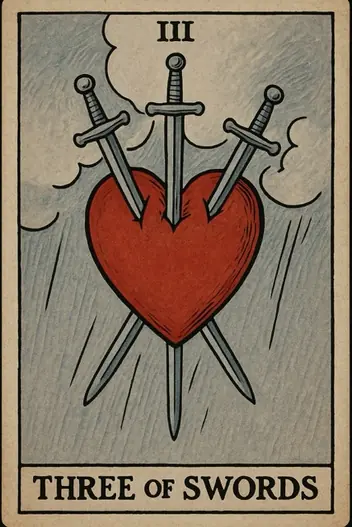
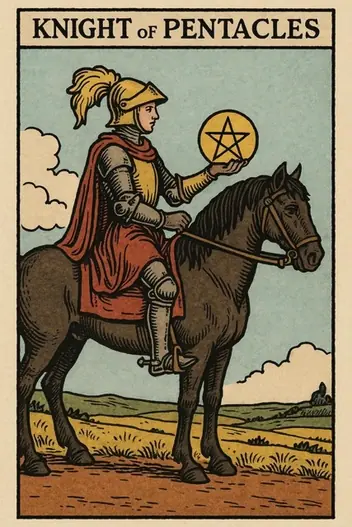
When the Three of Swords—a card of heartbreak, betrayal, and piercing emotional truth—collides with the Knight of Pentacles—the stoic, methodical worker of the material world—you get a powerful tension between emotional pain and pragmatic duty. This pairing often appears when someone is forced to process a deep wound while simultaneously maintaining their responsibilities, finances, or daily routines.
Psychologically, this combination represents the archetypal struggle between the Wounded Healer (the Three of Swords' raw vulnerability) and the Steadfast Guardian (the Knight of Pentacles' unyielding practicality). In real life, this might look like a person who just discovered a partner's infidelity but must still show up for a work deadline, or someone grieving a loss while managing a household budget. The key insight here is that emotional healing does not pause the material world, and the Knight's discipline can either become a shield against processing pain or the very tool that rebuilds trust.
Three of Swords and Knight of Pentacles: How These Energies Interact
The core dynamic of this pairing is a psychological tug-of-war between vulnerability and control. The Three of Swords demands that you confront a painful truth—often about a relationship, a betrayal, or a long-denied emotional reality. The Knight of Pentacles, however, urges you to stay grounded, focus on tangible tasks, and avoid impulsive reactions. This creates a state of emotional compartmentalization where the seeker may feel torn between crying and clocking in.
In practical terms, this combination suggests a period where slow, steady action is the only antidote to acute emotional pain. The Knight of Pentacles doesn't rush into dramatic gestures or quick fixes; instead, he advocates for incremental, disciplined steps—like setting a budget after financial infidelity, or maintaining a consistent therapy schedule after a breakup. The psychological insight here is that grief can be processed through ritual and routine, not just through catharsis. The seeker must learn to hold their sorrow while still showing up for their daily obligations, which paradoxically builds emotional resilience.
However, there is a significant risk: the Knight's methodical nature can devolve into emotional avoidance. If the seeker uses work, chores, or financial planning as a way to numb the pain, the Three of Swords' wound will fester. True healing requires both acknowledgment and action—you must feel the sword in your heart while also tending to your garden. The most productive path is to allocate specific times for grief (e.g., journaling sessions, therapy) and specific times for material focus (e.g., work hours, financial reviews), creating a structured rhythm that honors both energies.
Three of Swords and Knight of Pentacles in Love and Relationships
If you are single:
This combination suggests that a recent heartbreak may be clouding your judgment when evaluating new prospects. You might be drawn to someone stable and reliable (like the Knight), but only if you first address the underlying pain from the past.
If you are in a relationship:
The pairing indicates a crisis of trust or communication where one partner feels wounded and the other is trying to "fix" things through practical actions rather than emotional validation.
In romantic contexts, the Three of Swords and Knight of Pentacles often signals a relationship tested by betrayal, neglect, or unspoken resentments. The Knight's energy here can manifest as a partner who responds to conflict by retreating into work, chores, or financial planning—actions that feel like love to them but appear as coldness to the wounded partner. The critical relationship advice is to bridge this gap explicitly: the wounded person must articulate their need for emotional processing, while the Knight-like partner must learn to pause their problem-solving mode and simply witness the pain.
For singles, this combination warns against rushing into a "safe" relationship to avoid feeling heartbreak. The Knight of Pentacles may appear as a dependable, financially stable person who seems like a perfect rebound, but the Three of Swords cautions that unresolved grief will eventually surface. A better strategy is to use the Knight's discipline to structure your healing: set a timeline for self-reflection, join a support group, or commit to a weekly therapy session before dating again. Practical routines, not new partners, are the true healers here.
Your pair is already on the table. Ask your question and draw the clarifying card
or simply focus on it
Three of Swords and Knight of Pentacles in Career Readings
Strategic Opportunities:
Use a recent professional setback (e.g., a failed project, a layoff) to refine your systems and workflows. The Knight of Pentacles excels at incremental improvement.
Strategic Opportunities:
Leverage your emotional resilience to handle a difficult client or colleague. The Three of Swords gives you insight into others' pain points.
Calculated Risks:
Avoid making major financial decisions while you are emotionally raw. The Knight's caution is valuable, but the Three of Swords' grief can distort risk assessment.
In career and financial readings, this combination often appears when a professional disappointment (a rejection, a pay cut, a partnership dissolution) requires a methodical, long-term recovery plan. The Three of Swords represents the sting of the event, while the Knight of Pentacles offers the only viable path forward: slow, steady, and stubbornly consistent effort. For example, after losing a major client, the Knight's energy suggests rebuilding your portfolio one small project at a time, rather than chasing a quick replacement.
A critical financial warning: Do not use work or money management as a substitute for emotional processing. The Knight's focus on material security can become a dangerous obsession when fueled by the Three of Swords' pain. You might overwork to avoid feeling, or overspend to soothe the wound. Instead, create a "grief budget"—allocate a specific amount of time and money for self-care, while maintaining your normal professional routines. This combination also favors practical, low-risk investments like paying down debt or building an emergency fund, as these actions provide psychological safety during emotional turmoil.
The Shadow Side of Three of Swords and Knight of Pentacles
The shadow manifestation of this pairing is a dangerous cycle of emotional suppression and compulsive productivity. When the Three of Swords' pain is too great to face, the Knight of Pentacles' energy can morph into workaholism, financial rigidity, or obsessive cleaning/organizing as a way to maintain control. The cognitive bias here is "if I just keep moving, the pain won't catch up" —but the wound only deepens. You may find yourself snapping at colleagues, making careless errors, or developing physical symptoms like headaches or digestive issues from unprocessed grief.
Another pitfall is mistaking the Knight's loyalty for emotional availability. In relationships, this can lead to staying in a partnership that is "stable" but emotionally barren, because the Knight's reliability feels safe after the Three of Swords' betrayal. Conversely, the Three of Swords' cynicism can cause you to reject the Knight's genuine efforts because they don't feel "romantic enough." The shadow path is a self-fulfilling prophecy: you expect pain, so you sabotage steady love or steady work, then use the resulting failure as proof of your original fear.
Poor judgment manifests as over-caution—refusing to take any emotional or professional risk because of past hurt. The Knight's slowness becomes paralysis, and the Three of Swords' lesson becomes a prison. The antidote is to consciously integrate both energies: acknowledge the pain without letting it dictate your future, and take action without ignoring your emotional reality.
Get a personalized interpretation
Unlock the combined meaning of your cards in the context of your unique question — for free.
Three of Swords and Knight of Pentacles Reversed: What Changes?
If the Three of Swords is reversed, the sharp pain subsides, but a dull sense of guilt or self-blame remains. You may no longer be crying, but you continue to punish yourself. The Knight of Pentacles in an upright position becomes dangerous in this context: you start to "atone" for guilt by overworking yourself to the point of exhaustion. Advice: stop self-flagellation through labor. Work will not redeem what you consider to be your mistake.
If the Knight of Pentacles is reversed, the ability for systematic work disappears. This manifests as procrastination and chaos. The upright Three of Swords here indicates that the pain is so intense that you cannot even bring yourself to perform basic duties. Warning: this is a high-risk state for your career. What you need is not psychoanalysis, but strict time management and external support (coach, mentor).
If BOTH cards are reversed, this is a complete imbalance: you are stuck between a past trauma and an inability to act in the present. This is an emotional and professional quagmire. The only logical way to rectify the situation is to turn to a third party (therapist or crisis manager), as your own will and logic are paralyzed.
Three of Swords and Knight of Pentacles: The Combined Message
How can the energy of this complex pair be used constructively? Your task is to use the Three of Swords as fuel for the Knight of Pentacles' discipline, without allowing pain to become your sole motivator. Understand: acute pain is a signal that old patterns are no longer working. The Knight of Pentacles provides you with the tool to create new, healthier structures.
Start small. Do not try to "fix" your entire life at once. Take one area where the pain (Three of Swords) is most evident and apply the "one step per day" method from the Knight of Pentacles to it. For example, if you have experienced a breakup, do not try to forget it. Make a list of 5 things you can do for your physical comfort (cleaning, cooking, a walk) and perform them daily, as a routine. This will translate the chaos of pain into structured action.
A deep strategic advice: do not seek meaning in suffering; seek meaning in the discipline that follows it. The Three of Swords is the diagnosis. The Knight of Pentacles is the prescription. If you ignore the diagnosis and simply take the "pills" of work, you will treat the symptoms but not the disease. If you only suffer without taking the medicine, you will perish. Only the synthesis—awareness of the pain and methodical recovery—offers a chance for post-traumatic growth.
Where to Go From Here
The core message of the Three of Swords and Knight of Pentacles is that healing and responsibility are not enemies, but partners. You can feel heartbroken and still show up; you can grieve and still build. The key is to structure your recovery with the Knight's discipline, while honoring the Three of Swords' call for honest emotional processing. This combination asks you to trust that slow, consistent action—even when it feels mundane—is the most powerful medicine for a wounded heart.
While this article provides the general archetype, the true magic happens when Tarot is applied to your unique situation. The Fortune Cards app can give you a deep, personalized interpretation of this exact combination for your specific question right now. Use it on the web or download it to get tailored insights that consider your relationship history, career context, and emotional patterns. Stop guessing—let the cards speak directly to your life.
Interpretation by the Fortune Cards editorial team, based on the Rider–Waite tradition and Jungian archetypes. About our methodology · Updated: 2026-08-26
Other Combinations with Three of Swords
Other Combinations with Knight of Pentacles
Explore Individual Card Meanings
Table of Contents
- Three of Swords and Knight of Pentacles: How These Energies Interact
- Three of Swords and Knight of Pentacles in Love and Relationships
- Three of Swords and Knight of Pentacles in Career Readings
- The Shadow Side of Three of Swords and Knight of Pentacles
- Three of Swords and Knight of Pentacles Reversed: What Changes?
- Three of Swords and Knight of Pentacles: The Combined Message
- Where to Go From Here
Ready to find answers to your questions?
Start your first reading now and look at your situation with fresh clarity. The cards are ready to reveal deeper meaning.