Three of Swords and Seven of Swords Together in Tarot

- Arcana
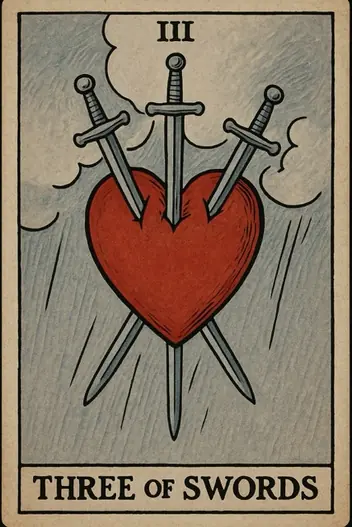
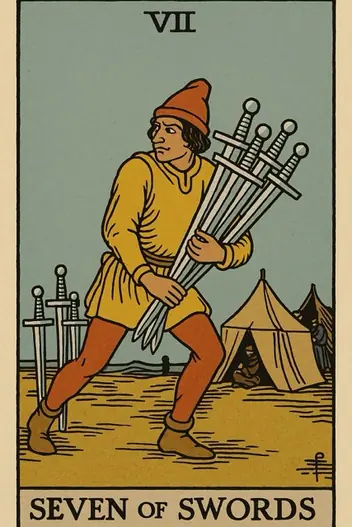
- Three of Swords — Minor Arcana, Swords; Seven of Swords — Minor Arcana, Swords
- Elements
- Three of Swords — Air; Seven of Swords — Air
- Elemental interaction
- Same element — energies intensify each other
- Numerology
- 3 + 7 = 10 → 1
When the Three of Swords—the card of heartbreak, grief, and piercing truth—collides with the Seven of Swords—the archetype of cunning, deception, and strategic retreat—you face a complex psychological landscape. This pairing often signals a painful realization that someone has betrayed your trust, or that you are using intellectual dishonesty to avoid confronting emotional wounds. The core dynamic is a clash between raw emotional vulnerability and calculated self-protection.
This combination demands a pragmatic, Jungian approach: you must acknowledge the shadow aspects of both cards. The Three of Swords forces you to feel the pain of a broken agreement or shattered illusion, while the Seven of Swords warns against resorting to further manipulation or self-deception to escape that pain. The key insight here is that strategic thinking must be applied to emotional healing, not to avoiding it. Real growth occurs when you stop using cleverness to bypass grief and instead use it to navigate the path toward recovery.
What Do Three of Swords and Seven of Swords Mean Together?
The psychological state created by the Three of Swords and Seven of Swords together is one of defensive grief. On the surface, you may feel stabbed by a betrayal or loss (Three of Swords), but your immediate impulse is to retreat into secrecy, blame-shifting, or subtle revenge (Seven of Swords). This is a classic shadow pattern: using intellectual superiority to mask emotional pain. You might rationalize why you were wronged, craft a narrative that makes you the victim, or plot a quiet exit without addressing the real issue.
In real-world terms, this combination often appears when you have discovered a lie or omission in a relationship, or when you are considering a strategic move in a career that feels morally gray. The pragmatic interpretation is that you are caught between the need to heal and the temptation to outsmart the situation. The Seven of Swords energy can be constructive if channeled into careful planning and boundary-setting, but destructive if used to deceive yourself or others. The core challenge is to distinguish between strategic protection and self-sabotaging dishonesty.
For example, in a business negotiation, this pair might indicate that you feel stabbed by a competitor’s unfair tactic (Three of Swords), and your response is to devise a clever countermove that borders on unethical (Seven of Swords). The healthier path is to acknowledge the pain, assess the damage objectively, and then choose a transparent, principled strategy—even if it requires a tactical retreat. The most powerful insight here is that true recovery requires both emotional honesty and strategic intelligence, not one at the expense of the other.
Career and Finances
Strategic Opportunities:
Use the Seven of Swords’ analytical skills to audit your finances or project plans for hidden risks. This is a good time for competitive intelligence—but keep it ethical.
Strategic Opportunities:
The Three of Swords can signal a necessary career pivot after a painful setback. Let the grief motivate a clear-eyed reassessment of your professional goals.
Calculated Risks:
Avoid backchannel negotiations or sharing sensitive information with untrustworthy colleagues. The combination warns of potential sabotage or intellectual property theft.
In your professional life, this combination often appears during restructuring, layoffs, or competitive power struggles. You may feel stabbed by a colleague’s betrayal, a project failure, or an unfair promotion decision. The Seven of Swords energy then tempts you to respond with office politics, withholding information, or plotting a quiet escape. While strategic thinking is valuable, the Seven of Swords can become a liability if you lose sight of your integrity. The practical approach is to document everything, protect your interests legally, and communicate only through transparent channels.
Financially, this pair warns against deceptive financial schemes or hiding losses from yourself or partners. The Three of Swords suggests a painful financial lesson—perhaps a bad investment or unexpected expense. The Seven of Swords advises careful, methodical damage control rather than impulsive cover-ups. Bold advice: Conduct a full financial audit, cut losses where necessary, and resist the urge to “win back” money through risky maneuvers. Your best career move is to leverage your intelligence for long-term stability, not short-term revenge or escape.
Your pair is already on the table. Ask your question and draw the clarifying card
or simply focus on it
What Do Three of Swords and Seven of Swords Say About Love?
If you are single:
This combination warns against projecting past heartbreak onto new connections. You may be using skepticism or aloofness as a shield, which prevents genuine intimacy. Focus on healing old wounds before dating strategically.
If you are in a relationship:
A hidden truth or unspoken grievance is likely causing distance. One partner may be withdrawing emotionally or acting deceptively to avoid conflict. Direct, honest communication is non-negotiable.
In love, the Three of Swords and Seven of Swords often reveal a power imbalance rooted in secrecy. One partner may feel emotionally stabbed by the other’s evasiveness or infidelity, while the other uses manipulation to maintain control. The emotional intelligence required here is high: you must resist the urge to retaliate with further deception. Instead, establish clear boundaries and demand transparency. If you are the one feeling betrayed, do not let the Seven of Swords energy tempt you into spying, passive-aggressive behavior, or silent withdrawal. The boldest relationship move is to say, “I know what happened, and I need the truth—no more games.”
For couples, this card pair suggests that the path to reconciliation depends on both partners abandoning their strategic defenses. The Three of Swords represents the painful truth that must be spoken, while the Seven of Swords represents the cunning avoidance that must be surrendered. If you can face the pain together without resorting to blame or secrecy, the relationship can rebuild on a foundation of authenticity. If not, the Seven of Swords energy will erode trust further, leading to a quiet, calculated separation.
Reversed Three of Swords and Seven of Swords Explained
When one or both cards are reversed, the dynamic becomes more complex, but often more manageable.
If the Three of Swords is Reversed:
The pain is not denied, but the potential for its conscious awareness is blocked. The person may be in a state of depression or apathy without understanding its cause. The Seven of Swords in the upright position then becomes dangerous: this is unconscious manipulation. You harm others without realizing your motivation. Advice: cease all active actions and turn to therapy or deep reflection. Your cunning right now is merely a symptom of an unacknowledged trauma.
If the Seven of Swords is Reversed:
This signals internal resistance and weakness. You cannot or will not use strategic thinking. Combined with the upright Three of Swords, this means you are helplessly taking the blow without trying to defend yourself. You are relinquishing your agency. Advice: you urgently need to reclaim your capacity for planning. Even a bad plan is better than passive suffering. Start with one small step that returns control of the situation to you.
If BOTH are Reversed:
This is a complete imbalance of the dynamic. The pain (Three of Swords) is repressed, and the strategy (Seven of Swords) is paralyzed. The person is in a state of "learned helplessness" , yet may exhibit passive aggression. The only way to rectify the situation is an active return to reality. Start keeping a journal of facts (without emotions or judgments) to see what is actually happening. Acknowledge that you are in pain, and acknowledge that you do not know what to do. This admission will be the first step out of the impasse.
Ask your specific question
Don't rely on generic meanings. Get a customized reading tailored specifically to your energies.
What Are the Risks of Three of Swords and Seven of Swords?
The shadow manifestation of this pairing is self-deception masquerading as strategy. You might convince yourself that a lie is necessary for protection, or that your emotional pain justifies manipulative behavior. Common cognitive biases include confirmation bias (only seeing evidence that supports your victimhood) and the illusion of control (believing you can outsmart the emotional fallout). This can lead to a cycle of passive-aggressive revenge, where you quietly undermine others while nursing your own wounds.
Another pitfall is emotional numbness—the Three of Swords’ grief is so overwhelming that you dissociate and become coldly calculating (Seven of Swords). This blocks genuine healing and prevents you from learning the lesson the pain was meant to teach. The shadow side of the Seven of Swords is also intellectual arrogance: you may think you are too clever to be caught, but the Three of Swords reminds you that truth always surfaces. Avoid the trap of believing you can manipulate your way out of emotional accountability. The most dangerous outcome is a loss of self-trust, where you become so accustomed to deception that you no longer know what is true.
Synthesis: Strategic Conclusion
Constructive use of this combination's energy requires a bold paradox: to accept pain as a given, in order to stop fearing it. The Three of Swords is not a verdict, but a signal of the need for cleansing. The Seven of Swords is not a weapon for deception, but a tool for strategic planning. When you stop fearing pain, your cunning ceases to be defensive and becomes creative.
How does this work in practice? Imagine you are a chess player who knows they could lose the game (Three of Swords). Instead of hiding pieces under the table (Seven of Swords in its shadow aspect), you begin calculating moves five steps ahead, but with full acceptance of the risk. You analyze your weaknesses, acknowledge them, and build a strategy not on concealment, but on strengthening those areas.
Your strategic advice: use pain as a compass. If you feel fear or a pang of conscience while planning a certain move, it is a sure sign you are on the path to the shadow side. If, instead, you feel a cold clarity and readiness for the consequences, you are using the Seven of Swords as a tool of a wise strategist. The Three of Swords teaches us that pain is inevitable, but suffering is a choice. The Seven of Swords gives us the intellect to make that choice consciously. Stop running from the truth. Instead, use your mind to accept it and develop a plan that makes you stronger, not merely protected.
Where to Go From Here
The core message of the Three of Swords and Seven of Swords is this: painful truths require honest strategy, not clever avoidance. Whether you are healing a relationship or navigating a career crisis, the path forward demands that you acknowledge the wound (Three of Swords) while using your intelligence ethically (Seven of Swords). Your greatest strength is not in outsmarting others, but in outsmarting your own fear of vulnerability.
Ready to see exactly how this combination applies to your unique situation? While this article provides the general archetype, the true power of Tarot lies in personalized interpretation. Use the Fortune Cards app to get a deep, tailored reading of this exact combination for your specific question about love, career, or personal growth. Access it on the web or download it now—your next step is one click away.
Interpretation by the Fortune Cards editorial team, based on the Rider–Waite tradition and Jungian archetypes. About our methodology · Updated: 2026-08-26
Other Combinations with Three of Swords
Other Combinations with Seven of Swords
Explore Individual Card Meanings
Table of Contents
- What Do Three of Swords and Seven of Swords Mean Together?
- Career and Finances
- What Do Three of Swords and Seven of Swords Say About Love?
- Reversed Three of Swords and Seven of Swords Explained
- What Are the Risks of Three of Swords and Seven of Swords?
- Synthesis: Strategic Conclusion
- Where to Go From Here
Ready to find answers to your questions?
Start your first reading now and look at your situation with fresh clarity. The cards are ready to reveal deeper meaning.