Three of Wands and Ten of Swords Meaning in Tarot
- Arcana
- Three of Wands — Minor Arcana, Wands; Ten of Swords — Minor Arcana, Swords
- Elements
- Three of Wands — Fire; Ten of Swords — Air
- Elemental interaction
- Friendly elements — energies support each other
- Numerology
- 3 + 10 = 13 → 4
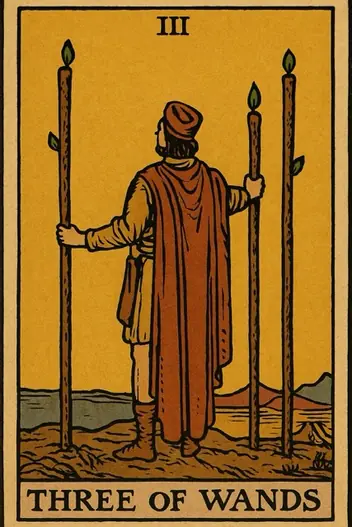
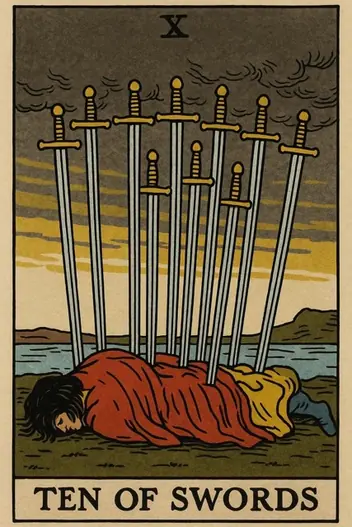
The Three of Wands represents the moment of strategic foresight—when you’ve laid the groundwork and are scanning the horizon for new opportunities. The Ten of Swords symbolizes the brutal end of a mental cycle, often marked by betrayal, over-analysis, or a painful conclusion. When these two cards collide, you’re facing a paradox: you’re ready to expand, but a critical breakdown is forcing you to stop.
Psychologically, this combination signals a crisis of confidence. Your inner planner (Three of Wands) is pushing you to take the next step, but your inner critic (Ten of Swords) has already envisioned the worst-case scenario—or is reeling from a recent failure. The real work here is to distinguish between a genuine ending that clears the path and a self-inflicted mental trap that sabotages your growth.
Three of Wands and Ten of Swords Together: Meaning
The core dynamic of the Three of Wands and Ten of Swords is the tension between future-oriented action and past-oriented regret. The Three of Wands is the archetype of the explorer—confident, patient, and scanning for possibilities. The Ten of Swords is the archetype of the wounded thinker—exhausted, betrayed, and lying face-down in the aftermath of a mental collapse. Together, they depict a person who has been planning a major move but has just been hit by a devastating realization or external blow.
This is not a card pair that suggests immediate success. Instead, it forces you to confront a hard truth: your expansion plan may be built on a flawed premise. The Ten of Swords often appears when you’ve ignored red flags, overcommitted to a strategy, or trusted the wrong people. The Three of Wands asks you to pivot—but only after you’ve fully processed the loss. The key psychological insight here is the need to separate healthy grief from paralyzing rumination.
In practical terms, this combination warns against forcing a new venture while still bleeding from a previous wound. The seeker must pause, audit their assumptions, and release any attachment to the original timeline. The horizon you’re looking at may be real, but you cannot sail there with a broken mast. The most strategic move is to treat the Ten of Swords as a diagnostic tool: what exactly ended, and what lesson must be integrated before you proceed?
Three of Wands and Ten of Swords in Love and Relationships
If you are single:
This pair suggests you are eager to meet someone new or expand your romantic horizons, but you may be carrying the emotional weight of a recent betrayal or rejection. Do not rush into a new connection until you’ve processed the ending of the last one. Your desire for expansion will only attract more chaos if you haven’t healed.
If you are in a relationship:
The dynamic here points to a power struggle or a painful communication breakdown. One partner may feel ready to move forward together (Three of Wands), while the other feels stabbed in the back or emotionally exhausted (Ten of Swords). The relationship needs a ceasefire before any planning can occur.
In relationships, the Three of Wands and Ten of Swords combination highlights the danger of projecting future fantasies onto a wounded dynamic. You might be dreaming of a shared trip, a move, or a deeper commitment, but the Ten of Swords reveals that unresolved resentment or a recent argument has created a toxic foundation. The boldest relationship advice here is to address the elephant in the room directly. Ask yourself: Is this relationship truly ready for expansion, or am I using future plans to avoid confronting a painful truth?
Emotionally intelligent action requires you to listen more than you plan. If your partner feels defeated or betrayed, your job is not to convince them of the future—it’s to validate their pain and rebuild trust step by step. For singles, this means setting a boundary between “healing time” and “exploration time.” Use the Three of Wands energy to map out what you want in a partner, but only after the Ten of Swords has been fully processed.
Your pair is already on the table. Ask your question and draw the clarifying card
or simply focus on it
Three of Wands and Ten of Swords for Career and Money
Strategic Opportunities:
Reassess your long-term plan based on recent failure. The Ten of Swords often signals a project or partnership that has ended abruptly. Use the Three of Wands to identify what you learned and where you can redirect your energy.
Strategic Opportunities:
Leverage the ending to cut dead weight. This is the perfect time to drop clients, roles, or investments that were draining your resources. The horizon is clearer when you’re not dragging a corpse behind you.
Calculated Risks:
Avoid making any major financial commitments for 30 days. The pain of the Ten of Swords can cloud your judgment, and the Three of Wands’ optimism may lead you to overinvest in a rebound strategy. Let the dust settle before signing anything.
In a career context, this combination is a strategic wake-up call. The Three of Wands represents your ambition and your vision for growth—perhaps a new business, a promotion, or a market expansion. The Ten of Swords represents a failure that exposes the fragility of that vision. This is not the time to double down; it is the time to pivot. For example, if you were planning to launch a product and a key supplier just backed out, the Ten of Swords is telling you to accept the loss and rework the strategy, not to force the launch with inferior resources.
Financial planning here requires ruthless honesty. The Ten of Swords often accompanies debt, lawsuits, or sudden income loss. The Three of Wands wants you to plan for the future, but you must first stabilize your present. Bold tip: Create a “post-mortem” document—list what went wrong, what you ignored, and what you will do differently. Then, use the Three of Wands to set three concrete, low-risk steps toward a new goal. The biggest financial warning is against “sunk cost fallacy.” Do not throw good money after bad because you’re attached to your original plan.
The Shadow Side of Three of Wands and Ten of Swords
The shadow side of this combination is compulsive optimism masking unresolved trauma. The seeker may stubbornly cling to their expansion plans (Three of Wands) while ignoring the catastrophic signs of collapse (Ten of Swords). This leads to cognitive dissonance—knowing something is broken but pretending it’s not. Alternatively, the shadow can manifest as paralyzing fatalism, where the seeker interprets the Ten of Swords as a permanent end and abandons all future planning. Both extremes are irrational.
Self-sabotage is a major pitfall here. The seeker might unconsciously create a crisis to avoid the risk of success. For example, you sabotage a promising negotiation (Ten of Swords) because you fear the responsibility of expansion (Three of Wands). Poor judgment arises when you conflate “ending” with “failure.” The Ten of Swords is often a necessary death—it clears the way for something new. But if you’re stuck in the victim archetype, you’ll miss the lesson.
Another cognitive bias at play is the “hindsight bias.” After the Ten of Swords event, you may falsely believe you saw it coming all along, which erodes your confidence in future planning. The pragmatic antidote is to practice radical acceptance: the ending happened, but it does not define your ability to plan. Use the Three of Wands to create a new map, not to obsess over why the old one failed.
Uncover hidden insights
Let our advanced Tarot system interpret these archetypes specifically for your personal path.
Three of Wands and Ten of Swords Reversed: How to Read It
If the Three of Wands is reversed:
Potential is blocked due to fear or procrastination. You are not making plans; you are afraid to even begin. The Ten of Swords upright here means you are being "finished off" by your own inaction. Advice: Take a micro-step. Any action is better than paralysis of the will.
If the Ten of Swords is reversed:
Inner resistance to accepting an ending. You refuse to acknowledge that a project, relationship, or life stage is over. The Three of Wands upright compels you to build castles in the air to avoid pain. Warning: This is a path to prolonged depression. Acknowledge the loss to make room for something new.
If BOTH are reversed:
Complete imbalance and chaos. You are not making plans (Three in minus) and cannot complete a cycle (Ten in minus). This is a state of "stagnation" in a toxic situation. Logical way to correct: First, accept and live through the "death" of the old (even symbolically, through a farewell ritual). Only after that, begin to build new plans.
Three of Wands and Ten of Swords: Tarot Advice
How to constructively use the energy of the Three of Wands to balance the Ten of Swords? The key lies in shifting focus from "result" to "process." The Three of Wands is the energy of expansion, but without wisdom, it becomes recklessness. The Ten of Swords is the energy of completion, but without hope, it becomes catastrophe. Your strategic task is to integrate these two poles.
Constructive algorithm of action:
First — acknowledge the "death" of the old plan. Do not attempt to revive it. Second — use the analytical capacity of the Three of Wands not for fantasies, but for auditing what has occurred. Ask yourself: "Which specific blind optimism of mine led to this blow?" Third — reframe the defeat. The Ten of Swords is not the end of the path, but the end of a specific path. It is the clearing of ground for a new start.
Your strategic conclusion: Do not fear collapse. Fear the illusions that led to it. The energy of this pair arms you with unique clarity: you know exactly what you MUST NOT do. Use this experience as the most valuable and effective filter for future decisions. You are now at a point where you can build not just an ambitious strategy, but a sustainable and realistic one that will withstand the test of reality.
Applying This to Your Situation
The core message of the Three of Wands and Ten of Swords is “stop before you start.” You are eager to expand, but a painful ending demands your full attention. The most strategic move is to integrate the lesson of the defeat before you chart a new course. Your growth depends on your willingness to sit with the discomfort of the ending, rather than rushing to replace it with a new beginning. True foresight requires clear vision, and clear vision requires a healed mind.
While this article provides the general archetype, the true magic happens when Tarot is applied to your unique situation. Your specific question, your emotional state, and the context of your life will shift the meaning dramatically. Use the Fortune Cards app to get a deep, personalized interpretation of this exact combination for your specific question right now. Whether you access it on the web or download it, the app will guide you through the psychological nuances and strategic actions that are tailored to you. Don’t settle for general advice—get the clarity you need to move forward with both wisdom and courage.
Interpretation by the Fortune Cards editorial team, based on the Rider–Waite tradition and Jungian archetypes. About our methodology · Updated: 2026-08-26
Other Combinations with Three of Wands
Other Combinations with Ten of Swords
Explore Individual Card Meanings
Table of Contents
- Three of Wands and Ten of Swords Together: Meaning
- Three of Wands and Ten of Swords in Love and Relationships
- Three of Wands and Ten of Swords for Career and Money
- The Shadow Side of Three of Wands and Ten of Swords
- Three of Wands and Ten of Swords Reversed: How to Read It
- Three of Wands and Ten of Swords: Tarot Advice
- Applying This to Your Situation
Ready to find answers to your questions?
Start your first reading now and look at your situation with fresh clarity. The cards are ready to reveal deeper meaning.