Two of Cups and Ten of Swords Meaning in Tarot
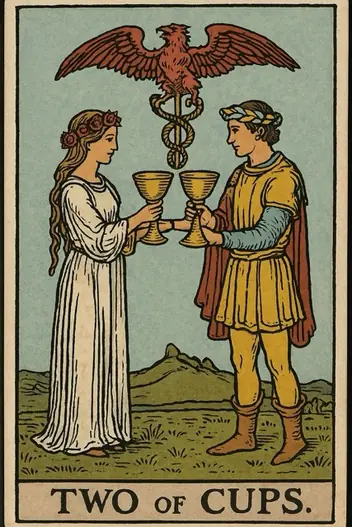

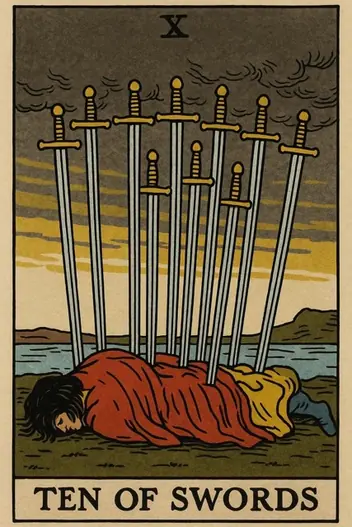
- Arcana
- Two of Cups — Minor Arcana, Cups; Ten of Swords — Minor Arcana, Swords
- Elements
- Two of Cups — Water; Ten of Swords — Air
- Elemental interaction
- Neutral elements — energies coexist without conflict
- Numerology
- 2 + 10 = 12 → 3
The intersection of the Two of Cups and Ten of Swords presents a stark psychological paradox: the promise of deep emotional connection colliding with a brutal, often necessary, ending. In Jungian terms, this pairing represents the tension between the Anima/Animus (the drive for union and relational wholeness) and the Shadow of betrayal, loss, or cognitive dissonance. Pragmatically, this combination signals that a powerful bond is either being tested by a decisive break or is emerging from the ashes of a painful conclusion.
For the seeker, this is not a card of simple romance or simple ruin. Instead, it points to a strategic moment where emotional vulnerability must be weighed against the risk of being hurt again. The Two of Cups asks for mutual respect and equal investment, while the Ten of Swords demands honest acknowledgment of past wounds—or a clean severance. The core dynamic is about learning when to rebuild trust and when to walk away with finality.
Two of Cups and Ten of Swords: How These Energies Interact
When these two cards appear together, the psychological landscape is one of post-traumatic re-evaluation. The Ten of Swords represents a crisis point—a betrayal, a sudden loss, or a painful truth that has already "killed" a previous version of a relationship or project. The Two of Cups then emerges not as a naive restart, but as a conscious choice to form a new alliance based on radical honesty and shared accountability. The key insight here is that this connection cannot be built on denial; it must be forged through the acknowledgment of what went wrong.
The energy is intense and requires emotional sobriety. The seeker may feel a magnetic pull toward someone, but this pull is laced with the memory of a "stabbing" betrayal. In a career context, this combination suggests a partnership offer that comes immediately after a public failure or a toxic project's end. The pragmatic takeaway is to avoid rushing into any agreement without first processing the lessons of the Ten of Swords. The Two of Cups offers a healing partnership, but only if both parties have completed their grief work. Dismissing the past pain leads to a repeat of the same wound.
Two of Cups and Ten of Swords for Career and Money
Strategic Opportunities:
A partnership or merger that emerges after a major failure—this could be a rescue deal or a collaboration that leverages lessons learned from a past mistake. Consider it if the terms are equitable.
Strategic Opportunities:
A role or project that requires emotional intelligence to heal a team’s morale after a scandal or layoff. Your ability to connect authentically will be your greatest asset.
Calculated Risks:
Avoid financial entanglements with someone who has a history of betrayal or unreliability. The Ten of Swords indicates that the "sting" is still fresh; do not ignore documented evidence of poor judgment.
Professionally, this combination is a high-stakes negotiation card. It often appears when a professional relationship has been damaged—perhaps by a failed partnership, a leaked secret, or a public mistake. The Two of Cups suggests a second chance through genuine collaboration, but only if you insist on clear contracts and shared accountability. Do not rely on goodwill alone; the Ten of Swords is a reminder that people can turn on you. Financially, this is not a time for speculative joint ventures. Instead, focus on consolidating resources after a loss. The best strategic move is to rebuild your reputation through a single, high-trust alliance, rather than trying to please everyone. Boldly cut ties with any colleague or client who has proven toxic.
Your pair is already on the table. Ask your question and draw the clarifying card
or simply focus on it
Two of Cups and Ten of Swords in Love and Relationships
If you are single:
This combination warns against jumping into a new romance to escape the pain of a recent breakup. It suggests that a potential partner may appear who mirrors your deepest emotional needs, but you must first verify their integrity through consistent actions, not just intense chemistry.
If you are in a relationship:
You are at a crossroads where an old betrayal or a hidden truth has been exposed. The path forward requires a mutual decision to either rebuild trust through transparent communication or to accept that the relationship has reached its natural end.
In existing relationships, this pairing often signals a powerful reconciliation—but only after a significant rupture. The Two of Cups offers the chance for a "new contract" between partners, where resentments are aired and boundaries are redrawn. However, the Ten of Swords warns that repeating the same argument without structural change is futile. The psychological health of the relationship depends on both people taking full responsibility for their part in the crisis. The most loving act may be to let go, especially if the connection has become a source of chronic emotional injury. For singles, the advice is to cautiously open your heart but keep your critical thinking sharp; a whirlwind romance here may be a defense mechanism against facing loneliness.
Two of Cups and Ten of Swords Reversed: What Changes?
Two of Cups Reversed:
The potential for union is blocked or distorted. You may be forcing a partnership, failing to see that the other party has already left. Instead of idealization — cynicism and distrust. Advice: lower your expectations to zero. Any interaction now is a test of boundary strength.
Ten of Swords Reversed:
Internal resistance to an inevitable end. You refuse to acknowledge that a project or relationship is dead. This leads to chronic stress and exhaustion. You are wasting resources on resuscitating a corpse. Advice: perform a "funeral rite" — write down exactly what has ended and accept it.
BOTH Reversed:
Complete imbalance. This is chaotic destruction with no chance of recovery. You simultaneously crave closeness and fear it, sabotaging any attempts at intimacy. The logical way to correct this: temporary total isolation. Cease all contacts that cause pain. You need an "information detox" from the toxic environment to hear your own needs.
Deepen your understanding
Find out exactly what this reading means for your current life situation with our oracle.
Negative Meaning of Two of Cups and Ten of Swords
The shadow manifestation of this pairing is co-dependency disguised as soulmate connection. The seeker may romanticize a relationship that is actually a cycle of betrayal and reconciliation. The cognitive bias at play is sunk cost fallacy—believing that because you have already suffered so much, the relationship must be meant to work out. This leads to ignoring objective red flags. Another pitfall is premature vulnerability: sharing your deepest wounds with someone who has not yet proven trustworthy, simply because the chemistry is intense. On the career side, the shadow is naive optimism after a failure—agreeing to a partnership without due diligence because you are desperate to start over. The rational path requires skepticism balanced with openness; do not let the promise of connection override your survival instincts.
Two of Cups and Ten of Swords: The Combined Message
How can the energy of the Two of Cups be constructively used to balance and activate the Ten of Swords? The key lies in the integration of opposites. The Two of Cups is not only about romance but also about equal exchange, mutual respect, and clear agreements. The Ten of Swords is not only about pain but also about catharsis, liberation, and clarity.
Your strategy: use the energy of the Two of Cups to create a safe space for closure. Acknowledge that both of you (or you and your old part of the personality) deserve a dignified ending. This is not about "reconciling at any cost" but about respect for the path traveled. Psychologically, this means moving from the position of a "victim" to that of an "observer" and, finally, to an "architect".
A deep strategic insight: do not try to "fix" the Ten of Swords with the force of the Two of Cups. If you attempt to "heal" the wound with new ideal relationships, you will only create a repeating cycle. Instead, allow the Ten of Swords to fully complete itself. Use the Two of Cups for an honest dialogue with yourself: "What exactly have I lost? What illusion has been shattered? What do I now know about myself?" Only by accepting the "death" of the old scenario can you build a new union—with yourself or with another person—based on reality, not fantasy.
Where to Go From Here
The core message of Two of Cups and Ten of Swords is that true connection requires a clean break from the past. Whether you are healing a relationship or forging a new one, the path demands that you honor the pain of the ending as much as the hope of the beginning. Your next step is not to choose between love and logic, but to integrate both. This general reading offers the archetype, but your specific situation—your history, your values, your timing—is unique.
To get a deeper, personalized interpretation of this exact combination for your specific question, use the Fortune Cards app. Available on the web and for download, it applies these psychological insights directly to your context, helping you move from understanding to action with clarity and confidence. Click here to start your personalized reading now.
Interpretation by the Fortune Cards editorial team, based on the Rider–Waite tradition and Jungian archetypes. About our methodology · Updated: 2026-10-15
Other Combinations with Two of Cups
Other Combinations with Ten of Swords
Explore Individual Card Meanings
Table of Contents
- Two of Cups and Ten of Swords: How These Energies Interact
- Two of Cups and Ten of Swords for Career and Money
- Two of Cups and Ten of Swords in Love and Relationships
- Two of Cups and Ten of Swords Reversed: What Changes?
- Negative Meaning of Two of Cups and Ten of Swords
- Two of Cups and Ten of Swords: The Combined Message
- Where to Go From Here
Ready to find answers to your questions?
Start your first reading now and look at your situation with fresh clarity. The cards are ready to reveal deeper meaning.