Two of Swords and Ten of Swords Together in Tarot
- Arcana
- Two of Swords — Minor Arcana, Swords; Ten of Swords — Minor Arcana, Swords
- Elements
- Two of Swords — Air; Ten of Swords — Air
- Elemental interaction
- Same element — energies intensify each other
- Numerology
- 2 + 10 = 12 → 3
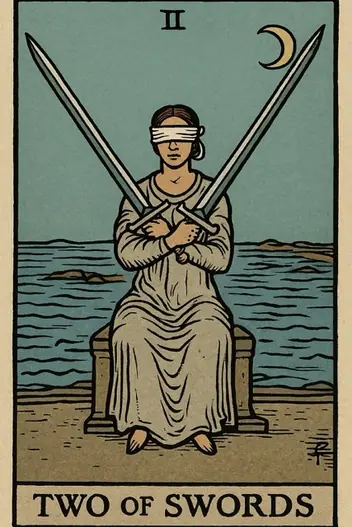
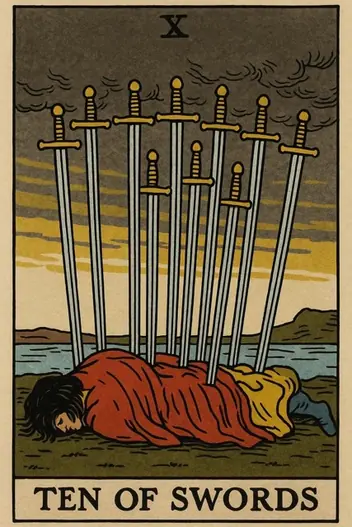
The intersection of the Two of Swords and the Ten of Swords presents a powerful psychological paradox. The Two of Swords embodies deliberate avoidance—a conscious decision to blind oneself to a painful truth in order to maintain a fragile peace. The Ten of Swords represents the inevitable collapse of that denial, the moment when reality crashes through the defenses you’ve built. Together, they reveal a story of a mind that has been fighting a losing battle against its own awareness.
In practical terms, this combination signals that a period of painful silence or indecision is about to be shattered by a definitive, often brutal, ending. The core energy here is not about defeat per se, but about the psychological cost of inaction. You have likely been holding a position of neutrality or paralysis, hoping a problem would resolve itself. The Ten of Swords arrives to show you that this strategy has failed, and a clean break—however violent it may feel—is now the only path forward.
Core Dynamics & Interpretation
The primary dynamic here is the clash between cognitive dissonance (Two of Swords) and catastrophic resolution (Ten of Swords). The seeker has been maintaining a mental equilibrium by refusing to look at the full picture. This is not a healthy balance; it is a calculated blindness designed to avoid a painful decision. The Ten of Swords then acts as the psychological breakthrough—or breakdown—that forces the truth into the light. The key insight to grasp is that the ending was not sudden; it was the inevitable conclusion of a prolonged refusal to act.
This combination often appears when someone has been "playing dead" in a situation, hoping the threat would pass. The Ten of Swords shows that the worst-case scenario has materialized, but it also signals the end of the cycle of avoidance. The mind can no longer sustain the illusion. From a Jungian perspective, this is the moment when the Shadow (the repressed truth) overwhelms the Persona (the calm, neutral facade). The result is a psychological "bottom" that, while painful, clears the way for authentic living.
The real-world implication is a call to stop managing the symptoms and accept the diagnosis. The Two of Swords represents the anesthetic; the Ten of Swords represents the surgery. The pain is real, but it is also the necessary price for healing. The only way out is through. Continuing to ignore the problem will only prolong the suffering and delay the inevitable renewal that the Ten of Swords ultimately promises.
What Do Two of Swords and Ten of Swords Indicate for Your Career?
Strategic Opportunities:
The forced end of a toxic project or role. While painful, this creates space for a new beginning. Accept the loss to free up your energy.
Strategic Opportunities:
The chance to reset your professional reputation. A clean break allows you to redefine your narrative without the baggage of past indecision.
Calculated Risks:
Do not attempt to "fix" or resurrect a dead deal. The Ten of Swords is a final ending. Pouring resources into a lost cause is a denial of reality and will compound the loss.
In the professional arena, this combination is a red flag for sunk-cost fallacy. You have likely been clinging to a failing strategy, a toxic job, or a financial investment that you knew deep down was doomed. The Two of Swords represents the internal debate that prevented you from cutting your losses early. The Ten of Swords is the market, the boss, or the client making the decision for you. The lesson here is that indecision is a decision with consequences.
Strategic advice: treat the ending as a data point, not a verdict. Analyze what you were avoiding and why. Was it fear of failure? Fear of confrontation? The most financially sound move now is to accept the loss, liquidate the emotional attachment, and move on. Do not seek revenge or try to "win" the argument. The Ten of Swords is about closure, not victory. Focus on damage control and resource reallocation. The energy you spent denying reality is now free to be invested in a more viable path.
Your pair is already on the table. Ask your question and draw the clarifying card
or simply focus on it
Love and Relationships
If you are single:
This combination warns that you may be ignoring clear red flags or denying your own feelings about a potential partner. The choice to remain undecided is itself a decision that will likely lead to a painful, abrupt ending rather than a gradual fade.
If you are in a relationship:
You are likely in a state of emotional stalemate. One or both partners are avoiding a critical conversation, and the pressure is building toward a destructive climax. Silence is not peace; it is a ticking clock.
The relationship dynamic here is fundamentally about power through paralysis. The Two of Swords partner withholds their truth as a form of control, while the Ten of Swords partner may feel they have been "ambushed" by an ending that was years in the making. The core issue is a failure of emotional risk management. You have been protecting yourself from a difficult conversation, but the cost of that protection is now a much more painful rupture.
Key relationship advice: prioritize honesty over harmony. The temporary discomfort of a direct conversation is far less destructive than the long-term damage of a silent betrayal. If you are the one holding the sword of denial, understand that your partner already knows something is wrong. The Ten of Swords is simply the moment they stop pretending they don't. A controlled, conscious end is far better than a catastrophic collapse. For couples, this card pair demands a radical commitment to transparency, even if it means the relationship cannot survive the truth.
Get a personalized interpretation
Unlock the combined meaning of your cards in the context of your unique question — for free.
Shadow Side & Pitfalls
The shadow side of this combination is masochistic passivity. The seeker may unconsciously choose to suffer rather than to act. The Two of Swords provides the justification ("I need more time to think"), while the Ten of Swords provides the payoff ("See? I was right to expect the worst"). This is a form of self-fulfilling prophecy where the fear of making a wrong decision leads to the worst possible outcome. The cognitive bias at play is analysis paralysis—the belief that thinking longer will yield a perfect solution, when in reality, it simply delays the inevitable.
Another significant pitfall is victim identity. After the Ten of Swords falls, it is easy to see oneself as the helpless recipient of fate. However, this card pair often reveals that the seeker was an active participant in their own downfall through their refusal to engage. The shadow asks: Did you fail to act, or did you choose to fail? Acting irrationally here means continuing to blame external forces while ignoring the internal decision to look away. True growth requires owning the moment of blindness that led to the fall.
Reversed Positions: What Changes?
When cards appear in a reversed position, the dynamic shifts from fatal inevitability to a painful, yet necessary awakening.
If the Two of Swords is Reversed:
This is no longer paralysis, but a sudden, painful moment of clarity. The blindfold falls off by itself — you can no longer ignore the truth. However, this can be accompanied by recklessness: instead of a balanced decision, you may commit an impulsive act that only accelerates the collapse. Advice: Use this insight for analysis, not for immediate action.
If the Ten of Swords is Reversed:
This is resistance to an inevitable end. You feel that the "bottom" is near, but you cling to the past with all your might. This is a state of extreme weakness and self-deception. You are not allowing the situation to conclude, prolonging the agony. Warning: This is a path to chronic stress and depression. Allow the old to pass away.
If BOTH are Reversed:
A complete imbalance emerges — panic without clarity. You realize the crisis is close, but you see no way out. This is a state of chaos. Method of Correction: You need an external arbiter — a psychologist, mentor, or coach. You cannot handle this on your own. Advice: Delegate the decision-making. Take a 48-hour pause, not to hide, but to gather the facts.
What Is the Overall Message of Two of Swords and Ten of Swords?
The energy of the Two of Swords is an instrument of analysis and distance, but in this combination, it is being used incorrectly. Your task is to transform this potential. Instead of closing your eyes to the problem, use the "swords" (rational thinking) for a cold, dispassionate audit of the situation. Ask yourself: "What decision have I been putting off for over a month?" The answer to that is the truth you must accept.
How to use the Two of Swords to balance the Ten? Make a decision before reality "finishes you off." If you feel a crisis approaching, don't wait for the blow. Take the initiative into your own hands. Make the choice first. Quit before you are fired. Leave the relationship before you are betrayed. This is not cowardice; it is a strategic interruption of the cycle. You cannot avoid pain, but you can choose its form — the active pain of choice versus the passive pain of defeat.
A deep strategic piece of advice: Use the Ten of Swords as a reference point. Perceive the current crisis not as an end, but as a zero mark. Everything before this was an investment in experience. Everything that comes after depends on whether you remove the blindfold. Your clarity is the only asset you have left. Do not try to "fix" the past. Create a new rule: "I will never ignore the obvious again." This is the synthesis that turns a dead end into the foundation for a new structure.
Your Next Step: Personal Context Matters
The core message of the Two of Swords and Ten of Swords is that denial is a temporary strategy with permanent consequences. The pain you are feeling is not a punishment; it is the price of clarity. The ending you face is the direct result of a decision you made to not decide. The path forward requires you to stop protecting yourself from the truth and to accept the clean break as a necessary reset. Your mind is now free from the exhausting task of maintaining a fiction.
While this article provides a powerful framework for understanding these archetypes, the true value of Tarot lies in its application to your specific life. A general interpretation can guide you, but only a personalized reading can show you how this dynamic is playing out in your unique situation. To get that depth, use the Fortune Cards app. Whether on the web or as a download, it allows you to input your exact question and receive a deep, tailored interpretation of this combination for your relationship, career, or personal dilemma right now. Don't just read about the archetypes—apply them to your life.
Interpretation by the Fortune Cards editorial team, based on the Rider–Waite tradition and Jungian archetypes. About our methodology · Updated: 2026-08-26
Other Combinations with Two of Swords
Other Combinations with Ten of Swords
Explore Individual Card Meanings
Table of Contents
Ready to find answers to your questions?
Start your first reading now and look at your situation with fresh clarity. The cards are ready to reveal deeper meaning.