Five of Swords and Seven of Pentacles Reversed in Tarot

- Arcana
- Five of Swords — Minor Arcana, Swords; Seven of Pentacles — Minor Arcana, Pentacles
- Elements
- Five of Swords — Air; Seven of Pentacles — Earth
- Elemental interaction
- Opposing elements — energies create tension
- Numerology
- 5 + 7 = 12 → 3
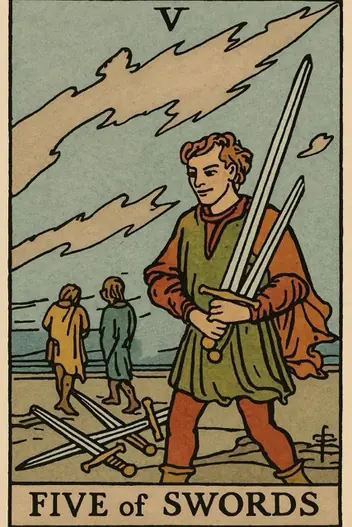
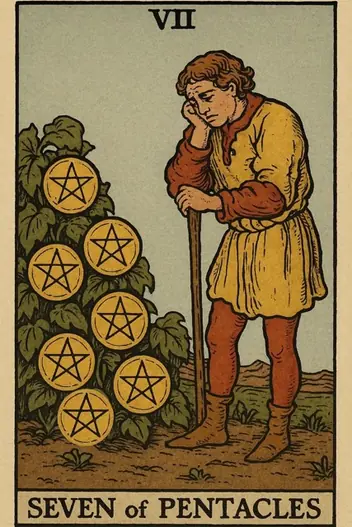
When the Five of Swords—a card of conflict, winning at all costs, and hollow victories—collides with the Seven of Pentacles—a card of patience, assessment, and long-term cultivation—we encounter a profound psychological tension. This pairing asks: Are you sacrificing your future harvest for a short-term win? It represents the moment when your strategic patience is tested by a desire to prove yourself right, even if it means damaging the very garden you’ve been tending.
Psychologically, this combination highlights the conflict between the ego’s need for immediate validation and the self’s need for sustainable growth. The Five of Swords brings a sharp, competitive edge, while the Seven of Pentacles calls for a cool, detached evaluation of whether that competition is worth the collateral damage. The key insight here is that winning a battle does not guarantee winning the war—especially when the battlefield is your own life’s work.
Five of Swords and Seven of Pentacles Together: Meaning
The core dynamic of Five of Swords and Seven of Pentacles is a strategic paradox: you are being asked to fight for something that requires patience, or to be patient with something that feels like a fight. This often manifests as a situation where you have invested significant time, energy, or resources into a project, relationship, or goal—only to face a conflict that threatens to undo that progress. The Five of Swords energy wants to cut losses and declare victory, even if it means walking away with nothing but bruised pride. The Seven of Pentacles energy asks you to step back, assess the crop, and decide if the conflict is actually necessary.
From a Jungian perspective, this pairing represents the clash between the Warrior archetype and the Farmer archetype. The Warrior wants to conquer; the Farmer wants to nurture. When these two energies are unbalanced, you may find yourself over-identifying with the role of the victor (Five of Swords) while neglecting the slow, unglamorous work of tending your resources (Seven of Pentacles). The healthy integration of these cards is strategic withdrawal: knowing when to fight AND when to let the soil rest. The most powerful move you can make right now is to pause and calculate the long-term cost of your next move.
Five of Swords and Seven of Pentacles as Feelings
If you are single:
This combination warns against turning dating into a power struggle. You may be tempted to "win" a romantic situation by proving your worth through argument or competition. Instead, ask yourself if this person is worth the emotional investment, or if you are simply addicted to the chase.
If you are in a relationship:
You are likely experiencing a recurring conflict that feels like a battle for control. One partner may feel they are "winning" arguments, while the other is quietly withdrawing investment. The relationship itself is the harvest—is this conflict worth the damage?
In the context of love, the Five of Swords and Seven of Pentacles reveal a relationship dynamic where power struggles have begun to erode the foundation of trust and mutual effort. You may be fighting over principles, past grievances, or future plans, but the real question is: What are you actually cultivating together? If the answer is resentment, then every "win" is a loss. Bold action here means choosing to de-escalate conflict and reinvest in shared goals, even if it feels like "losing" the argument. The Seven of Pentacles reminds you that relationships are gardens, not battlegrounds—they require consistent, patient care, not tactical victories.
Your pair is already on the table. Ask your question and draw the clarifying card
or simply focus on it
Five of Swords and Seven of Pentacles in Career Readings
Strategic Opportunities:
Reassess the ROI of your current conflicts. Is the fight over a promotion, a client, or a project worth the energy? If the answer is no, redirect your effort to more fruitful endeavors.
Strategic Opportunities:
Use this tension to clarify your long-term goals. The conflict may be highlighting what you truly value. Let the Seven of Pentacles help you prune away projects or relationships that are not yielding results.
Calculated Risks:
Avoid the trap of "sunk cost fallacy." Just because you have invested time or money does not mean you should continue fighting for a losing cause. Know when to walk away with your dignity and resources intact.
Professionally, this combination signals a critical decision point where short-term wins could sabotage long-term growth. You may be in a negotiation, a competitive workplace, or a financial situation where winning feels necessary for your self-esteem. However, the Five of Swords warns that victory achieved through aggression or manipulation often leaves you isolated. The Seven of Pentacles advises a cool-headed audit of your assets: time, energy, reputation, and money. Ask yourself: "If I win this fight, what will I have lost?" If the answer includes trust, collaboration, or future opportunities, then the win is hollow. The strategic move is to either negotiate a fair compromise or redirect your efforts to a more sustainable path.
The Shadow Side of Five of Swords and Seven of Pentacles
The shadow side of this combination is cognitive dissonance and self-sabotage. You may convince yourself that you are being "patient" when you are actually stuck in a cycle of passive-aggressive conflict. Alternatively, you may believe you are "fighting for what you deserve" when you are actually indulging in ego-driven battles that drain your resources. The confirmation bias here is dangerous: you will only see evidence that supports your need to win, ignoring the mounting costs. This can lead to a "scorched earth" mentality where you burn bridges, exhaust your savings, or damage your reputation—all in the name of being right. The deepest pitfall is mistaking stubbornness for perseverance. The Five of Swords, when unintegrated, becomes a tyrannical inner critic that demands victory at any cost, while the Seven of Pentacles, when blocked, becomes procrastination disguised as patience.
Deepen your understanding
Find out exactly what this reading means for your current life situation with our oracle.
Five of Swords and Seven of Pentacles Reversed Meaning
When cards appear reversed, the dynamics become more complex and less obvious.
Reversed Five of Wands + Upright Seven of Pentacles:
You are refusing to fight where it is necessary. You allow yourself to be "outplayed" or voluntarily surrender positions to avoid conflict. This is not wisdom, but passive aggression. You are harboring resentment that will later destroy your long-term plans (Pentacles). Advice: defend your boundaries, even if it is unpleasant. Silence does not equal consent.
Upright Five of Wands + Reversed Seven of Pentacles:
You have become embroiled in a conflict that has no meaning. Your labor (Pentacles) is not bearing fruit, and you are taking your anger out on those around you. This is a classic self-sabotage syndrome: you are destroying what has not yet had a chance to grow. Warning: stop. Your aggression right now is not strength, but a sign of exhaustion. You need rest, not war.
Both cards reversed:
Complete imbalance. Inner conflict paralyzes the will. You can neither attack (Wands are weak) nor wait (Pentacles are sluggish). A state of apathy and depression. The only way out is a radical change of environment. Remove yourself from the environment that triggered this crisis. You need a new frame of reference, not attempts to fix the old one.
Five of Swords and Seven of Pentacles: The Combined Message
Constructive use of this combination requires rigorous differentiation. The energy of the Five of Swords (aggression, intellect, will) must be directed not at people, but at obstacles. The energy of the Seven of Pentacles (patience, labor, time) must be directed at creating value.
Your strategy is "managed conflict." Choose one area of life where you are willing to fight hard (e.g., salary negotiations or copyright protection). In all others, cultivate "strategic retreat" and long-term investment. You cannot be a warrior everywhere. Define the zone of battle and the zone of growth.
Practical action algorithm:
- Conduct a resource audit. What is your current "war" costing you? (Time, money, nerves, reputation).
- Formulate a victory criterion. What exactly will you gain when you "win"? If you cannot measure the result, you are fighting for the process itself—a path to nowhere.
- Apply the "80/20 Rule." 20% of your efforts (aggressive tactics) should yield 80% of the result. The remaining 80% of efforts (patient labor) should ensure the system's stability.
The main conclusion: your strength lies not in breaking your opponent, but in making yourself invulnerable. Building (Seven of Pentacles) is always more profitable than destroying (Five of Swords). Use the sharp mind of the Swords to protect your crops, not to burn the field.
Where to Go From Here
The Five of Swords and Seven of Pentacles together deliver a powerful message: your next move must be calculated, not reactive. This is not a time for impulsive victories or passive waiting. It is a time for strategic patience—knowing when to hold your ground, when to let go, and when to reinvest your energy elsewhere. The core truth is that real power comes from choosing your battles wisely and nurturing what truly matters.
To get a deep, personalized interpretation of this exact combination for your specific situation—whether it’s a relationship, career crossroads, or financial decision—use the Fortune Cards app. The app applies the archetypes directly to your unique context, helping you move from generic advice to actionable insight. You can access it on the web or download it now to discover what this combination means for your life, right now.
Interpretation by the Fortune Cards editorial team, based on the Rider–Waite tradition and Jungian archetypes. About our methodology · Updated: 2026-08-26
Other Combinations with Five of Swords
Other Combinations with Seven of Pentacles
Explore Individual Card Meanings
Table of Contents
- Five of Swords and Seven of Pentacles Together: Meaning
- Five of Swords and Seven of Pentacles as Feelings
- Five of Swords and Seven of Pentacles in Career Readings
- The Shadow Side of Five of Swords and Seven of Pentacles
- Five of Swords and Seven of Pentacles Reversed Meaning
- Five of Swords and Seven of Pentacles: The Combined Message
- Where to Go From Here
Ready to find answers to your questions?
Start your first reading now and look at your situation with fresh clarity. The cards are ready to reveal deeper meaning.