Three of Swords and Four of Swords Tarot Combination
- Arcana
- Three of Swords — Minor Arcana, Swords; Four of Swords — Minor Arcana, Swords
- Elements
- Three of Swords — Air; Four of Swords — Air
- Elemental interaction
- Same element — energies intensify each other
- Numerology
- 3 + 4 = 7
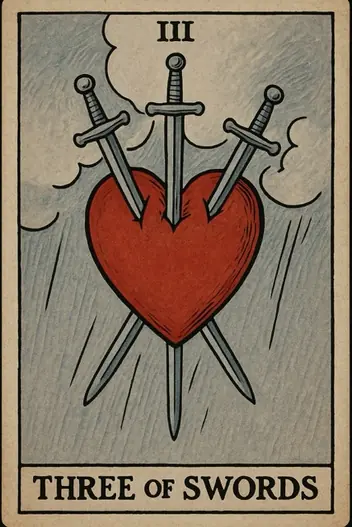
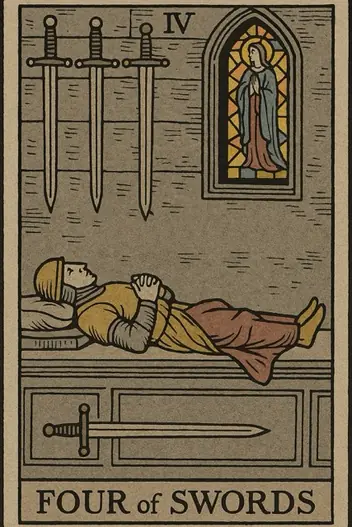
The intersection of the Three of Swords and Four of Swords is a powerful psychological crucible. The Three of Swords represents the sharp, undeniable pain of a truth—a heartbreak, a betrayal, or a painful realization that cuts through illusion. The Four of Swords, in contrast, is the archetype of retreat, mental stillness, and strategic recuperation. When these two collide, the message is clear: you are being forced to stop and process a wound, not to ignore it.
This combination signals a critical juncture in the psyche. The cognitive dissonance created by a painful event demands a period of deliberate, conscious reflection. You cannot outrun this pain with activity or distraction; the Four of Swords insists on a pause. The strategic value here is immense: by withdrawing from the battlefield of your emotions, you gain the clarity to see the wound for what it is—a necessary incision that cuts away falsehood, preparing the ground for genuine healing.
Three of Swords and Four of Swords Together: Meaning
The core dynamic is a tension between emotional exposure and mental protection. The Three of Swords exposes a raw nerve, often revealing a fundamental flaw in a relationship, a career path, or a personal belief system. The Four of Swords then provides the psychological architecture for processing this exposure. It is not about escape; it is about strategic isolation to prevent further damage. This is a time to treat your mind like a hospital ward—quiet, sterile, and focused solely on recovery.
The key psychological insight is that this combination often appears when the seeker is caught in a loop of rumination. The Three of Swords provides the painful thought, and the Four of Swords offers the only viable solution: conscious, deliberate rest for the analytical mind. Avoid the trap of "overthinking" the pain. Instead, use the Four of Swords energy to create a structured mental space—a journal, a meditation practice, or a temporary break from the source of conflict—where you can observe the pain without being consumed by it.
Practically, this means accepting a temporary reduction in external activity. Your energy is being redirected inward for triage. The world may demand you "move on," but this pair advises the opposite: slow down, sleep more, and reduce social obligations. The wound will not heal by being ignored. It heals by being acknowledged in a controlled, safe environment. This is not weakness; it is calculated emotional risk management.
Your pair is already on the table. Ask your question and draw the clarifying card
or simply focus on it
Three of Swords and Four of Swords Love Outcome
If you are single:
This pair strongly suggests you are carrying unresolved pain from a past relationship. Do not rush into a new connection. The wound needs to be examined, not projected. Your next partner will be healthier if you first withdraw to understand what went wrong.
If you are in a relationship:
A significant truth has been revealed—perhaps an infidelity, a broken promise, or a core incompatibility. The Four of Swords advises a temporary cooling-off period. Do not try to "fix" this in a heated argument. Request space to think clearly.
In a relationship context, the Three of Swords and Four of Swords together demand a period of radical honesty and structured silence. The pain is real, but the response must be calculated. Do not make permanent decisions from a temporary emotional state. The Four of Swords provides the necessary buffer to assess whether the relationship can be rebuilt or if it must be released. The key relationship advice here is to define clear boundaries for the retreat: agree on a specific time to reconvene, and use that time alone to write down your non-negotiable needs and the objective facts of the situation.
Emotional intelligence is critical. One partner may feel abandoned by the other's need for space. Clearly communicate that this withdrawal is a form of care, not punishment. The goal is to prevent further emotional lacerations. If both partners can respect the need for a "mental ceasefire," this combination can lead to a deeper, more authentic bond—or a clean, respectful separation.
Three of Swords and Four of Swords in Career Readings
Strategic Opportunities:
Use the Four of Swords energy to audit your professional trajectory. A project failure or a critical feedback session (Three of Swords) is a data point. Withdraw to analyze the root cause without ego.
Strategic Opportunities:
This is an ideal time for deep research and strategic planning. Remove yourself from the daily noise. Read market reports, update your resume, or draft a new business plan in solitude.
Calculated Risks:
Do not sign contracts or make major financial commitments. Your judgment is clouded by recent disappointment. The risk of making a reactive, loss-aversion decision is high. Wait at least two weeks.
Professionally, this combination often appears after a significant setback: a demotion, a failed pitch, or a toxic work environment that has finally broken your spirit. The strategic response is to declare a professional "time-out." Take a sick day, a mental health day, or even a short sabbatical if possible. The most expensive mistake you can make here is to quit in anger or accept a counteroffer out of fear. Use the Four of Swords to run a cost-benefit analysis on your current position, separate from the emotional sting of the Three of Swords.
Financial planning requires a conservative approach. The Three of Swords suggests a potential loss or unexpected expense. The Four of Swords advises building a cash buffer and avoiding speculative investments. Your financial risk tolerance is currently low, and your decision-making is compromised by stress. Focus on preserving capital and stabilizing your primary income source. This is a time for maintenance, not expansion.
Get a personalized interpretation
Unlock the combined meaning of your cards in the context of your unique question — for free.
When Three of Swords and Four of Swords Signal Trouble
The shadow side of this combination is a dangerous form of emotional paralysis. The seeker may use the Four of Swords as an excuse for chronic avoidance. Instead of a strategic retreat, they enter a state of learned helplessness, refusing to engage with the pain of the Three of Swords at all. This leads to prolonged depression and a stagnant life. The cognitive bias here is catastrophizing: assuming the pain will never end, so why bother trying?
Another pitfall is self-flagellation. The seeker may turn the Three of Swords inward, blaming themselves excessively for the wound. The Four of Swords then becomes a prison of guilt, not a sanctuary for healing. This is a distortion of the cards' message. The true lesson is to observe the pain without judgment, to understand the cause-and-effect, and then to plan a strategic re-entry into life. If you find yourself stuck in a cycle of self-blame and isolation for more than a few weeks, you are in the shadow territory of this combination. Seek external perspective—a therapist, a trusted mentor, or a structured support group—to break the loop.
Three of Swords and Four of Swords Reversed: How to Read It
If the Three of Swords is Reversed:
The pain is denied or suppressed. The person refuses to acknowledge the problem. Instead of a healthy pause (Four of Swords), a dangerous inaction arises, based on illusions. Advice: It is necessary to forcibly stop and acknowledge the fact of the loss, otherwise the crisis will drag on.
If the Four of Swords is Reversed:
Indicates an internal resistance to rest. The person cannot calm down, they are feverish, looking for someone to blame, or trying to escape into work. This exacerbates the pain of the Three of Swords, leading to nervous exhaustion. Key advice: Forced hospitalization or a complete digital detox.
If BOTH are Reversed:
Complete imbalance — chronic stress without the possibility of recovery. The person is in a state of "learned helplessness". External emergency intervention is necessary: help from a psychotherapist, a change of scenery, or a radical change in lifestyle.
Three of Swords and Four of Swords: The Combined Message
Constructive use of this combination requires conscious crisis management. The energy of the Three of Swords (sharp pain, truth, rupture) must be used as a scalpel to cut away what no longer works: toxic relationships, unprofitable projects, false beliefs. The Four of Swords provides a safe operating theater for this—time and isolation. Your task is to transform suffering into data.
Strategically, you need to create a "transition" ritual. This could be a written analysis: "What exactly did I lose?", "What lessons did I learn?", "What will I build on these ruins?". Key takeaway: This pair of cards is not the end of the road, but a bifurcation point. You either use the pain as fuel for transformation, or you get stuck in an endless cycle of "trauma-rest-trauma". The choice is yours. The third path—ignoring the signal—leads to relapse.
Applying This to Your Situation
The core message of the Three of Swords and Four of Swords is a disciplined call to heal. The pain is a signal, not a sentence. Your next step is to honor the wound by creating a safe, structured space to understand it, and then to emerge with a clearer, more resilient strategy for life. This is not an ending; it is a necessary psychological recalibration.
While this article provides a deep understanding of the archetypes, the true power of Tarot lies in its application to your unique life. The meaning of this combination shifts dramatically based on your specific question, your personal history, and the surrounding cards. To get a precise, personalized interpretation of this exact combination for your situation right now, use the Fortune Cards app. You can access it on the web or download it to receive a deep, tailored analysis that cuts through the generalities and speaks directly to your wound and your path forward.
Interpretation by the Fortune Cards editorial team, based on the Rider–Waite tradition and Jungian archetypes. About our methodology · Updated: 2026-08-26
Other Combinations with Three of Swords
Other Combinations with Four of Swords
Explore Individual Card Meanings
Table of Contents
- Three of Swords and Four of Swords Together: Meaning
- Three of Swords and Four of Swords Love Outcome
- Three of Swords and Four of Swords in Career Readings
- When Three of Swords and Four of Swords Signal Trouble
- Three of Swords and Four of Swords Reversed: How to Read It
- Three of Swords and Four of Swords: The Combined Message
- Applying This to Your Situation
Ready to find answers to your questions?
Start your first reading now and look at your situation with fresh clarity. The cards are ready to reveal deeper meaning.