Love Tarot: Five of Swords and Eight of Swords

- Arcana
- Five of Swords — Minor Arcana, Swords; Eight of Swords — Minor Arcana, Swords
- Elements
- Five of Swords — Air; Eight of Swords — Air
- Elemental interaction
- Same element — energies intensify each other
- Numerology
- 5 + 8 = 13 → 4
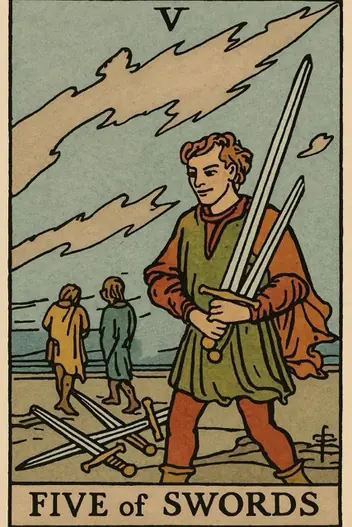
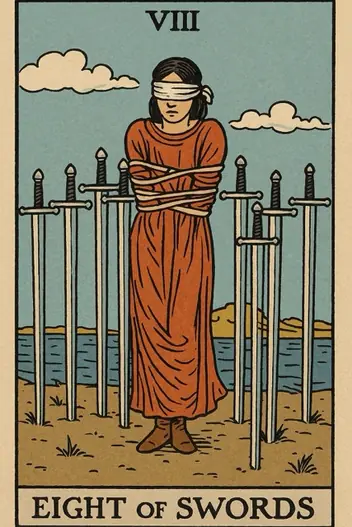
When the Five of Swords meets the Eight of Swords, we witness a collision between external conflict and internal paralysis. The Five of Swords represents a battle won at great cost—often through manipulation, aggression, or hollow victory. The Eight of Swords embodies a state of mental entrapment, where perceived limitations bind the seeker tighter than any real chains. Together, they form a potent psychological warning: the greatest enemy may be the story you tell yourself about your losses.
This combination often appears when a person has fought hard for something—a job, a relationship, a point of view—only to realize the victory feels empty. The aftermath of the Five of Swords leaves the seeker isolated, while the Eight of Swords traps them in recursive loops of regret, guilt, or self-blame. The key insight here is that the cage is largely self-constructed, built from beliefs about being wronged, misunderstood, or irrevocably damaged by past conflicts.
Five of Swords and Eight of Swords Combination Meaning
The psychological core of this pairing is cognitive dissonance between action and consequence. The Five of Swords demands a win at any cost, often sacrificing relationships and integrity. The Eight of Swords then arrives to enforce the emotional bill: isolation, shame, and a sense of being trapped by one's own choices. The seeker may replay the conflict obsessively, wondering where they went wrong or how they could have avoided the fallout.
This combination reveals a self-reinforcing loop of defeat. The Five of Swords creates real-world consequences—lost allies, damaged reputation, bitter opponents. The Eight of Swords then amplifies these consequences through catastrophic thinking, convincing the seeker that there is no way out, no redemption, and no path forward. The truth is more nuanced: the seeker still has agency, but they must first recognize that their current perspective is distorted.
A pragmatic Jungian lens suggests this pairing represents the Shadow complex of the "victorious loser"—someone who wins battles but loses wars, especially the war for self-respect and authentic connection. The solution lies not in fighting more, but in stepping back to examine the unconscious beliefs that made the conflict seem necessary in the first place. What core fear drove the need to win at any cost?
Love and Relationships
If you are single:
This pairing suggests you may be attracted to unavailable or combative partners, or you are holding onto a past conflict that prevents you from seeing new opportunities. Let go of the need to be "right" about past relationships before you can move forward.
If you are in a relationship:
Power struggles have created a toxic dynamic where one or both partners feel trapped. The "winner" of recent arguments is likely feeling hollow, while the "loser" feels victimized and unable to speak up.
In relationships, this combination often signals a cycle of blame and withdrawal. One partner may have "won" an argument through verbal dominance or emotional manipulation (Five of Swords), but the cost is a partner who now feels silenced, resentful, or victimized (Eight of Swords). The relationship becomes a prison of unspoken grievances.
Key relationship advice:
The only way to break this cycle is to acknowledge the emptiness of the victory. Both partners must recognize that winning an argument at the expense of connection is a Pyrrhic victory. A structured conversation—perhaps with a mediator or using "I" statements—can help each person see how their own behaviors contribute to the trap. Bold action here means apologizing for the win, not doubling down on it.
Your pair is already on the table. Ask your question and draw the clarifying card
or simply focus on it
Career and Finances
Strategic Opportunities:
Re-examine recent conflicts to identify what was truly worth fighting for. Some battles are unnecessary; redirect energy toward collaborative wins.
Strategic Opportunities:
Use this moment of paralysis to audit your professional relationships. Who is a true ally, and who is a competitor you've been feeding with your resentment?
Calculated Risks:
Avoid any new negotiations or confrontations until you have clarity. Do not sign contracts or make major financial moves while feeling trapped or defensive.
In the professional realm, this combination warns against career moves driven by ego or revenge. The Five of Swords may represent a recent promotion gained through office politics, a bitter client dispute you "won," or a negotiation where you leveraged unfair advantages. The Eight of Swords then reveals the hidden costs: damaged team morale, loss of trust from superiors, or a reputation that now precedes you. The financial gain may be real, but the long-term cost to your career network is higher.
Practical financial advice:
This is a time for damage control, not expansion. Focus on rebuilding bridges with colleagues you may have alienated. Bold financial warning: Avoid the temptation to "win" another round—the Eight of Swords suggests that each victory under this energy tightens the trap. Instead, invest in transparency and repair. Consider whether a current project or role is truly worth the psychological toll it's taking.
Shadow Side & Pitfalls
The shadow of this pairing is the martyr-complex combined with the bully. The seeker may oscillate between seeing themselves as the victimized underdog (Eight of Swords) and the aggressive conqueror (Five of Swords), without ever landing in a place of balanced self-awareness. This creates a dangerous cognitive bias known as "moral licensing" : feeling justified in past aggression because of current suffering, or using current suffering as an excuse to lash out.
Self-sabotage manifests through refusal to accept help. The Eight of Swords suggests the seeker feels bound, but the Five of Swords warns that they may have alienated the very people who could help cut those bonds. A common pitfall is rumination—endlessly replaying the conflict to justify one's own actions, rather than seeking a way forward. The shadow asks: Are you more invested in being right than in being free?
Another critical pitfall is overgeneralization. A single conflict (Five of Swords) may lead the seeker to believe that all relationships are adversarial or that trust is impossible (Eight of Swords). This cognitive distortion must be challenged directly. The truth is that one battle does not define the entire war, and one difficult person does not represent all humanity.
Ask your specific question
Don't rely on generic meanings. Get a customized reading tailored specifically to your energies.
What If Five of Swords or Eight of Swords Appears Reversed?
When cards appear in a reversed position, the dynamics shift, but not always for the better.
If the Five of Swords is reversed:
This points to suppressed aggression or an unresolved conflict. You were unable to defend your position and now feel like a victim (the Eight). Warning: do not turn your unspoken resentment into chronic helplessness. You need to find a safe way to express your dissatisfaction, otherwise it will consume you from within.
If the Eight of Swords is reversed:
This is a sign of internal resistance to change. You can already see the way out but consciously refuse to take it, preferring to suffer. Advice: your "bondage" is a voluntary choice. You cling to old grievances and fears because they give you an excuse for inaction. Remove the blindfold—the solution is already before you.
If BOTH are reversed:
This is a complete imbalance, indicating deep self-deception. The person is simultaneously aggressive and passive. They may complain about injustice while provoking conflicts. Way to correct: honest reflection is necessary. Write down on paper what you accuse others of and what you accuse yourself of. Only by acknowledging your role in creating this trap can you escape it.
Five of Swords and Eight of Swords Combined Message
Constructive use of this energy requires a paradoxical action: relinquishing control. The Five of Swords is the archetype of the Warrior, accustomed to resolving everything through force and pressure. The Eight of Swords is the Prisoner, waiting to be freed. To balance this pair, you need to stop being the Warrior and stop being the Victim. Become the Observer.
Your strategy is "active inaction." Do not try to fight again (the Five) and do not fall into a stupor (the Eight). Instead, pause and ask yourself: "What beliefs of mine are keeping me in this trap?" Most likely, you will discover irrational attitudes: "I cannot lose," "I must be respected," "If I give in, I will be destroyed." Awareness of these attitudes is the first step toward liberation.
A deep strategic counsel: use the energy of the Five not for attack, but to defend your new boundaries. You have already realized that the old methods do not work. Now, use your determination (the Five) to implement new rules of the game. For example, firmly tell yourself and those around you: "I will no longer participate in arguments where there is no room for compromise." This will be your true victory—a victory over your own ego and fear. You are not escaping the cage; you are rebuilding it into a home.
Where to Go From Here
The Five of Swords and Eight of Swords together deliver a stark message: You are trapped by a story of victory that feels like defeat. The path out requires you to distinguish between real constraints and self-imposed limitations. Let go of the need to be right, and instead ask what you truly want—connection, peace, or growth—rather than what you feel you must prove. Your next move is not to fight harder, but to see clearly.
While this article provides a deep archetypal analysis, the true power of Tarot lies in its application to your unique situation. The Fortune Cards app allows you to input your specific question and receive a personalized, context-aware interpretation of this exact card combination. Whether you're navigating a career crisis, a relationship crossroads, or an internal struggle, the app cuts through generalities to deliver actionable insights tailored to your life. Use it on the web or download it now to break free from the trap of generic readings and discover what these cards truly mean for you—right now.
Interpretation by the Fortune Cards editorial team, based on the Rider–Waite tradition and Jungian archetypes. About our methodology · Updated: 2026-08-26
Other Combinations with Five of Swords
Other Combinations with Eight of Swords
Explore Individual Card Meanings
Ready to find answers to your questions?
Start your first reading now and look at your situation with fresh clarity. The cards are ready to reveal deeper meaning.