Five of Swords and Nine of Swords Meaning in Tarot

- Arcana
- Five of Swords — Minor Arcana, Swords; Nine of Swords — Minor Arcana, Swords
- Elements
- Five of Swords — Air; Nine of Swords — Air
- Elemental interaction
- Same element — energies intensify each other
- Numerology
- 5 + 9 = 14 → 5
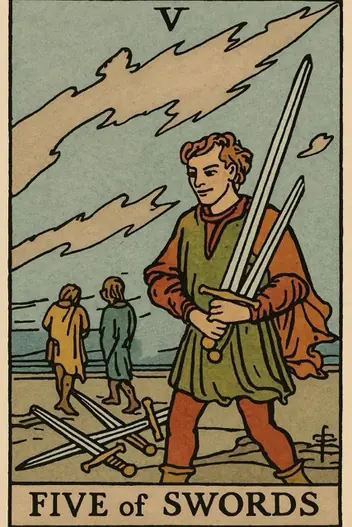
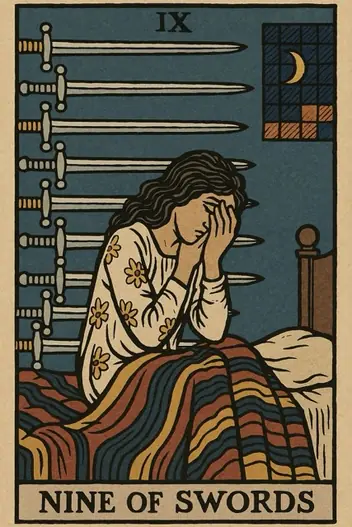
When the Five of Swords—a card of conflict, hollow victory, and moral compromise—collides with the Nine of Swords—the card of anxiety, nightmares, and self-inflicted mental torment—the result is a potent psychological cocktail. This combination often describes a situation where winning a battle has come at the cost of your inner peace. You may have achieved a short-term goal, but the guilt, regret, or paranoia that follows is eroding your sense of self.
This pairing represents a cognitive trap: the belief that external dominance will silence internal fears. Instead, the victory only magnifies the anxiety. The Five of Swords says, "I must win at all costs," while the Nine of Swords whispers, "The cost was your soul." Together, they demand a hard look at the true price of your choices and the stories you tell yourself about conflict.
Five of Swords and Nine of Swords Card Meaning Explained
The core dynamic here is a feedback loop of self-sabotage. The Five of Swords energy drives you to engage in power struggles, often picking fights or manipulating situations to prove you are "right" or superior. However, the Nine of Swords reveals that this victory is hollow. You are left alone, not just physically, but mentally—replaying the argument, questioning your motives, and fearing retaliation. The psychological state is one of hypervigilance: you won, but now you must constantly guard against the next attack, real or imagined.
This combination often signals a breakdown of trust—not just with others, but with yourself. You may have acted against your core values to achieve a win, and now your subconscious is punishing you with sleepless nights and intrusive thoughts. The key insight here is that the anxiety is not the problem; it is a symptom of a deeper ethical or strategic misstep. The cards force you to ask: Was the outcome worth the internal cost? Pragmatically, this pair suggests that you cannot outrun your conscience through external victories. The only way forward is to stop fighting and start reconciling.
Your pair is already on the table. Ask your question and draw the clarifying card
or simply focus on it
Five of Swords and Nine of Swords: Career and Money
Strategic Opportunities:
This combination can signal a time to cut losses in a toxic work environment or competitive project. The "win" may not be worth the mental health toll.
Strategic Opportunities:
It can also indicate a need to redefine success. Instead of focusing on beating others, shift your goal to collaborative innovation or sustainable growth.
Calculated Risks:
Avoid legal battles, public disputes, or aggressive negotiations that could backfire. The short-term gain will likely be overshadowed by long-term reputational damage or legal fees.
Professionally, the Five of Swords and Nine of Swords together are a red flag for burnout and ethical compromise. You may be in a situation where you feel forced to fight for your position, but every "win" drains your energy and self-respect. Financial warning: If you are considering a deal that requires you to undercut a colleague, hide information, or break a promise, the anxiety this will generate will likely impair your judgment and productivity. Strategic tip: Instead of fighting for scraps, walk away from the battlefield. Look for a role or project where your skills are valued without requiring you to compromise your integrity. The long-term cost of a toxic win is always higher than the short-term loss.
Five of Swords and Nine of Swords as Feelings
If you are single:
This combination warns against pursuing a connection through competition or manipulation. If you are trying to "win" someone’s affection by undermining a rival or playing games, you will likely end up feeling empty and anxious. Focus on authenticity over conquest.
If you are in a relationship:
This points to a cycle of verbal sparring or power plays where one partner "wins" arguments but damages the emotional safety of the union. The winner often feels guilty, while the loser harbors resentment.
In relationships, this pair highlights a toxic dynamic of control and guilt. One partner may be using sharp words or emotional withdrawal to dominate, but the victory is Pyrrhic. The Nine of Swords reveals that the "winner" is often the one lying awake at night, consumed by regret or fear of being exposed. The key advice here is to recognize that a relationship is not a battlefield. If you find yourself keeping score, you have already lost the connection. Bold relationship advice: Stop trying to prove you are right, and start asking if you are being kind. The only resolution is to apologize for the harm caused and rebuild trust through vulnerability, not victory.
Your unique Tarot reading
See how these cards interact with your destiny. Start a free personal reading now.
Five of Swords and Nine of Swords Reversed: How to Read It
If the Five of Swords is reversed:
The potential for conflict is blocked, generating passive self-destruction. The person hesitates to engage in open confrontation but accumulates resentment, which amplifies the anxiety of the Nine. Advice: you need to safely express aggression — through sports, therapy, or anonymous letters. Otherwise, suppressed anger will turn into psychosomatic issues.
If the Nine of Swords is reversed:
Anxiety sinks into the unconscious, manifesting as irrational procrastination or a "paralysis of will." The person avoids decisions, fearing consequences, but is unaware of this fear. Warning: this state is dangerous because you may mistake inaction for wisdom. Reality demands action, yet you are stuck in the illusion of "weighing options." It is necessary to force a decision through artificial deadlines.
If BOTH cards are reversed:
Complete imbalance — the energy of the Five is suppressed, the anxiety of the Nine remains unrecognized. The person lives in a state of chronic frustration, unable to understand its source. A method for correction: conduct an audit of the last 6 months — where did you stay silent when you needed to speak, and where did you worry without objective reason? Restore the connection between actions and emotions through a decision journal.
The Shadow Side of Five of Swords and Nine of Swords
The shadow side of this combination is the martyr complex disguised as a warrior. You may believe you are fighting for justice or survival, but in reality, you are addicted to conflict. The cognitive bias at play is confirmation bias: you only see evidence that supports your narrative of being wronged or under attack, ignoring the possibility that you are the aggressor. This leads to self-sabotage through overthinking and paranoia. You might isolate yourself, convinced that everyone is an enemy, and then wonder why you feel lonely and anxious. Another pitfall is moral licensing: feeling justified in your harsh actions because of past pain, which only deepens the cycle of guilt and fear. The shadow asks: Are you fighting a real enemy, or a projection of your own inner critic?
Overall Meaning of Five of Swords and Nine of Swords
Constructive use of the Five of Swords' energy to balance the Nine of Swords requires separating "war" from "peace." You cannot remain in a constant state of conflict — it exhausts the nervous system and makes you vulnerable to anxiety. The strategy is to concentrate aggression only on critically important points, while applying diplomacy or inaction in other areas. For example, if you are worrying about a work conflict, ask yourself: "Will this victory change my life in a year?" If not — retreat, conserving resources for real battles.
The second strategic step is transforming anxiety into preventive planning. The Nine of Swords is not just a "bad card," but a powerful indicator of blind spots. Instead of tormenting yourself with worry, create a risk map: what exactly could go wrong, what resources do you have for each scenario, who could become an ally. Anxiety translated into an action plan loses its destructive power and becomes a tool of strategy.
The third aspect is working with guilt. The Five of Swords often leaves a moral residue, even when you were in the right. It is important to distinguish between objective guilt (you actually violated ethical norms) and neurotic guilt (you feel you could have acted "better," though no alternative existed). Practice the "decision protocol": write down what factors influenced your choice, what the constraints were, and what result you obtained. This will reduce the subjectivity of self-assessment and provide clarity for future actions.
The final strategic advice: use the Five of Swords to defend boundaries, not to attack, and perceive the Nine of Swords as a signaling system, not a verdict. Your task is not to eliminate anxiety completely (that is impossible), but to learn to read its messages and act rationally, not reactively. Only then will this complex combination become a tool for growth, not a trap.
Your Next Step: Personal Context Matters
The core message of the Five of Swords and Nine of Swords is clear: Victory bought with anxiety is not victory at all. You are being challenged to step back from the fight, examine the true cost of your actions, and choose peace over pride. The anxiety you feel is a valuable signal, not a weakness—it is asking you to realign with your values.
While this article provides a general map of these archetypes, the true magic happens when Tarot is applied to your unique situation. To get a deep, personalized interpretation of this exact combination for your specific question—whether it’s about a relationship, a career move, or a personal dilemma—use the Fortune Cards app. You can access it on the web or download it to your device and receive an analysis tailored to your life, right now.
Interpretation by the Fortune Cards editorial team, based on the Rider–Waite tradition and Jungian archetypes. About our methodology · Updated: 2026-08-26
Other Combinations with Five of Swords
Other Combinations with Nine of Swords
Explore Individual Card Meanings
Table of Contents
- Five of Swords and Nine of Swords Card Meaning Explained
- Five of Swords and Nine of Swords: Career and Money
- Five of Swords and Nine of Swords as Feelings
- Five of Swords and Nine of Swords Reversed: How to Read It
- The Shadow Side of Five of Swords and Nine of Swords
- Overall Meaning of Five of Swords and Nine of Swords
- Your Next Step: Personal Context Matters
Ready to find answers to your questions?
Start your first reading now and look at your situation with fresh clarity. The cards are ready to reveal deeper meaning.