Love Tarot: Three of Swords and Eight of Swords
- Arcana
- Three of Swords — Minor Arcana, Swords; Eight of Swords — Minor Arcana, Swords
- Elements
- Three of Swords — Air; Eight of Swords — Air
- Elemental interaction
- Same element — energies intensify each other
- Numerology
- 3 + 8 = 11 → 2
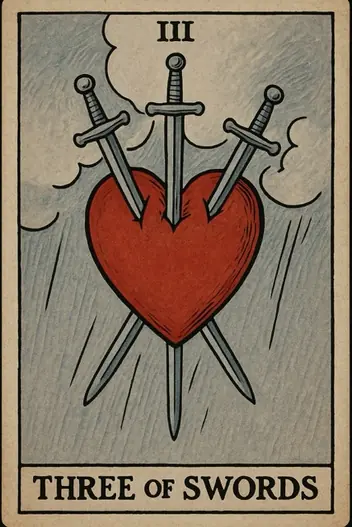
When the Three of Swords—the card of piercing grief, betrayal, and emotional truth—collides with the Eight of Swords—the card of self-imposed limitation, anxiety, and cognitive paralysis—the result is a powerful psychological trap. This combination represents a state where painful past experiences are actively distorting your perception of present reality. You are not just hurting; you are hurting yourself further by believing you are trapped.
The core conflict here is between objective emotional wounds (Three of Swords) and subjective mental restraints (Eight of Swords). The Three of Swords delivers the blow, but the Eight of Swords is the cage you build around that wound. Together, they create a feedback loop: the pain confirms your worst fears, and those fears amplify the pain. The strategic insight is that the prison is largely in your mind, though the initial injury was real.
Three of Swords and Eight of Swords Combination Meaning
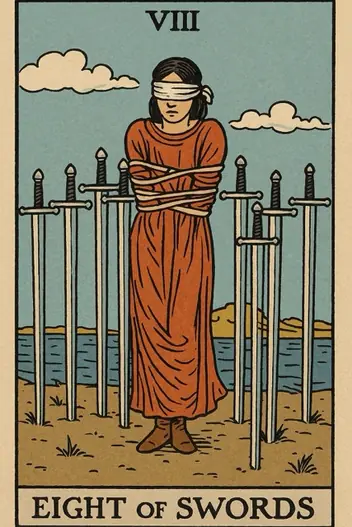
The psychological state created by this combination is one of victimhood masquerading as clarity. You believe you see the situation clearly—the betrayal, the failure, the loss—but your vision is filtered through a lens of catastrophic thinking. The Eight of Swords blindfold prevents you from seeing exits, resources, or alternative interpretations. Meanwhile, the Three of Swords keeps the emotional wound fresh, preventing healing.
This pairing often surfaces when someone is stuck in a narrative of powerlessness. The Three of Swords says, "Something hurtful happened." The Eight of Swords responds, "And therefore I can do nothing about it, and it will always be this way." The real danger is not the original pain, but the belief that you are permanently disabled by it. This is a classic Jungian shadow dynamic: the wounded inner child is being guarded by a self-critical inner judge who insists on staying in the pain because it feels familiar.
In practical terms, this combination signals a need for cognitive restructuring. The situation may genuinely be difficult, but the paralysis is disproportionate to the threat. The path forward requires distinguishing between valid grief and unnecessary suffering. The Three of Swords asks you to feel the pain fully. The Eight of Swords asks you to question the story you are telling yourself about that pain.
Career Meaning of Three of Swords and Eight of Swords
Strategic Opportunities:
Use this combination as a signal to audit your assumptions about your career path. The pain may be real (a failed project, a missed promotion), but your belief that you are now stuck is likely exaggerated.
Strategic Opportunities:
This is an ideal time to seek external feedback. Your judgment is clouded by emotion. A mentor or objective colleague can help you see options you are currently blind to.
Calculated Risks:
Avoid making major financial or career decisions while in this emotional state. The combination of pain and paralysis leads to either impulsive escape moves or frozen indecision—both poor strategies.
In a professional context, the Three of Swords and Eight of Swords together often indicate a crisis of confidence following a specific setback. You may have been publicly criticized, lost a key client, or experienced a professional betrayal. The Eight of Swords now whispers that your reputation is permanently damaged, that you have no good options, or that leaving is impossible. This is almost always a cognitive distortion. The setback is real, but the conclusion that you are trapped is a choice.
Financially, this combination warns against making decisions from a scarcity mindset. You might be tempted to accept unfavorable terms out of fear, or to avoid necessary negotiations because you believe you have no leverage. The bold financial truth is that your perceived powerlessness is your biggest liability. Take one small, concrete action to test your assumptions—apply for a different role, renegotiate a contract, or simply ask for what you need.
Your pair is already on the table. Ask your question and draw the clarifying card
or simply focus on it
Three of Swords and Eight of Swords in Love Tarot
If you are single:
This combination warns against projecting past heartbreaks onto new potential partners. You are likely interpreting neutral behaviors as signs of impending betrayal. Your primary task is to separate past wounds from present reality.
If you are in a relationship:
This suggests a dynamic where one or both partners feel trapped by unresolved conflict. There may be a power imbalance where one person's pain is used as justification for controlling or withdrawing behavior.
In relationships, this pairing is a red flag for emotional gridlock. The Three of Swords represents a specific hurt—perhaps infidelity, a harsh criticism, or a broken promise. The Eight of Swords represents the resulting relationship prison: you walk on eggshells, avoid important conversations, or believe the relationship can never be safe again. The key insight is that the blindfold prevents you from seeing your partner's genuine attempts at repair. You may be so focused on protecting yourself from being hurt again that you miss opportunities for genuine connection.
The most important relationship advice here is to challenge the assumption of helplessness. Ask yourself: "What evidence do I have that I am truly trapped in this situation? What small action could I take to test whether my fears are accurate?" This combination often requires clear, uncomfortable communication to break the cycle. The alternative is a slow erosion of trust and intimacy.
Reversed Three of Swords and Eight of Swords Explained
When cards appear reversed, the dynamics shift, but not always for the better.
If the Three of Swords is Reversed:
This indicates blocked pain or reckless denial. You refuse to acknowledge that you have been hurt. You pretend that "everything is fine," but the suppressed emotion seeks an outlet through passive aggression or psychosomatic symptoms. Warning: Do not try to "tough out" this pain. It will not disappear; it will only deform your behavior.
If the Eight of Swords is Reversed:
This can mean the beginning of liberation, but with caveats. You are starting to see a way out, but your internal resistance (laziness, fear, pride) prevents you from taking the first step. Advice: This is a state of "insight without action." You know what needs to be done, but you find excuses. The only way to overcome this is to take a micro-step right now.
If BOTH are Reversed:
This is complete disorientation. You do not feel the pain (Three reversed) and you do not see the limitations (Eight reversed), yet you are in total chaos. This is a state of unconscious self-destruction. You act impulsively, without understanding your motives. The logical way to correct this: You need an external frame of reference. Seek out a mentor, a psychologist, or use strict time management. You need someone to tell you "stop," because your internal controller is offline.
Your unique Tarot reading
See how these cards interact with your destiny. Start a free personal reading now.
Three of Swords and Eight of Swords: Warning Signs
The shadow manifestation of this combination is chronic victimhood. The seeker may unconsciously prefer the safety of known pain over the uncertainty of healing. This is a form of learned helplessness where the person has become so accustomed to suffering that they actively resist solutions. They may reject help, dismiss alternative perspectives, or even sabotage attempts at resolution because the identity of "the wounded one" feels more comfortable than the unknown identity of "the healed one."
Cognitive biases at play include confirmation bias (seeking evidence that confirms you are trapped) and catastrophizing (assuming the worst-case scenario is inevitable). The seeker may also engage in emotional reasoning ("I feel trapped, therefore I am trapped"). This combination is particularly dangerous when the seeker uses their pain as a weapon to control others, or as an excuse to avoid responsibility for their own recovery.
Self-sabotage appears as refusing to remove the blindfold. The seeker may know intellectually that their situation is not as dire as it feels, but they cling to the narrative of powerlessness. This is often a defense mechanism: if you believe you have no agency, you cannot be blamed for failing to act. The shadow asks you to confront the terrifying possibility that you have been choosing to stay in pain.
Three of Swords and Eight of Swords Combined Message
How to constructively use the energy of this pair? The Three of Swords is your surgical scalpel. The Eight of Swords is the anesthesia that prevents you from picking it up. Your strategic task is to use pain as a tool for cutting through illusions.
The first step is to acknowledge your pain without guilt. Tell yourself: "Yes, I was wounded. This is an objective fact." But don't stop there. Immediately add: "But my thoughts that I am trapped are not a fact. They are my interpretation." Separate the event from its evaluation.
The second step is to analyze your "blind spots". The Eight of Swords is a card where the figure is blindfolded. Ask yourself: "What information am I ignoring? What resources do I have that I refuse to see?" Often the answer lies on the surface: help from friends, professional skills, free time that you waste on worry.
The third step is action as an antidote. The only way to defeat paralysis is to start moving. You don't need to solve the global problem. You need to take one small but concrete action. Send a resume. Call a partner. Write a plan. Every micro-action destroys the illusion of helplessness. Remember: The Eight of Swords fears movement. As soon as you start to act, its bonds become an illusion.
This synthesis teaches you courage: the courage to acknowledge your vulnerability (Three) and the courage to refuse the comfort of victimhood (Eight). Your strength lies not in not feeling pain, but in not allowing pain to dictate how you live.
Applying This to Your Situation
The core message of Three of Swords and Eight of Swords is this: Your pain is real, but your prison is not. The injury you experienced has created a pattern of thinking that makes you feel helpless. The path forward requires courage—not to ignore the pain, but to question the story you have built around it. You have more options than you can currently see. The first step is to admit that your vision is limited.
Your specific situation is unique, and these general insights can only take you so far. To unlock the full depth of what this combination means for your exact question, use the Fortune Cards app. Whether you access it on the web or download it, the app provides a deeply personalized interpretation of this card pairing, tailored to your relationship, career, or personal growth situation. Stop guessing and start seeing clearly—your personalized reading is waiting.
Interpretation by the Fortune Cards editorial team, based on the Rider–Waite tradition and Jungian archetypes. About our methodology · Updated: 2026-08-26
Other Combinations with Three of Swords
Other Combinations with Eight of Swords
Explore Individual Card Meanings
Table of Contents
- Three of Swords and Eight of Swords Combination Meaning
- Career Meaning of Three of Swords and Eight of Swords
- Three of Swords and Eight of Swords in Love Tarot
- Reversed Three of Swords and Eight of Swords Explained
- Three of Swords and Eight of Swords: Warning Signs
- Three of Swords and Eight of Swords Combined Message
- Applying This to Your Situation
Ready to find answers to your questions?
Start your first reading now and look at your situation with fresh clarity. The cards are ready to reveal deeper meaning.