Three of Swords and Five of Swords Tarot Combination

- Arcana
- Three of Swords — Minor Arcana, Swords; Five of Swords — Minor Arcana, Swords
- Elements
- Three of Swords — Air; Five of Swords — Air
- Elemental interaction
- Same element — energies intensify each other
- Numerology
- 3 + 5 = 8
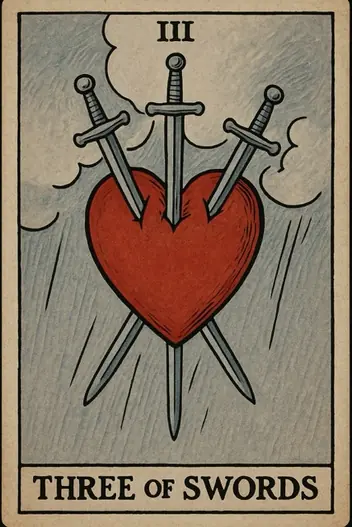
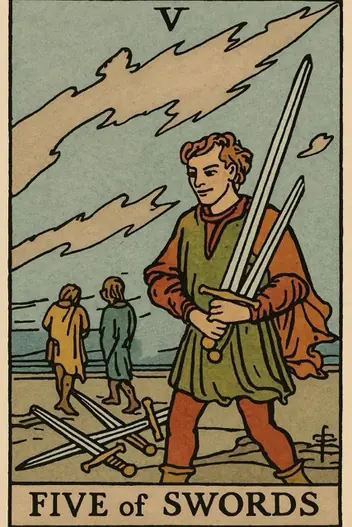
When the Three of Swords—the card of heartbreak, betrayal, and piercing emotional truth—meets the Five of Swords—the card of hollow victory, conflict, and unethical competition—the result is a psychological storm. This pairing signals a moment where emotional wounds are deepened by a power struggle, or where a "win" leaves a bitter taste of loss. The core dynamic is one of cognitive dissonance: the head knows it "won," but the heart feels it lost.
This combination rarely indicates a clean break or a simple success. Instead, it points to a scenario where the seeker must confront the emotional cost of their choices. Whether they are the aggressor (Five) nursing a hidden wound (Three) or the victim (Three) engaging in a pointless fight (Five), the message is clear: avoidance and denial are no longer viable strategies. The truth, however painful, must be faced head-on.
Three of Swords and Five of Swords: How These Energies Interact
The psychological state created by this pairing is one of defensive aggression mixed with profound grief. The seeker may be acting out—lashing out in arguments, sabotaging relationships, or pursuing a victory that leaves them isolated—as a way to mask a deeper hurt. The Three of Swords represents the raw emotional data (the wound), while the Five of Swords represents the maladaptive coping mechanism (the fight). The key insight here is that the conflict is rarely about the external situation; it is a manifestation of an internal war.
This combination often appears when a person has been deeply hurt and is now using intellectual ruthlessness as a shield. They may be winning debates but losing friends, or achieving professional goals at the cost of their integrity. The real-world implication is a tactical error in emotional intelligence: the seeker is prioritizing short-term control over long-term peace. The mind is trying to solve a heart problem with logic, which only deepens the wound.
The most critical psychological concept here is the "shadow victory." This is a win that, upon reflection, feels empty or even shameful. It is the promotion achieved by undermining a colleague, the argument won by hurting a partner, or the legal battle that destroys a family. The combination demands an honest audit: "What did I gain, and what did I truly lose?" The cost of this victory is almost always higher than the seeker initially estimates.
Three of Swords and Five of Swords as Feelings
If you are single:
This pairing suggests you are carrying emotional baggage from a past betrayal into a new connection. You may be overly defensive, testing your potential partner's loyalty or engaging in unnecessary power plays. Your next step is to heal the past wound before seeking a new relationship.
If you are in a relationship:
This combination warns of a toxic cycle of arguments where someone "wins" but the relationship loses. There may be unresolved infidelity, broken trust, or a persistent dynamic of one partner dominating the other. The relationship is bleeding.
In a relationship context, the Three of Swords and Five of Swords often indicate a communication breakdown that has turned into a war of attrition. One partner may be using past grievances as ammunition in current fights, while the other is withdrawing or retaliating. The emotional intelligence required here is radical honesty without cruelty. The seeker must learn to state their pain (Three of Swords) without using it as a weapon (Five of Swords).
The key relationship advice is to stop keeping score. The "winner" of an argument is often the one who has done the most damage to the relationship's foundation. If you are in this dynamic, consider a temporary ceasefire. A structured conversation with a neutral third party (counselor or mediator) may be necessary to break the cycle. Boundaries are essential, but they must be set with compassion, not contempt.
Your pair is already on the table. Ask your question and draw the clarifying card
or simply focus on it
Three of Swords and Five of Swords: Career and Money
Strategic Opportunities:
This is a moment to renegotiate contracts or roles where you have been undervalued. The pain of the past can be used to fuel a fairer deal.
Strategic Opportunities:
If you are exiting a toxic work environment, this combination can signal the courage to walk away from a "win" that isn't worth it—like a promotion that requires compromising your ethics.
Calculated Risks:
Avoid public disputes, legal battles, or gossip-driven politics. The Five of Swords warns that winning this particular fight will damage your reputation more than you think. The cost of litigation or a public spat often outweighs the financial gain.
In a professional context, this pairing points to a high-stakes negotiation or a conflict that has become personal. You may feel betrayed by a colleague (Three of Swords) and are now tempted to retaliate or outmaneuver them (Five of Swords). The strategic error is treating a business problem as a personal vendetta. The pragmatic approach is to separate your wounded ego from your professional goals.
A critical financial warning: do not make major financial decisions based on anger or revenge. The Five of Swords can lead to impulsive spending to "show them," or risky investments driven by a desire to prove someone wrong. Instead, use the clarity of the Three of Swords to objectively assess the situation. What is the actual data? What is the best outcome for your long-term career, not just your immediate emotional satisfaction? The most strategic move may be to cut your losses and move on.
Uncover hidden insights
Let our advanced Tarot system interpret these archetypes specifically for your personal path.
When Three of Swords and Five of Swords Signal Trouble
The shadow side of this combination is a vicious cycle of victimhood and aggression. The seeker may identify so strongly with their pain (Three of Swords) that they feel justified in any action they take (Five of Swords). This is a cognitive bias known as "moral licensing" : believing that past suffering gives you permission to be unethical now. This leads to self-sabotage, as the seeker burns bridges and isolates themselves, only to feel more hurt and betrayed.
Another pitfall is rumination and paranoia. The seeker may replay past hurts obsessively, using them as "evidence" to justify a defensive or aggressive posture. This prevents any genuine resolution. The irrational action here is to fight for a principle that no longer serves you, or to hold onto a grudge that is costing you peace of mind. The shadow asks: "Are you willing to be right, or are you willing to be happy?"
Three of Swords and Five of Swords Reversed Meaning
When cards appear reversed, the sharpness of the conflict subsides, but new risks emerge.
If the Three of Swords is reversed:
This indicates blocked or denied pain. You haven't processed the grief; you've "frozen" it. In a pair with the upright Five, this is dangerous: you will aggressively attack (the Five) without realizing the true cause of your anger (the suppressed Three). Advice: do not start conflicts until you have conducted an honest inventory of your feelings. Otherwise, you risk destroying what could have been saved.
If the Five of Swords is reversed:
This points to internal resistance and weakness. You feel you have lost before even beginning the fight. In a pair with the upright Three, this turns into a victim position: "I am already in pain, so I give up without a fight." Warning: this is a direct path to depression and loss of resources. You need to find the strength to at least minimally assert your own interests.
If BOTH are reversed:
This is a complete imbalance of dynamics. Pain is denied, and conflict is avoided. The situation resembles the "calm before the storm." Problems are not resolved but driven underground. A logical way to correct this: create a safe space for a "controlled crisis." Allow yourself to express accumulated irritation and pain in a measured, constructive form (for example, through therapy or a structured dialogue with a partner). Continuing to hide means waiting for everything to explode at the most inopportune moment.
Three of Swords and Five of Swords: Tarot Advice
How to constructively use the energy of this difficult pair? The key lies in the integration of the rational and the emotional. The Three of Swords is the truth about what happened. You cannot ignore it. The Five of Swords is the will to act. But instead of directing this will toward the destruction of others, direct it toward the destruction of your own illusions and ineffective patterns.
Your strategy is one of "surgical conflict." You must learn to separate important battles from empty ones. Not every offense requires a retaliatory strike. Ask yourself: "What is my end goal? Do I want peace, or do I want to punish the guilty party?" If you choose peace, then your Five must work toward establishing clear, unbreakable boundaries, not toward attack. You can firmly say "no" or demand adherence to a contract without making it personal or raking up old wounds.
A deep strategic counsel: use the pain of the Three as a compass. If a situation once again makes you feel the same humiliation or betrayal, it means you have stepped on the same rake. Do not enter that fight. Step back and analyze the scenario. The Five of Swords will give you the energy for this analysis, not for a senseless brawl. Your true victory is not a victory over another person, but a victory over your own reactivity. When you can meet a provocation with cold, clear awareness rather than rage, you have won. This combination teaches us that sometimes the strongest move is not a strike, but a demonstration that you are ready for it yet choose not to act.
Where to Go From Here
The core message of the Three of Swords and Five of Swords is a call to integrate your pain with your power. You cannot heal a wound by winning a fight, and you cannot win a fight while nursing an unhealed wound. The path forward requires you to choose your battles wisely and to acknowledge the true cost of your actions. This is a moment for deep, honest self-reflection about what you truly value.
While this article provides the general archetype of this challenging combination, the true magic happens when Tarot is applied to your unique situation. Your specific question, your personal history, and the other cards in your spread will reveal the exact path through this emotional and strategic maze. To get a deep, personalized interpretation of this exact combination for your specific question right now, use the Fortune Cards app. You can access it on the web or download it to receive a reading tailored to your life, your relationships, and your career—giving you the clarity you need to move forward with wisdom and strength.
Interpretation by the Fortune Cards editorial team, based on the Rider–Waite tradition and Jungian archetypes. About our methodology · Updated: 2026-08-26
Other Combinations with Three of Swords
Other Combinations with Five of Swords
Explore Individual Card Meanings
Table of Contents
- Three of Swords and Five of Swords: How These Energies Interact
- Three of Swords and Five of Swords as Feelings
- Three of Swords and Five of Swords: Career and Money
- When Three of Swords and Five of Swords Signal Trouble
- Three of Swords and Five of Swords Reversed Meaning
- Three of Swords and Five of Swords: Tarot Advice
- Where to Go From Here
Ready to find answers to your questions?
Start your first reading now and look at your situation with fresh clarity. The cards are ready to reveal deeper meaning.