Three of Swords and Six of Swords Tarot Combination
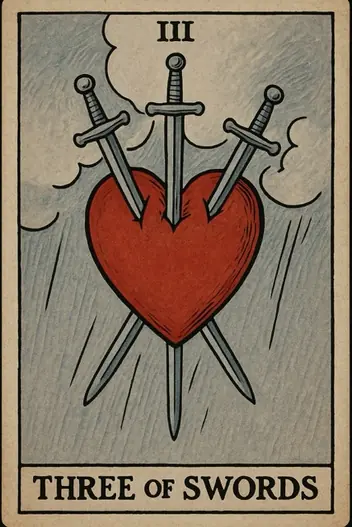

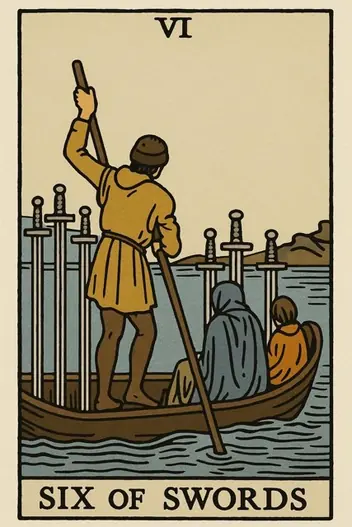
- Arcana
- Three of Swords — Minor Arcana, Swords; Six of Swords — Minor Arcana, Swords
- Elements
- Three of Swords — Air; Six of Swords — Air
- Elemental interaction
- Same element — energies intensify each other
- Numerology
- 3 + 6 = 9
The intersection of the Three of Swords and the Six of Swords represents a critical psychological transition: the moment when acute emotional pain begins to transform into deliberate, conscious movement. The Three of Swords signals a wound—often a betrayal, heartbreak, or painful truth—that has pierced the ego’s defenses. The Six of Swords indicates a journey, not necessarily physical, but a mental and emotional passage toward calmer waters.
When these two cards appear together, the message is clear: you are in the process of leaving behind what has hurt you, but the pain is still fresh. This combination does not promise immediate healing, but rather a strategic retreat from a toxic or untenable situation. The key psychological insight here is that acknowledging the wound is the first step toward navigating away from it. Denial or avoidance of the Three of Swords’ pain will only prolong the journey of the Six of Swords.
Three of Swords and Six of Swords: How These Energies Interact
The core dynamic of this pairing is the tension between suffering and escape. The Three of Swords represents the cognitive dissonance of knowing a painful truth—the sword that pierces the heart is often a realization that cannot be unlearned. The Six of Swords represents the ego’s survival mechanism: the drive to move forward, even when the heart is still bleeding. Psychologically, this mirrors the process of cognitive reappraisal, where you consciously reframe a painful experience to reduce its emotional charge while still honoring its reality.
In practical terms, this combination suggests a period of calculated withdrawal. You are not running away from your problems; you are strategically repositioning yourself to minimize further damage. The Six of Swords requires a navigator—someone who can steer the boat while the passengers (your emotions) are still in distress. This means you must take on the role of your own inner captain, making decisions based on long-term stability rather than short-term emotional relief.
The real-world implication is that you cannot heal in the same environment that wounded you. The Three of Swords demands honesty about the source of the pain, while the Six of Swords demands the courage to leave it behind. This is not a time for revenge or confrontation; it is a time for quiet, deliberate exit strategies. The mindset required is one of stoic acceptance—acknowledging the hurt without letting it define your next move.
Your pair is already on the table. Ask your question and draw the clarifying card
or simply focus on it
Three of Swords and Six of Swords in Love and Relationships
If you are single:
This combination warns against rushing into a new relationship to distract from past hurt. Instead, use this time to understand the patterns that led to the pain. The Six of Swords suggests a journey of self-reflection, not a rebound.
If you are in a relationship:
The Three of Swords indicates a painful truth must be faced—perhaps infidelity, betrayal, or a fundamental mismatch. The Six of Swords advises discussing the possibility of separation or a major shift in dynamics rather than ignoring the issue.
In relationships, this pairing is a call for emotional clarity and boundary-setting. The Three of Swords reveals where trust has been broken, and the Six of Swords asks if both partners are willing to navigate toward a new, healthier configuration—or if it’s time to part ways. Bold key relationship advice: Do not sacrifice your emotional safety for the comfort of staying in a familiar but painful dynamic. The Six of Swords is not about escape; it is about intentional movement. If you are in a partnership, this means having a difficult conversation about what needs to change. If you are single, it means pausing to process the grief of past relationships before seeking new ones.
The most important takeaway is that love cannot thrive in an environment of unaddressed wounds. The combination demands that you either work through the pain together (if both are committed) or release each other with compassion. There is no middle ground here that avoids the emotional work.
Your unique Tarot reading
See how these cards interact with your destiny. Start a free personal reading now.
Three of Swords and Six of Swords for Career and Money
Strategic Opportunities:
Reassess your professional environment. If a job, project, or partnership has caused repeated emotional distress, this is the time to plan an exit.
Strategic Opportunities:
Focus on skill-building during the transition. The Six of Swords favors preparation over action—update your resume, network quietly, or pivot to a new industry.
Calculated Risks:
Avoid impulsive resignations or financial gambles. The pain of the Three of Swords can cloud judgment; the Six of Swords requires a calm, methodical plan.
In career, this combination is a warning against staying in a toxic workplace for the sake of stability. The Three of Swords represents the emotional cost of a hostile boss, a failed project, or a betrayal by a colleague. The Six of Swords advises strategic disengagement—not quitting in anger, but preparing a dignified exit. Bold financial warning: Do not invest money in a venture that is already causing you stress or regret. The Six of Swords is about moving toward safety, not doubling down on risk.
Financially, this is a time for austerity and precision. The Six of Swords suggests cutting losses on a failing investment or debt rather than hoping for a turnaround. The key strategic action is to prioritize liquidity and flexibility—keep funds accessible so you can pivot quickly if needed. Bold strategic tip: Use this period to build a financial buffer of 3-6 months of expenses to support your transition.
The Shadow Side of Three of Swords and Six of Swords
The shadow side of this combination manifests as emotional paralysis or avoidance. When the pain of the Three of Swords is too great, the Six of Swords can become a fantasy of escape rather than a real journey. This leads to cognitive biases like wishful thinking (“If I just move away, everything will be fine”) or emotional numbing (using work, substances, or new relationships to avoid processing the wound).
Another pitfall is acting on the pain without a plan. The Three of Swords can trigger impulsive decisions—quitting a job in anger, ending a relationship in a text, or making a vengeful financial move. The Six of Swords demands patience and preparation. If you rush, you risk jumping from the frying pan into the fire.
Self-sabotage is a real risk here. The wounded ego may unconsciously seek out more pain to confirm its negative beliefs. This is the victim archetype taking over—blaming others for your situation while refusing to take the helm of your own boat. The shadow of the Six of Swords is a passive surrender to fate, believing that time alone will heal all wounds without active effort.
Poor judgment arises when you confuse the Six of Swords’ journey with the Three of Swords’ pain. You might think that leaving a situation will automatically heal you, but the boat only moves if you row. Without conscious emotional processing (therapy, journaling, honest conversations), you will carry the wound into your new environment.
Three of Swords and Six of Swords Reversed: How to Read It
If the Three of Swords is Reversed:
Acute pain is denied or suppressed. Instead of experiencing the crisis, the person gets stuck in a victim state or engages in self-flagellation. Advice: stop avoiding the truth. Acknowledge your pain, otherwise it will become chronic and destroy you from within.
If the Six of Swords is Reversed:
Forward movement is blocked. The person clings to the past, fears change, or sabotages their own salvation. This is a "swamp" state — you know you need to leave, but you don't do it. Warning: this is a path to stagnation and the repetition of trauma. You will have to confront the fear of the unknown to get unstuck.
If BOTH are Reversed:
Complete imbalance. The pain is not recognized, and the way out is not found. The person lives in the illusion that they can remain in a ruined house. This is a dangerous combination of self-deception and passive aggression. How to fix it: a harsh external intervention is required — the help of a psychotherapist, coach, or wise mentor. It is necessary to artificially create a crisis that will force action.
Three of Swords and Six of Swords: Tarot Advice
Constructive use of this combination requires cold pragmatism and emotional discipline. Your task is not to "heal" (that is a long process), but to evacuate with minimal losses. The energy of the Three of Swords is fuel. It is rage, resentment, pain. Do not try to suppress it. Use it as the driving force for the Six of Swords. Allow yourself to be angry at the situation, but channel that anger into action: write your resignation letter, change your tickets, break your contracts.
Deep strategic advice:
View this period as a "rescue operation". Your personality, your future—this is the patient on the operating table. The Three of Swords is the scalpel that opens the wound. The Six of Swords is the procedure to remove dead tissue. It is painful, but it saves a life. Your task is to disconnect your emotions for the duration of the operation and act according to a clear plan. Ask yourself: "What three things must I do right now to guarantee that in a month I will be safe?" Do them. Do not look back. Movement is the only cure for pain.
Applying This to Your Situation
The core message of the Three of Swords and Six of Swords is this: Pain is a signal, not a sentence. Acknowledge the wound, but do not let it anchor you. The journey ahead requires courage, clarity, and a plan. You are not broken; you are in transition. The most powerful move you can make right now is to separate the story of your pain from the strategy for your future.
While this article provides the general archetype, the true magic happens when Tarot is applied to your unique situation. Your specific question, your personal history, and your current context will shift how these cards speak to you. To get a deep, personalized interpretation of this exact combination for your specific question right now, use the Fortune Cards app. Available on the web or for download, it analyzes your cards in the context of your life, giving you actionable insights tailored to your journey. Don’t just read about the archetypes—apply them to your reality.
Interpretation by the Fortune Cards editorial team, based on the Rider–Waite tradition and Jungian archetypes. About our methodology · Updated: 2026-10-01
Other Combinations with Three of Swords
Other Combinations with Six of Swords
Explore Individual Card Meanings
Table of Contents
- Three of Swords and Six of Swords: How These Energies Interact
- Three of Swords and Six of Swords in Love and Relationships
- Three of Swords and Six of Swords for Career and Money
- The Shadow Side of Three of Swords and Six of Swords
- Three of Swords and Six of Swords Reversed: How to Read It
- Three of Swords and Six of Swords: Tarot Advice
- Applying This to Your Situation
Ready to find answers to your questions?
Start your first reading now and look at your situation with fresh clarity. The cards are ready to reveal deeper meaning.