Five of Wands and Ten of Swords Meaning in Tarot
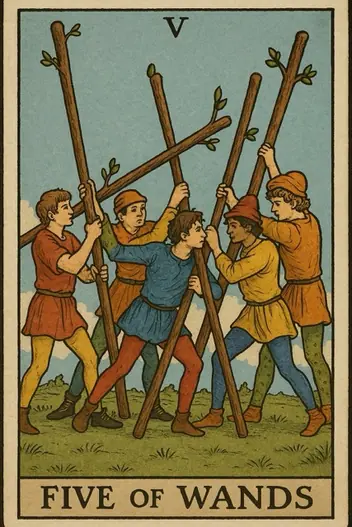

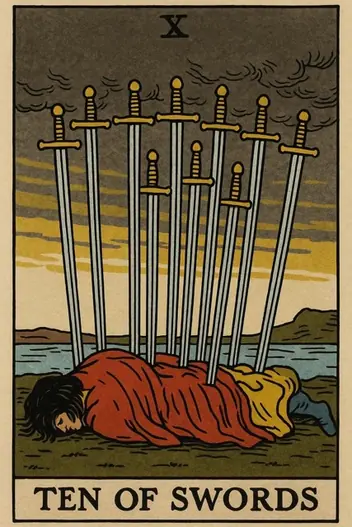
- Arcana
- Five of Wands — Minor Arcana, Wands; Ten of Swords — Minor Arcana, Swords
- Elements
- Five of Wands — Fire; Ten of Swords — Air
- Elemental interaction
- Friendly elements — energies support each other
- Numerology
- 5 + 10 = 15 → 6
When the Five of Wands—a card of chaotic competition, friction, and scattered energy—collides with the Ten of Swords—a card of finality, betrayal, and hitting rock bottom—the result is a psychological snapshot of burnout born from unresolved conflict. This combination suggests a scenario where the seeker has been fighting endlessly, often against multiple opponents or internal contradictions, only to face a decisive, painful ending.
From a Jungian perspective, this pairing represents the shadow of the Warrior archetype. The seeker may have clung to a conflict that no longer serves them, mistaking persistence for strength. The Ten of Swords delivers the brutal truth: the battle is over, and continuing to fight only deepens the wound. The key insight here is that surrender is not weakness—it is a strategic retreat to preserve energy for the next cycle.
Five of Wands and Ten of Swords Card Meaning Explained
The core dynamic of the Five of Wands and Ten of Swords is the collapse of a competitive or confrontational situation. The Five of Wands brings a chaotic, often petty struggle—think office politics, sibling rivalry, or internal self-doubt manifesting as a "war" within. The Ten of Swords then delivers the coup de grâce, representing a moment where the seeker feels utterly defeated, stabbed in the back, or forced to accept a painful reality.
Psychologically, this combination triggers a crisis of identity. The ego, which has been invested in winning the fight, must now confront its own mortality (the Ten of Swords). The most pragmatic interpretation is that this is a necessary ending. The seeker’s energy has been wasted on a zero-sum game. The advice is to stop picking at the wound. The Ten of Swords is not a death sentence; it is the lowest point before dawn, but only if the seeker stops trying to "win" the lost battle.
A critical cognitive bias at play here is the sunk cost fallacy. The seeker may feel compelled to continue the fight because they have already invested so much time, emotion, or pride. The cards demand a cold, objective assessment: Is this fight worth your life force? If the answer is no, the only rational move is to walk away, accept the loss, and begin the process of psychological recovery.
Your pair is already on the table. Ask your question and draw the clarifying card
or simply focus on it
Five of Wands and Ten of Swords for Career and Money
Strategic Opportunities:
The end of a toxic project or job role. This combination signals that a professional situation that has been draining your energy is finally reaching its conclusion. This is an opportunity to cut your losses and redirect your efforts toward work that aligns with your true skills.
Strategic Opportunities:
A chance to rebuild your reputation. The Ten of Swords often involves public failure or criticism. The Five of Wands suggests you have been fighting for recognition in a crowded field. Use this "rock bottom" moment to rebrand yourself by focusing on a niche where you have a clear advantage.
Calculated Risks:
Avoid any new competitive ventures for 30 days. The energy of the Five of Wands is still too raw. Jumping into another conflict or negotiation will lead to the same painful outcome. Bold important financial warnings: Do not invest money in a desperate attempt to "win back" a client or position. This is a time for preservation, not expansion.
The professional advice here is brutally pragmatic. The Five of Wands and Ten of Swords together suggest that your current strategy is failing because it is based on a flawed premise. You may be trying to compete on the wrong battlefield. Ask yourself: "Am I fighting for a position that doesn't even exist anymore?" The Ten of Swords indicates a structural end—a company restructuring, a project cancellation, or a partnership dissolution. Your strategic move is to accept the loss, collect any severance or exit package, and use the time to upskill. The most financially sound decision is to stop throwing good money after bad.
Get a personalized interpretation
Unlock the combined meaning of your cards in the context of your unique question — for free.
Five of Wands and Ten of Swords as Feelings
If you are single:
This combination warns against entering a relationship that feels like a competition. If you are constantly arguing or trying to "win" the other person’s attention, you are setting yourself up for a painful, one-sided ending. Step back and assess if the dynamic is genuinely collaborative or just a power struggle.
If you are in a relationship:
The pairing indicates a relationship that has become a battlefield. One partner may feel "stabbed in the back" by the other, or a long-standing conflict has reached a final breaking point. The relationship as you knew it is over, but this does not necessarily mean the end of the partnership—it means the end of the old, dysfunctional pattern.
The relationship dynamics here are toxic unless consciously managed. The Five of Wands suggests a lack of alignment in goals or values, leading to constant friction. The Ten of Swords indicates that this friction has escalated to a point of emotional or psychological injury. The most important relationship advice is to stop defending your position and listen to the wound. The "swords" represent painful truths that have been avoided. If the seeker wants to salvage anything, they must accept responsibility for their part in the conflict and be willing to let go of the need to be "right."
Bold key relationship advice:
If you are in a relationship, do not try to "fix" the fight immediately. The Ten of Swords requires a period of silence and reflection. Take a 24-hour break from communication to allow the emotional swords to stop cutting. Then, approach the conversation with a focus on mutual safety, not winning.
Five of Wands and Ten of Swords Reversed: What Changes?
Reversed cards shift the vector of interpretation from external events to internal processes.
Reversed Five of Wands:
This points to an internal conflict without external expression. You avoid competition, suppress aggression, but feel chaos inside. The risk is passive-aggressive behavior that will lead to a sudden explosion. Advice: find a safe way to express disagreement, otherwise the Ten of Swords becomes inevitable.
Reversed Ten of Swords:
The most dangerous scenario is denial of the ending. You lie "nailed" to the ground but refuse to admit defeat. This prolongs the agony. Warning: resistance to the inevitable turns a temporary setback into a chronic crisis. You need to acknowledge the loss to set yourself free.
Both reversed:
Complete imbalance: you are afraid to fight (Five of Wands) but also cannot let go (Ten of Swords). This is paralysis of will. The logical way to correct this is micro-steps. Do not try to solve everything at once. Choose one area and make a final decision in it to set things in motion.
Negative Meaning of Five of Wands and Ten of Swords
The shadow side of this combination is masochistic persistence. The seeker may derive a perverse sense of identity from being the "underdog" or the "victim." The Five of Wands can manifest as a compulsion to create drama where none exists, while the Ten of Swords becomes a self-fulfilling prophecy of betrayal. The cognitive bias here is confirmation bias: the seeker looks for evidence that they are being attacked, ignoring signs of collaboration or peace.
Another major pitfall is catastrophizing. The Ten of Swords feels like the end of the world, but in reality, it is often the end of a specific chapter. The shadow response is to over-identify with the pain and adopt a permanent victim identity. This prevents the necessary psychological work of integrating the shadow—accepting that the seeker may have been their own worst enemy. Poor judgment manifests as impulsive, dramatic exits (quitting a job without notice, ending a relationship via text) that burn bridges unnecessarily.
Overall Meaning of Five of Wands and Ten of Swords
How can the energy of the Five of Wands be used constructively to balance the Ten of Swords? The key lies in shifting focus from struggle to analysis. The energy of the Five of Wands is fuel, but without direction, it consumes you. Your task is to channel this aggression not toward an external enemy, but toward overcoming your own inertia. The Ten of Swords shows that old methods no longer work. Therefore, you must stop using them.
Strategic advice: use the state of "defeat" as a point of maximum clarity. When everything has collapsed, you finally see the real picture, free from illusions and self-deception. At this moment, the energy of the Five of Wands is needed not to rebuild the ruins, but to clear the ground for a new foundation. Ask yourself: "Which struggle is truly justified right now?" The answer will likely be — the struggle for silence, rest, and a reassessment of values.
Understand this: the Ten of Swords is not a verdict, but a bill for past mistakes. Once you pay it (by accepting the losses), you receive a clean slate. The Five of Wands, meanwhile, is the energy for a new beginning — but only if you stop looking back at what is already dead. Your wisdom now lies in surrendering to the facts, not in resisting them.
Where to Go From Here
The core message of the Five of Wands and Ten of Swords is clear: The battle is over, and the only way forward is through acceptance. You must stop fighting the past and allow the wound to heal. This is not a time for action, but for deep, honest reflection. Ask yourself: What belief system am I defending that is actually causing my suffering? The answer will be the key to your next chapter.
Your unique situation requires more than a general archetype. While this analysis provides a solid psychological and strategic framework, the true power of Tarot lies in its ability to speak directly to your specific question. The Fortune Cards app offers a deeply personalized reading for this exact combination, tailored to your relationship, career, or personal growth query. You can use it right now on the web or download it to receive a custom interpretation that accounts for your unique context, timing, and emotional state. Don't settle for generic advice—get the answer that is truly yours.
Interpretation by the Fortune Cards editorial team, based on the Rider–Waite tradition and Jungian archetypes. About our methodology · Updated: 2026-08-26
Other Combinations with Five of Wands
Other Combinations with Ten of Swords
Explore Individual Card Meanings
Table of Contents
- Five of Wands and Ten of Swords Card Meaning Explained
- Five of Wands and Ten of Swords for Career and Money
- Five of Wands and Ten of Swords as Feelings
- Five of Wands and Ten of Swords Reversed: What Changes?
- Negative Meaning of Five of Wands and Ten of Swords
- Overall Meaning of Five of Wands and Ten of Swords
- Where to Go From Here
Ready to find answers to your questions?
Start your first reading now and look at your situation with fresh clarity. The cards are ready to reveal deeper meaning.