Five of Swords and Ten of Swords Tarot as Feelings
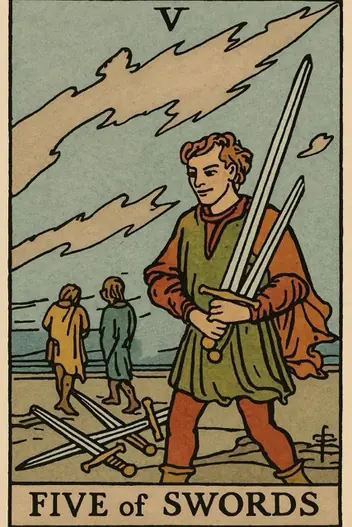

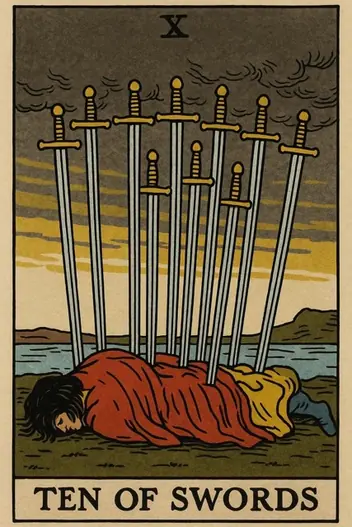
- Arcana
- Five of Swords — Minor Arcana, Swords; Ten of Swords — Minor Arcana, Swords
- Elements
- Five of Swords — Air; Ten of Swords — Air
- Elemental interaction
- Same element — energies intensify each other
- Numerology
- 5 + 10 = 15 → 6
The convergence of the Five of Swords and the Ten of Swords represents a critical psychological juncture where a hard-won, but hollow, victory gives way to a complete breakdown. The Five of Swords embodies the archetype of the conflict-driven ego, fixated on winning at any cost—often leaving behind a trail of resentment and isolation. The Ten of Swords, in contrast, is the archetype of inevitable endings and rock-bottom reality, where the costs of past actions become impossible to ignore.
When these two cards appear together, they describe a situation where a person has exhausted their resources, relationships, or integrity in a fight they may have "won" but ultimately lost themselves. This is not a random misfortune; it is the logical consequence of a mindset that prioritized short-term dominance over long-term stability. The key insight here is that the Ten of Swords often follows the Five of Swords as a necessary clearing—a painful but essential reset that forces a reckoning with one's own shadow behavior.
What Do Five of Swords and Ten of Swords Mean Together?
The psychological state created by this pairing is one of post-conflict exhaustion mixed with cognitive dissonance. The seeker may have recently achieved a goal or "won" a dispute (Five of Swords), only to discover that the victory came at a devastating price: broken trust, lost allies, or a tarnished reputation (Ten of Swords). The mind reels from the gap between the expected payoff and the actual outcome. This is the classic Pyrrhic victory—a success that costs more than it's worth.
From a Jungian perspective, this combination often signals that the shadow aspect of the "Warrior" archetype has been operating unchecked. The seeker may have rationalized aggressive, manipulative, or zero-sum behavior as necessary for survival or success. However, the Ten of Swords reveals the unconscious guilt and self-sabotage that follows such actions. The swords—representing thoughts and beliefs—have turned inward, resulting in a mental "flatline" where the ego's defenses collapse.
Practically, this means the situation is not about fighting harder or "winning" again. The energy here is about surrender to reality, not defeat. The Ten of Swords is a card of endings, but also of dawn after darkness. The only way forward is to stop resisting the lesson. Acknowledge the cost, accept the loss, and begin the process of psychological integration. The fight is over—not because you lost, but because the old strategy no longer works.
Love and Relationships
If you are single:
This combination warns against pursuing a connection through competition, manipulation, or trying to "win" someone's affection. Any victory achieved through such means will likely result in a painful, abrupt ending. Focus on authenticity rather than conquest.
If you are in a relationship:
The dynamic suggests a history of unresolved power struggles or a recent argument where one partner "won" at the expense of the other's dignity. The relationship may be in a state of emotional collapse—the conflict has cut too deep for the current dynamic to continue without fundamental change.
In relationships, this pairing is a red flag for toxic communication patterns. The Five of Swords energy manifests as verbal jabs, score-keeping, or the need to be right. The Ten of Swords reveals the cumulative damage: trust is shattered, intimacy is replaced by resentment, and the relationship may feel "dead" or beyond repair. The key insight is that this is not about placing blame, but about recognizing that the current structure is unsustainable.
To move forward, both partners must stop the cycle of attack and defense. The Ten of Swords offers a clean break—either a conscious ending of the relationship or a symbolic "death" of the old, dysfunctional pattern. Emotional intelligence here means admitting when you've caused harm and being willing to start from zero. If reconciliation is possible, it requires a complete renegotiation of boundaries and a commitment to non-combative communication.
Your pair is already on the table. Ask your question and draw the clarifying card
or simply focus on it
What Do Five of Swords and Ten of Swords Indicate for Your Career?
Strategic Opportunities:
The collapse of a project or role creates a blank slate to rebuild from a position of greater clarity. Use this moment to cut losses and redirect energy toward something more aligned with your values.
Strategic Opportunities:
The painful ending may force you to confront a toxic work environment or a flawed business strategy that you were avoiding. This is the catalyst for necessary change.
Calculated Risks:
Do not attempt to "win back" a lost client, job, or deal through aggressive negotiation or litigation. The cost of such a victory will far exceed the benefit.
In the professional realm, this combination is a stern warning against zero-sum thinking. The Five of Swords suggests you may have recently outmaneuvered a colleague, secured a deal at someone else's expense, or pushed a project through against opposition. The Ten of Swords indicates that this victory has backfired—perhaps the client is unhappy, the colleague has become a silent saboteur, or the project is collapsing under its own weight.
Financially, this is a time for damage control, not expansion. The key is to identify the sunk costs and stop pouring resources into a losing battle. The Ten of Swords often appears when a financial strategy has reached its logical end—insisting on "staying the course" will only increase losses. The strategic move is to accept the loss, learn the lesson about competitive behavior, and pivot. For entrepreneurs, this might mean dissolving a partnership that has become adversarial. For employees, it might mean seeking a new role where collaboration is valued over internal competition.
Deepen your understanding
Find out exactly what this reading means for your current life situation with our oracle.
Five of Swords and Ten of Swords: Warning Signs
The shadow of this combination is the cognitive bias of "sunk cost fallacy" —the irrational belief that because you've invested so much (time, ego, money), you must continue fighting even when the situation is hopeless. The seeker may cling to a losing position, refusing to admit defeat, which only deepens the eventual collapse. This is often driven by a fear of humiliation or a fragile ego that equates surrender with worthlessness.
Another pitfall is playing the victim. After the Ten of Swords' "rock bottom," the seeker may adopt a narrative of being unfairly attacked or betrayed, ignoring their own role in creating the conflict (Five of Swords). This blocks the psychological integration needed for growth. The shadow here is self-righteousness disguised as victimhood—a refusal to own one's aggressive or manipulative actions.
Finally, beware of premature closure. The Ten of Swords can feel like a final ending, but its energy is cyclical. Without true reckoning, the same pattern (conflict → hollow victory → collapse) will repeat. The shadow is rushing to "move on" without processing the lesson, setting the stage for an encore of the same painful drama.
Reversed Five of Swords and Ten of Swords Explained
The reversed position of the cards softens the fatalistic nature of the combination but does not negate its core issues; rather, it shifts them to an internal plane.
- If the Five of Swords is reversed. Aggression finds no outlet. Instead of open conflict, you encounter passive aggression, intrigue, and hidden sabotage. You haven't "won" the battle, but you continue participating in it, exhausting yourself from within. Advice: stop the "underground war." It destroys you more than an open confrontation would.
- If the Ten of Swords is reversed. This points to a delayed crisis. The catastrophe has already occurred, but you refuse to acknowledge it. You try to "glue together" what is broken or ignore the obvious symptoms of burnout. Advice: stop denying the obvious. Only by acknowledging the loss can you begin the process of recovery.
- If BOTH are reversed. This is a complete imbalance: you are waging a hidden war against yourself. Your inner critic (Five of Swords) attacks your sense of self, driving you to a state of complete self-annihilation (Ten of Swords). Correction: immediately cease the internal dialogue based on self-criticism and guilt. What you need is not a "fight," but radical self-acceptance and a pause.
Synthesis: Strategic Conclusion
How can the energy of the Five of Swords be used constructively to balance the Ten of Swords? The answer is paradoxical: you must apply the same resolve and sharpness of mind you used to fight the external world to analyze your own motives. The Five of Swords is not only about aggression but also about the capacity for clear, ruthless analysis. Use this ability to "dissect" the illusion of your victory or defeat and see the true picture.
Your strategy is "controlled retreat." You are not surrendering to the enemy; you are acknowledging that the battle was lost and leaving the battlefield to conserve strength for the next, more important war. In this context, the Ten of Swords is not an end but a critical bifurcation point. It is the moment when you must decide: remain lying on the battlefield, lamenting your losses, or get up, assess the damage, and begin building a new strategy from scratch.
A deep strategic piece of advice: do not try to "win" in this situation. Any attempt to prove yourself right or to take revenge now will only deepen the crisis. Your task is to exit the "victory-defeat" cycle. Acknowledge your fiasco without self-flagellation, as a fact. This will lift the burden of false pride (Five of Swords) and allow you to experience the crisis (Ten of Swords) not as a death, but as a purification. Only by passing through this humility can you see the new opportunities that will open up amidst the ruins of the old.
Where to Go From Here
The core message of the Five of Swords and Ten of Swords is that victory without integrity leads to ruin, and ruin is the necessary teacher. The path forward requires humility, not more combat. You must accept the ending, own your part in the conflict, and allow the old structure to dissolve so something healthier can emerge. This is not a punishment—it is a reset.
While this article provides the general archetype, the true power of Tarot lies in applying it to your unique situation. The Fortune Cards app offers a deep, personalized interpretation of this exact combination for your specific question—whether it's about a relationship, career move, or personal crossroads. Use it on the web or download it now to receive a tailored reading that considers your context, timing, and the surrounding cards. Stop guessing; get the clarity you need to make your next move with confidence.
Interpretation by the Fortune Cards editorial team, based on the Rider–Waite tradition and Jungian archetypes. About our methodology · Updated: 2026-08-26
Other Combinations with Five of Swords
Other Combinations with Ten of Swords
Explore Individual Card Meanings
Table of Contents
Ready to find answers to your questions?
Start your first reading now and look at your situation with fresh clarity. The cards are ready to reveal deeper meaning.